

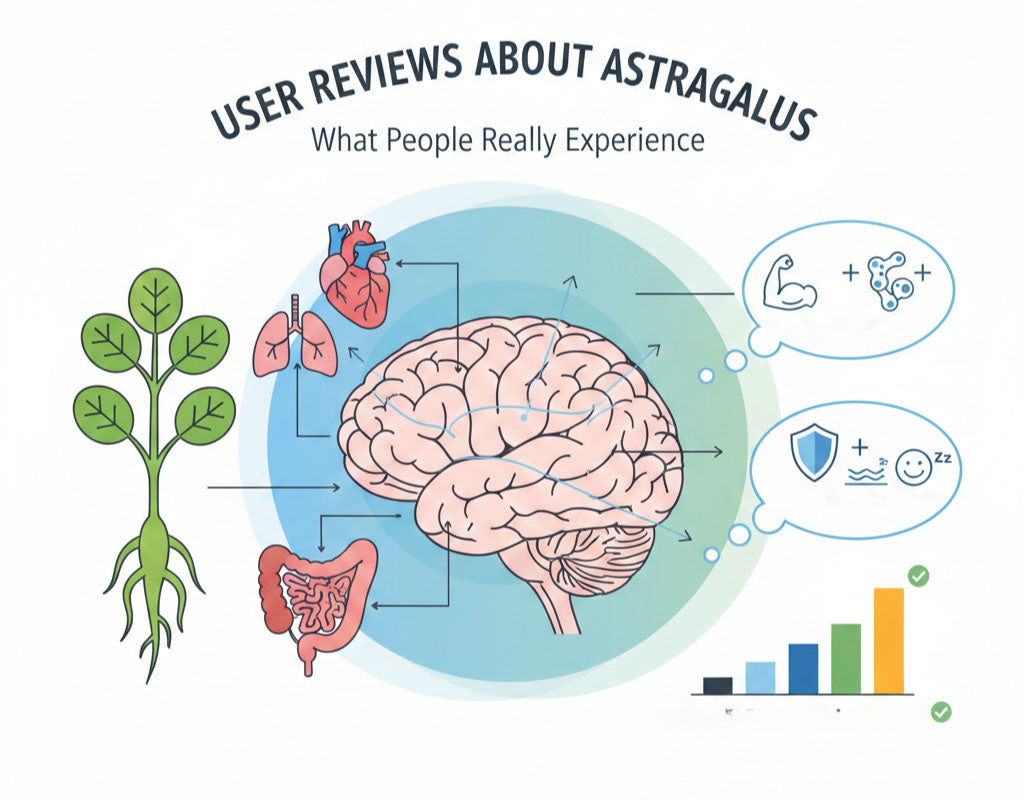
User Reviews About Astragalus: Real Experiences
Astragalus membranaceus, or Huang Qi, is a time-honored herb in Traditional Chinese Medicine, valued for its role in supporting immunity and overall vitality.
Today, it draws interest for its adaptogenic and antioxidant properties, though individual responses range from highly positive to concerns about overstimulation and interactions.
This report combines study findings and real user experiences to provide a clearer picture.
Before exploring further, please read the disclaimer located at the end of this webpage.
Key Takeaways
- Benefits: Astragalus may support immune function, energy levels, and antioxidant protection.
- Side Effects: Some users report overstimulation, stress, or digestive discomfort.*
- Safety: Interactions with immunosuppressants are a documented safety concern.
Why Astragalus Has Become So Popular

Astragalus (Huang Qi) has captivated modern interest due to its extensive history in TCM and a wide range of bioactive compounds. For over 2,000 years, it has been utilized as an adaptogenic herb to support vitality and immune resilience [1, 2, 7].
Modern research highlights key components: saponins, flavonoids, and polysaccharides, associated with antioxidant, immune-modulating, and organ‑supportive properties [1, 3, 4].
-
Healthy Aging: Studies suggest potential roles in aging through telomere-related pathways [1].
-
Metabolic Support: Research indicates potential benefits for blood sugar regulation and kidney function [3].
-
Fatigue & Clarity: More recently, Astragalus has attracted attention for its possible role in reducing fatigue and supporting cognitive clarity (Joung et al., 2024).
This combination of historical use, early studies support, and growing consumer interest has contributed to its rising popularity.
Read more: 5 Best Astragalus Supplements for Immune Support
How We Collected These User Experiences
We gathered hundreds of feedback entries from public forums, Reddit threads, and social media groups where users discussed Astragalus in powder, capsule, or extract form. We focused only on detailed testimonials describing noticeable effects.
Please note: these are personal accounts and should not be considered medical advice or scientific evidence.
Reported Benefits from Real Astragalus Users

Immune Support and Increased Vitality
Users commonly describe Astragalus as an herb that supports immune balance and resilience. This reflects its traditional role as a Qi‑supporting adaptogen and its documented immune‑modulating properties, such as enhancing T‑cell activity [1,3].
"It's mainly used as an immune booster, similar to echinacea. Off the top of my head, it stimulates T cell production.", as Gulbasaur said. *
Fatigue Reduction and Recovery Support
Astragalus is frequently discussed in communities focused on fatigue and recovery support. Some users report meaningful improvements in mood, energy, and cognitive clarity. *
"It has direct action on Mitochondria ER stress... It may benefit for those with fatigue.", DeliveryIcy2490 shared his thoughts. *
These reports correspond with observational research noting reduced fatigue severity after supplementation with Astragalus‑containing extracts [6,7].
Cellular Aging and Organ Support
Research suggests Astragalus polysaccharides may influence telomere‑associated pathways related to cellular longevity [1].
Other studies indicate potential supportive effects on kidney markers in membranous nephropathy and improvements in HbA1C when combined with metformin [3].
Users also mention improved resilience and adrenal balance. *
"Nourishes adrenals, reduces inflammation... nourishes the HP axis... Astragalus can help heal and regulate those brain organs." — Fancy-Category *
Reported Side Effects and User Complaints about Astragalus

Stimulation, Restlessness, and Stress
Despite being classified as an adaptogen, some individuals experience overstimulation, increased heart rate, or stress, highlighting that responses vary widely. *
Drug Interactions and Autoimmune Concerns
Astragalus may increase immune activity, raising concerns for certain medical conditions. Research reviews note that it can potentially interfere with immunosuppressant medications, including tacrolimus and cyclosporine [2].
This raises concerns for transplant recipients or those managing conditions requiring immune suppression. *
"If Astragalus makes the immune system more active, this could worsen the symptoms of auto-immune diseases. Avoid using astragalus if you have any of these conditions.", a Reddit user commented. *
Additionally, there is insufficient safety data for use during pregnancy or breastfeeding. Health authorities advise avoiding Astragalus in these populations until more conclusive research becomes available. *
Digestive Issues and Highly Individual Responses
Some users report mild symptoms such as headaches, rashes, or digestive upset. Individual variability is a recurring theme. *
"Supplement responses are highly individual... [and] highly reflective of current organ health.", as Back2theGarden shared. *
These differences highlight the importance of starting with low doses and closely observing personal reactions. As with many herbs, what works well for one person may not suit another. *
Common Dosages and How People Use Astragalus
Studies have found daily doses of up to 60g of raw Astragalus herb safe for use over four months [3, 5]. Another study utilized 2,000 mg/day of a combined Astragalus-Salvia extract for four weeks [7].
-
Forms: Commonly taken as a powder, capsule, or liquid extract.
-
Duration: Typical use spans 3–6 months [2].
-
User Perspective: Users often report taking it for immune support and stress adaptation. While some experiment with high doses, supplementation should never replace prescribed medical care.*
"I may experiment with even higher dosages, as apparently people can take up to 60g daily.", Content_Speech_1209 said. *
Who Might Benefit the Most (and Who Should Be Cautious)
Potentially Beneficial for:
-
Fatigue: Individuals seeking to enhance focus and energy (suggested by observational data). *
-
Immune Support: People seeking broad, adaptogenic immune support consistent with TCM [3].
-
General Vitality: Those looking for antioxidant and healthy-aging support.
Caution Advised To:
-
Autoimmune Conditions: Those with Lupus, RA, or MS due to potential immune stimulation.
-
Medication Interactions: Patients using immunosuppressants, as Astragalus may reduce efficacy.
-
Pregnancy/Nursing: Insufficient safety data exists for these groups [3].
-
Sensitive Individuals: Those prone to palpitations or anxiety (risk of overstimulation).
Overall Research Sentiment: The Big Picture
Overall, studies and user sentiment toward Astragalus presents a picture of meaningful potential but notable variability:
-
The Majority: Feedback highlights strong potential benefits in immune support, energy, and cellular health, with many users reporting noticeable improvements.*
-
The Caution: A significant segment of reports cautions against side effects such as stimulation or stress. The risk of drug interactions, particularly regarding autoimmune conditions, is a critical safety consideration.*
-
The Minority: A small number of users express disappointment due to minimal effects, suggesting that dosage and product quality play a large role.*
Conclusion
Astragalus represents a powerful bridge between traditional wisdom and modern adaptogen use, with benefits reported in immunity, energy, and metabolic support. *
However, reactions are highly individualized, and potential side effects or interactions should not be overlooked. It is best approached with care, especially for those on medication or with autoimmune concerns. *
As always, herbal supplementation should be viewed as complementary. Daily attention to balanced nutrition, quality sleep, and physical movement remains the foundation of long-term health.
Testimonial Disclaimer
*The testimonials presented on this website are provided by individuals based on their personal experiences with our products. These testimonials represent individual opinions and experiences, which may not be typical or applicable to all users of our products. Results may vary depending on a variety of factors, including individual health, lifestyle, and adherence to product usage instructions.References
- [1] Liu, P., Zhao, H., & Luo, Y. (2017). Anti-Aging Implications of Astragalus Membranaceus (Huangqi): A Well-Known Chinese Tonic. Aging and Disease, 8(6), 868. https://doi.org/10.14336/ad.2017.0816
- [2] Shane-McWhorter, L. (2024, March 4). Astragalus. MSD Manual Consumer Version. https://www.msdmanuals.com/home/special-subjects/dietary-supplements-and-vitamins/astragalus
- [3] Astragalus: Usefulness and Safety. (2024). NCCIH. https://www.nccih.nih.gov/health/astragalus
- [4] Jin, M., Zhao, K., Huang, Q., & Shang, P. (2014). Structural features and biological activities of the polysaccharides from Astragalus membranaceus. International Journal of Biological Macromolecules, 64, 257–266. https://doi.org/10.1016/j.ijbiomac.2013.12.002
- [5] Yang, Y., Yang, S., Chen, M., Zhang, X., Zou, Y., & Zhang, X. (2008). Compound Astragalus and Salvia miltiorrhiza Extract exerts anti-fibrosis by mediating TGF-β/Smad signaling in myofibroblasts. Journal of Ethnopharmacology, 118(2), 264–270. https://doi.org/10.1016/j.jep.2008.04.012
- [6] Peng, Q.-H., Tong, P., Gu, L.-M., & Li, W.-J. (2020). Astragalus polysaccharide attenuates metabolic memory-triggered ER stress and apoptosis via regulation of miR-204/SIRT1 axis in retinal pigment epithelial cells. Bioscience Reports, 40(1). https://doi.org/10.1042/bsr20192121
- [7] Joung, J.-Y., Lee, J.-S., Choi, Y., Kim, Y. J., Oh, H.-M., Seo, H.-S., & Son, C.-G. (2024). Evaluating myelophil, a 30% ethanol extract of Astragalus membranaceus and Salvia miltiorrhiza, for alleviating fatigue in long COVID: a real-world observational study. Frontiers in Pharmacology, 15, 1394810–1394810. https://doi.org/10.3389/fphar.2024.1394810
Author
Product Disclaimer
Including an ingredient or study does not evaluate, endorse, or recommend any Vinatura product or any third-party product. Some ingredients discussed may not be used in any Vinatura product.
The content of the articles has not been evaluated by the Food and Drug Administration (FDA) and is not intended to promote or endorse any specific product. Any products sold on this website are not intended to diagnose, treat, cure, or prevent any disease.
Opinions and Endorsements
Any claims, statements, or opinions expressed in the articles are those of the author(s) and do not necessarily reflect the views or opinions of the manufacturers of the dietary supplement products. The products sold on this website are separate from the content of the articles and are not directly endorsed or associated with the information presented here.
Liability Disclaimer
The author(s) of the articles, website, and manufacturers of the dietary supplement products do not assume any liability for any potential consequences arising from the use of the information provided in the articles. Ingredient effects, dosages, and safety vary by individual, formulation, and context; some ingredients interact with medications or may be unsuitable during pregnancy or lactation. It is recommended that individuals consult with a qualified healthcare professional before making any dietary or lifestyle changes, including the use of dietary supplements.
Product Usage
Please refer to the product labels and packaging for specific usage instructions and guidelines for the dietary supplement products sold on this website.
Customer Support
For any concerns or questions regarding the dietary supplement products, please contact our customer support team, who will be more than happy to assist you.


Leave a Comment
Be the first to comment.
What do you think?