

Horse Chestnut Seed Extract: What Human Research Shows
Quick answer. Horse chestnut (Aesculus hippocastanum) seed extract is a seed extract standardized to escin (aescin), a mix of plant saponins. In a Cochrane review of 17 randomized trials in people with chronic venous insufficiency (CVI), the extract reduced lower-leg volume by about 32 mL more than placebo, and most placebo-controlled trials reported less leg pain, over 2 to 16 weeks. The trials were small, mostly run in Germany between the 1970s and 2002, and none has been added to the review since 2005; the largest trial found no clear benefit over placebo in more advanced disease. Raw seeds, bark, flowers and leaves are unsafe to eat, and people taking blood thinners, as well as pregnant or breastfeeding women, should talk to a clinician first.
What horse chestnut is
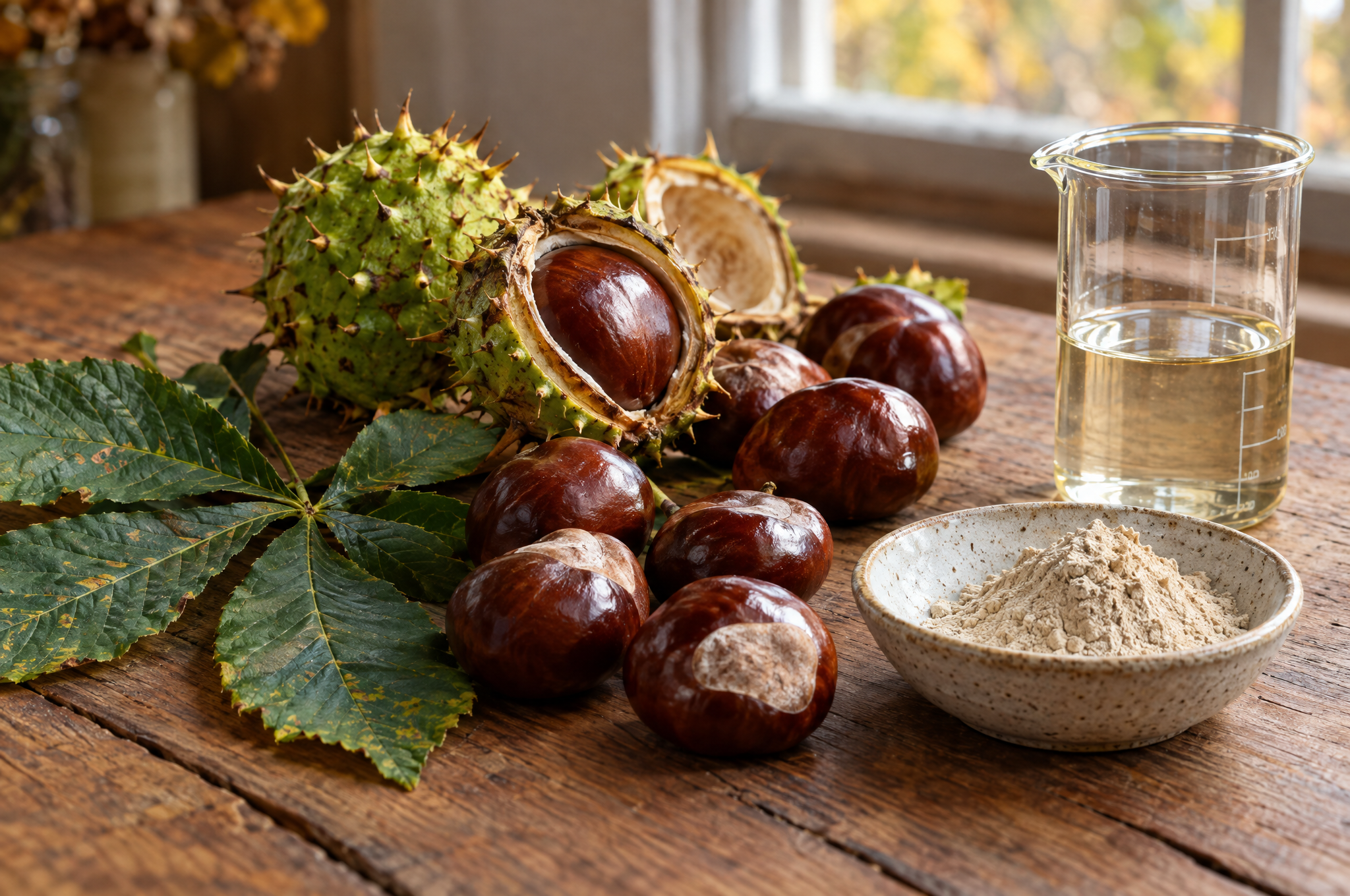
Horse chestnut is a large tree often planted along streets and in parks. Its shiny brown seeds look like edible sweet chestnuts, which come from a different plant, and people have become ill after eating them by mistake (see Safety).
The tested form is a seed extract standardized to escin. Escin is a mixture of triterpene saponins found in the seed. In every trial in the Cochrane review, the extract was standardized to escin, and most trials gave capsules supplying 50 mg escin twice a day (100 mg a day). The European Union herbal monograph describes its well-established-use preparation as a dry seed extract made with 40% to 80% ethanol and standardized to 6.5% to 10% triterpene glycosides. It now states the dose as 21 mg triterpene glycosides, calculated as protoaescigenin, twice daily, and notes this amount was "previously declared as 50 mg triterpene glycosides calculated as aescin." The same extract can carry different escin numbers on a label depending on the test method.
What it is not. Results for oral seed extract do not apply to raw seeds, bark or leaves; to creams and gels; or to purified escin salts (sodium aescinate) given by injection.
Regulatory status. In 2020 the European Medicines Agency's herbal committee (HMPC) adopted a revised monograph that accepts the standardized seed extract as a well-established-use medicine for CVI, "characterised by swollen legs, varicose veins, a feeling of heaviness, pain, tiredness, itching, tension and cramps in the calves." Other seed preparations are accepted only as traditional medicines for "discomfort and heaviness of legs related to minor venous circulatory disturbances" and for signs of bruises. In the United States, horse chestnut is sold as a dietary supplement, and the FDA does not have the authority to approve dietary supplements for safety and effectiveness.
What human studies have tested
| Study | Who took part | Form and daily amount | Duration | What was measured | Result |
|---|---|---|---|---|---|
| Pittler & Ernst 2012, Cochrane review of 17 RCTs | Adults with CVI; 10 placebo-controlled trials, others vs compression, rutosides or pine bark extract | Oral seed extract standardized to escin; mostly 50 mg escin twice daily (75 mg twice daily in two trials, 50 mg once daily in one) | 2 to 16 weeks | Leg pain, leg volume, oedema, itching, adverse events | Leg pain reduced vs placebo in 6 of 7 trials. Leg volume 32.1 mL lower than placebo (6 trials, 502 people; 95% CI 13.5 to 50.7). No difference vs compression or rutosides for pain. Adverse events "mild and infrequent" |
| Cochrane summary of findings (Underland 2012), GRADE ratings for the 2006 version | Same trials | Same | Same | Certainty of evidence | Leg volume: moderate. Ankle and calf circumference: low (3 trials, 80 people). Leg pain and oedema: very low |
| Siebert 2002, meta-analysis | 13 RCTs (1,051 patients) and 3 observational studies (10,725) | Seed extract | Varied | Leg volume and symptoms | Leg volume 46.4 mL lower vs placebo (11.3 to 81.4). Leg pain improvement 4.1-fold more likely (0.98 to 16.8; not significant). Oedema 1.5-fold (1.2 to 1.9). Not enough evidence for leg heaviness or calf cramps |
| Diehm 1996, RCT (Germany) | 240 adults with CVI, mostly early stage (grade I) | Extract with 50 mg escin twice daily vs class II compression stockings vs placebo | 12 weeks | Lower-leg volume | −43.8 mL with extract, −46.7 mL with stockings, +9.8 mL with placebo. Both better than placebo; the authors reported equivalence (see text). Extract vs placebo blinded; stockings open |
| Diehm & Schmidt 2000 ("Diehm 2000" in the Cochrane review), company study report summarized by Ottillinger & Greeske 2001 | 355 adults with more advanced CVI (grade II or IIIa) | Same extract and design | 16 weeks | Lower-leg volume | −18 mL with extract, −89 mL with stockings, +2 mL with placebo. Stockings beat placebo (P < 0.001); the extract did not (P = 0.115), except in a per-protocol analysis of 286 patients (P = 0.018) |
| Diehm 1992, RCT | 40 adults with venous oedema and deep vein incompetence | 75 mg escin twice daily (per Cochrane) vs placebo | 6 weeks | Leg volume | Authors reported a significant reduction; the Cochrane re-analysis found a standardized difference of 0.30 (−0.33 to 0.94), not statistically clear |
| Cloarec 1992, RCT (France; unpublished) | 30 adults with CVI | 50 mg escin twice daily vs placebo | 4 weeks | Leg pain on a 100 mm scale | 42.4 mm more reduction than placebo (34.9 to 49.9); very low certainty |
| Rehn 1996, RCT | 137 postmenopausal women with grade II CVI (completed per protocol) | Extract 600 mg a day vs oxerutins (rutosides) 1,000 mg a day, or 1,000 mg then 500 mg | 12 weeks, then 6 weeks off treatment | Leg volume over time | Leg volume fell in all groups; authors judged oxerutins equivalent or better. First author listed a drug-company affiliation |
| Koch 2002, open-label RCT | 40 adults with CVI | Extract 600 mg a day vs French maritime pine bark extract (Pycnogenol) 360 mg a day | 4 weeks | Leg circumference, symptoms | Extract: moderate, not significant drop in circumference; pine bark extract performed better |
What the findings suggest
Leg swelling (oedema and leg volume). Placebo-controlled trials that measured leg volume by water displacement found, on average, about 32 to 46 mL less volume with the extract in pooled analyses. The Cochrane summary rated this moderate certainty. The effect looks clearest in early CVI. In the trial of advanced disease, stockings cut leg volume about five times more than the extract (89 vs 18 mL), and the extract did not beat placebo in the main analysis.
Leg pain, itching and heaviness. Six of seven placebo-controlled trials reported less leg pain, but few gave usable numbers; certainty is very low. A 2002 meta-analysis found too little evidence to show an effect on leg heaviness or calf cramps.
Compared with other treatments. In the 1996 trial, the extract matched compression stockings for leg volume in early CVI, and, in a 2001 summary co-written by a company employee, compression wearers reported worse quality of life. That trial's design required compression to first prove itself clearly better than placebo, which it did not, so equivalence was not formally established. The extract did not outperform rutoside drugs, and one open-label trial favored pine bark extract.
How it might work. EMA states that how the oral extract acts in CVI is not known; proposed effects on leaky small vessels come from animal and lab studies.
What guidelines say. A 2025 review by vascular specialists (two of whom disclosed roles at a private company) found the highest-quality evidence for two other venoactive products, a micronized flavonoid fraction and a Ruscus (butcher's broom) combination, and reported that the 2023 U.S. varicose vein guideline from three vascular societies also favored those two. A 2025 Italian expert panel reached no consensus on horse chestnut used alone.
Where the evidence is limited or conflicting
- Old, small trials. EMA notes that 11 of the 17 trials had fewer than 50 participants. Only three reported adequate allocation concealment, and the review authors warned of "a possibility that treatment effects are exaggerated."
- No new trials. The Cochrane review was declared stable in 2012 because no new eligible studies had been found since 2005. Our own searches turned up no new placebo-controlled trial of the oral seed extract in CVI.
- The pooled effect shrank. The leg-volume estimate fell from 58.6 mL (4 trials, 239 people) in the 2002 Cochrane version to 32.1 mL (6 trials, 502 people) by 2006 as more trials were added.
- Industry ties. The 1996 and 2000 trials used the same commercial extract. The 2000 trial is known mainly from a company study report, summarized in a 2001 paper by a consultant who received honoraria for the manuscript and an employee of a company that markets the extract. The Cochrane authors noted that one unpublished trial was supplied by a manufacturer. In the oxerutin comparison, the first author's listed affiliation was a pharmaceutical company.
- Short duration. Trials lasted 2 to 16 weeks; the Cochrane authors stated that long-term efficacy is not established.
- Absorption is low and hard to measure. EMA cites an absolute bioavailability of only 1.5% for escin taken by mouth as a solution, which it attributes to extensive first-pass metabolism. It also notes that absolute blood-level values from the immunoassay used in published pharmacokinetic studies "are thus not reliable."
- Combinations are untested here. The Cochrane review excluded combination products. A 2015 South African trial (NCT02483962) tested a capsule combining red vine leaf extract (360 mg), horse chestnut extract (60 mg), butcher's broom and vitamin B6 in 40 women; it posts no results, and we found no published report.
Safety
In trials. Fourteen of the 17 Cochrane trials reported on adverse events, which were mild and infrequent: stomach complaints, dizziness, nausea, headache and itching, at 1% to 36% across six trials. Post-marketing surveillance cited by the review found such events in 43 of 6,183 patients (0.7%). In the 2000 trial, stomach and gut complaints affected 15% on the extract, 7% on compression and 9% on placebo (P = 0.09). EMA lists similar effects plus allergic reactions, frequency unknown. NCCIH (the U.S. National Center for Complementary and Integrative Health) says standardized extracts are "likely safe for short-term use" and have been used safely in research for up to 12 weeks.
Raw seeds and other plant parts. NCCIH states that the raw seeds, bark, flowers and leaves "are unsafe when used orally because they contain a toxic component." A 46-year-old man in Korea who ate one seed, mistaking it for an edible chestnut, developed stomach pain, nausea, raised liver and pancreatic enzymes and a brief bout of atrial fibrillation, and recovered the next day. A 32-year-old man who ate three boxes of unpurified horse chestnut paste over 6 weeks developed a large fluid build-up around the heart; his doctors judged the link "probable." Sources disagree on the toxin: NIH's LiverTox and the Cochrane summary name esculin, while EMA's assessment report states that esculin occurs in other parts of the tree but not in the seeds.
Liver. LiverTox gives horse chestnut a likelihood score of D, a "possible, rare cause" of liver injury, with few published cases; the injury was mild and resolved. Case reports include liver injury after an injected extract in 1986 and after a supplement in a 70-year-old man in 2021.
Bleeding and blood thinners. We found no human study of interactions with blood thinners; the evidence is limited to case reports and lab work. A woman treated in Dublin who was taking the extract had a life-threatening bleed from a known benign kidney tumor; the authors raised possible blood-thinning effects. Other reports linked horse chestnut, taken with other products, to a spinal blood collection after surgery and to bruising, both with normal clotting tests. The extract reduced platelet clumping in lab studies. EMA's monograph lists no reported interactions, while the Cochrane summary notes that "in theory, horse chestnut may increase the risk of bleeding." If you take warfarin, an antiplatelet drug or another supplement discussed for blood flow, such as nattokinase, ask your clinician or pharmacist before adding horse chestnut, and mention it before surgery.
Kidneys. EMA advises seeing a doctor if leg swelling occurs with heart or kidney failure, or comes on suddenly. Kidney failure has been linked to intravenous escin, including in a 1975 German report of cases after heart surgery, mostly in children, and one study cited by EMA found reduced kidney concentrating ability in rats given high intravenous doses. We found no study of the oral extract in people with kidney disease.
Pregnancy, children and allergy. EMA states that safety in pregnancy and breastfeeding "has not been established" and that use is not recommended, and it limits oral use to adults. The only contraindication it lists is hypersensitivity to the extract. We found no official upper intake level.
What research does not establish
- That horse chestnut extract works over months or years, or prevents ulcers, varicose veins or disease progression.
- That it is as effective as compression stockings in advanced CVI.
- That results from escin-standardized seed extracts apply to unstandardized powders, raw seeds or other plant parts.
- That combinations with red vine leaf or other herbs have the effects seen with the single extract.
- That it is safe with anticoagulants, in pregnancy, or in kidney or liver disease.
How we reviewed the evidence
On November 9, 2026, we searched PubMed for trials and reviews of horse chestnut, Aesculus hippocastanum, escin and aescin in venous disease (33 records for the main search, plus a 99-record search for trials and searches on poisoning, case reports, liver and kidney injury, bleeding and drug interactions), and ClinicalTrials.gov (5 registered venous-disease trials). We read the Cochrane review (2012 update) and its GRADE summary, the full texts of the 2001 trial report, three case reports and a 2025 review, abstracts for the other trials, the EMA monograph, assessment report and list of references, the NCCIH fact sheet and the LiverTox entry. We included randomized trials, meta-analyses and case reports of oral seed extracts, and excluded topical and injected products except where they bear on safety. None of the cited papers is marked as retracted in PubMed. Vinatura did not run any trials of horse chestnut.
Vinatura Research Perspective
We asked four questions of each study: which preparation (escin-standardized seed extract or something else), how much escin per day, in which stage of CVI, and whether the outcome was a measured leg volume or a symptom score. Most of the evidence concerns one dose, about 100 mg escin a day, from mostly German trials run between 1976 and 2002, in early or moderate CVI, for up to 16 weeks. The best-measured outcome, leg volume, improved by about 32 to 46 mL in pooled analyses. The often-repeated finding that the extract equals compression stockings rests on one trial in early disease. A larger trial in advanced disease, testing the same commercial extract, did not show a clear benefit over placebo in its main analysis; it is known only from a company study report summarized in a 2001 paper, not from a full trial publication. We also found that authoritative sources disagree on whether esculin, the toxin named in many summaries, is present in the seed at all. They agree on the practical point: unprocessed plant parts are unsafe.
Our assessment: moderate-certainty evidence that the standardized seed extract modestly reduces leg swelling in CVI over the short term; very low-certainty evidence for leg pain and itching; no evidence for long-term outcomes; and no human data on interactions with blood thinners. A large, independently funded, placebo-controlled trial lasting six months or more, using a characterized extract with a stated escin method and run in people already wearing compression, would change this assessment. So would a human study of the extract taken with warfarin or antiplatelet drugs.
Where this ingredient appears in Vinatura products
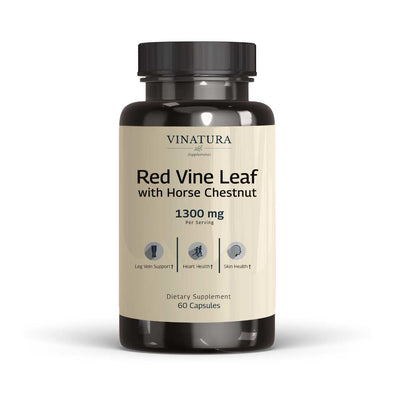
Red Vine Leaf extract Horse Chestnut 1300mg lists 200 mg horse chestnut and 1,100 mg red vine leaf (Vitis vinifera) per 1,300 mg serving, with directions of 2 capsules a day; the page names the species as Aesculus hippocastanum and says it contains aescins. The page does not state the plant part or an escin amount. The studies above did not test this product, and none of the published studies tested this combination.
Frequently asked questions
Is horse chestnut the same as the chestnuts people roast? No. Edible sweet chestnuts come from a different tree. Raw horse chestnut seeds are unsafe to eat.
How much escin did trials use? Most used 50 mg escin twice daily, or 100 mg a day, for 2 to 16 weeks. These are study amounts, not recommendations. Follow your product label and ask a healthcare professional.
Can horse chestnut extract replace compression stockings? One trial in early CVI found similar leg-volume results, but a larger trial in more advanced disease found stockings worked much better. Do not stop prescribed compression without talking to your clinician.
Is it safe with blood thinners? No study has tested this in people. Case reports describe bleeding events, so ask your clinician or pharmacist first.
References
- Pittler MH, Ernst E. Horse chestnut seed extract for chronic venous insufficiency. Cochrane Database Syst Rev. 2012;11(11):CD003230. doi:10.1002/14651858.CD003230.pub4
- Pittler MH, Ernst E. Horse chestnut seed extract for chronic venous insufficiency. Cochrane Database Syst Rev. 2002;(1):CD003230. doi:10.1002/14651858.CD003230
- Pittler MH, Ernst E. Horse chestnut seed extract for chronic venous insufficiency. Cochrane Database Syst Rev. 2006;(1):CD003230. doi:10.1002/14651858.CD003230.pub3
- Underland V, Sæterdal I, Nilsen ES. Cochrane summary of findings: horse chestnut seed extract for chronic venous insufficiency. Glob Adv Health Med. 2012;1(1):122-123. doi:10.7453/gahmj.2012.1.1.018
- Siebert U, et al. Efficacy, routine effectiveness, and safety of horsechestnut seed extract in the treatment of chronic venous insufficiency. A meta-analysis of randomized controlled trials and large observational studies. Int Angiol. 2002;21(4):305-315. PubMed 12518108
- Diehm C, et al. Comparison of leg compression stocking and oral horse-chestnut seed extract therapy in patients with chronic venous insufficiency. Lancet. 1996;347(8997):292-294. doi:10.1016/s0140-6736(96)90467-5
- Lange S, Freitag G, Trampisch HJ. Practical experience with the design and analysis of a three-armed equivalence study. Eur J Clin Pharmacol. 1998;54(7):535-540. doi:10.1007/s002280050509
- Ottillinger B, Greeske K. Rational therapy of chronic venous insufficiency – chances and limits of the therapeutic use of horse-chestnut seeds extract. BMC Cardiovasc Disord. 2001;1:5. doi:10.1186/1471-2261-1-5
- Diehm C, et al. Medical edema protection – clinical benefit in patients with chronic deep vein incompetence. A placebo controlled double blind study. Vasa. 1992;21(2):188-192. PubMed 1621440
- Rehn D, et al. Comparative clinical efficacy and tolerability of oxerutins and horse chestnut extract in patients with chronic venous insufficiency. Arzneimittelforschung. 1996;46(5):483-487. PubMed 8737631
- Koch R. Comparative study of Venostasin and Pycnogenol in chronic venous insufficiency. Phytother Res. 2002;16(Suppl 1):S1-S5. doi:10.1002/ptr.1010
- Gloviczki ML, et al. The role of venoactive compounds in the treatment of chronic venous disease. J Vasc Surg Venous Lymphat Disord. 2025;13(5):102258. doi:10.1016/j.jvsv.2025.102258
- Buso G, et al. Delphi consensus on the role of venoactive nutraceuticals in the management of chronic venous disease: a position statement of the Italian Society of Angiology and Vascular Medicine (SIAPAV). Nutrients. 2025;17(24):3830. doi:10.3390/nu17243830
- Yi HJ, Lee JH. Poisoning due to consumption of horse chestnut seed. Clin Exp Emerg Med. 2021;8(4):333-335. doi:10.15441/ceem.20.004
- Edem E, et al. Acute effusive pericarditis due to horse chestnut consumption. Am J Case Rep. 2016;17:305-308. doi:10.12659/ajcr.896790
- Takegoshi K, et al. A case of Venoplant-induced hepatic injury. Gastroenterol Jpn. 1986;21(1):62-65. doi:10.1007/BF02775942
- Costa Santos D, Lérias G, Madruga I. Drug-induced liver injury due to a horse chestnut dietary supplement. Eur J Case Rep Intern Med. 2021;8(3):002389. doi:10.12890/2021_002389
- Snow A, et al. Life-threatening rupture of a renal angiomyolipoma in a patient taking over-the-counter horse chestnut seed extract. J Emerg Med. 2012;43(6):e401-e403. doi:10.1016/j.jemermed.2010.11.044
- Du J, et al. Spinal epidural hematoma following combined spinal epidural anesthesia: a case report. J Perianesth Nurs. 2025;40(4):791-794. doi:10.1016/j.jopan.2024.10.005
- Villamor G, et al. Painful bruising: gynecology, hematology, or just? A case report. Case Rep Womens Health. 2023;39:e00538. doi:10.1016/j.crwh.2023.e00538
- McEwen BJ. The influence of herbal medicine on platelet function and coagulation: a narrative review. Semin Thromb Hemost. 2015;41(3):300-314. doi:10.1055/s-0035-1549089
- Hellberg K, Ruschewski W, de Vivie R. Drug induced acute renal failure after heart surgery [in German]. Thoraxchir Vask Chir. 1975;23(4):396-399. doi:10.1055/s-0028-1096991
- ClinicalTrials.gov. The Efficacy of Red Vine Leaf Extract, Butcher's Broom, Horse Chestnut and Vitamin B6 in the Treatment of Symptoms Associated With Chronic Venous Insufficiency, NCT02483962. Accessed November 9, 2026. clinicaltrials.gov
- European Medicines Agency, Committee on Herbal Medicinal Products. European Union herbal monograph on Aesculus hippocastanum L., semen (Revision 1; EMA/HMPC/628242/2018). Adopted January 15, 2020. ema.europa.eu
- European Medicines Agency, Committee on Herbal Medicinal Products. Assessment report on Aesculus hippocastanum L., semen (Revision 1; EMA/HMPC/638244/2018). Published April 23, 2020. ema.europa.eu
- European Medicines Agency, Committee on Herbal Medicinal Products. List of references supporting the assessment of Aesculus hippocastanum L., semen (Revision 1). Published April 23, 2020. ema.europa.eu
- European Medicines Agency. Hippocastani semen: herbal medicinal product summary. Last updated July 24, 2020. ema.europa.eu
- National Center for Complementary and Integrative Health. Horse Chestnut. Last updated April 2025. nccih.nih.gov
- National Institutes of Health, LiverTox. Horse Chestnut. References updated March 30, 2018; accessed November 9, 2026. ncbi.nlm.nih.gov
- U.S. Food and Drug Administration. FDA 101: Dietary Supplements. Content current as of June 2, 2022. fda.gov
Editorial note: This article reviews published research for educational purposes. It does not establish the effects or safety of any specific supplement, including Vinatura products, and is not medical advice. Written by Vinatura Editorial Team. Last reviewed November 2026.
Author
Product Disclaimer
Including an ingredient or study does not evaluate, endorse, or recommend any Vinatura product or any third-party product. Some ingredients discussed may not be used in any Vinatura product.
The content of the articles has not been evaluated by the Food and Drug Administration (FDA) and is not intended to promote or endorse any specific product. Any products sold on this website are not intended to diagnose, treat, cure, or prevent any disease.
Opinions and Endorsements
Any claims, statements, or opinions expressed in the articles are those of the author(s) and do not necessarily reflect the views or opinions of the manufacturers of the dietary supplement products. The products sold on this website are separate from the content of the articles and are not directly endorsed or associated with the information presented here.
Liability Disclaimer
The author(s) of the articles, website, and manufacturers of the dietary supplement products do not assume any liability for any potential consequences arising from the use of the information provided in the articles. Ingredient effects, dosages, and safety vary by individual, formulation, and context; some ingredients interact with medications or may be unsuitable during pregnancy or lactation. It is recommended that individuals consult with a qualified healthcare professional before making any dietary or lifestyle changes, including the use of dietary supplements.
Product Usage
Please refer to the product labels and packaging for specific usage instructions and guidelines for the dietary supplement products sold on this website.
Customer Support
For any concerns or questions regarding the dietary supplement products, please contact our customer support team, who will be more than happy to assist you.


Leave a Comment
Be the first to comment.
What do you think?