

Duckweed (Wolffia globosa, Mankai): What Human Research Shows
Quick answer. Duckweeds are tiny floating water plants, and the human research on eating them centers on Mankai, a cultivated strain of Wolffia globosa studied mostly by one research group in Israel, with the plant supplied by its grower. In short trials, its protein raised several blood amino acids about as much as peas or cheese did, and a Mankai drink after dinner lowered the post-meal glucose peak by about 19% compared with water in 40 adults with type 2 diabetes over 2 weeks. Lab analyses found active forms of vitamin B12 in the plant. The best-known results, on liver fat and waist size, come from the DIRECT PLUS trial, which tested a whole "green-Mediterranean" diet with walnuts, green tea and less red meat, so they cannot be credited to duckweed alone. The main safety point: in 2021 the European Food Safety Authority (EFSA) concluded that the safety of W. globosa powder "cannot be established" because eating it would add substantially to manganese intake, and it noted that the powder's high vitamin K content may interfere with coumarin blood thinners such as warfarin.
What duckweed is
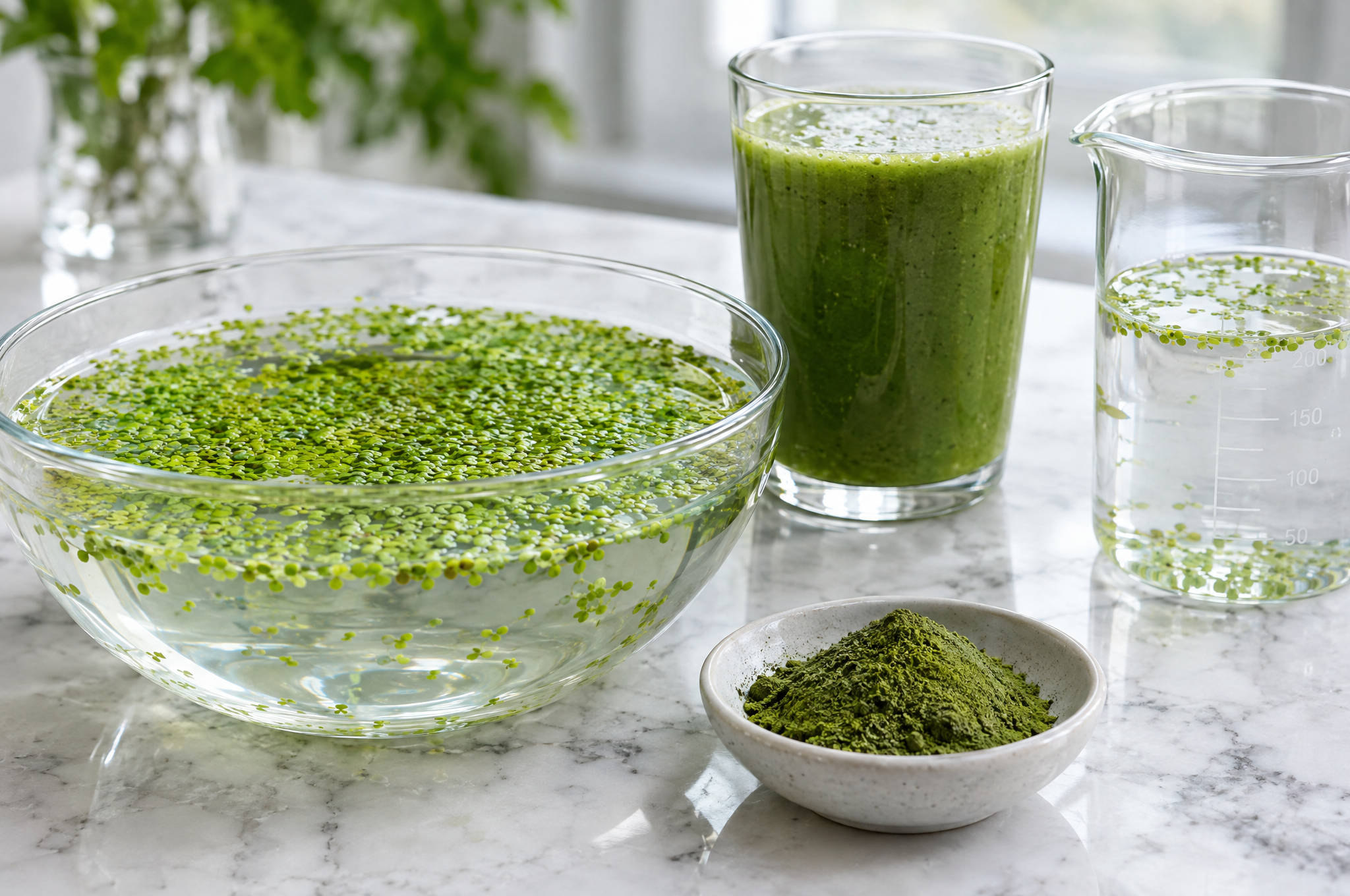
Duckweeds, also called water lentils, are the family Lemnaceae. EFSA describes 38 species in five genera. Wolffia has 11 species. Duckweeds are among the fastest-growing flowering plants, and W. globosa fronds are 0.4 to 0.8 mm long, according to EFSA; one trial team called W. globosa "the smallest plant on earth."
Traditional food. Fresh Wolffia has been eaten for generations in Myanmar, Laos and northern Thailand, according to EFSA; its Thai name, khai-nam, means "eggs of the water." A 2018 lab study notes its use in salads, omelets and curries.
Mankai is a strain of W. globosa grown in closed, monitored aquatic greenhouses, according to a paper co-written by employees of the company that grows it. Most human trials of "duckweed" used this strain, as frozen cubes blended into a shake, a fresh plant drink, or cooked whole plant. A Dutch research group tested a different genus, Lemna minor, and a protein concentrate made from Lemna.
What it contains. Composition depends on species, clone and growing water. In a lab analysis of all 11 Wolffia species grown under the same conditions, protein made up 20% to 30% of dry weight, starch 10% to 20%, fat 1% to 5% and fiber about 25%, and essential amino acids met or came close to World Health Organization requirements for young children. Manganese ranged from 78 to 431 mg per kg of dry weight across clones, and cadmium and iodine were detected even though neither was added to the growing medium. The W. globosa powder EFSA assessed was specified at 40% to 50% protein, 27% to 35% fiber and 7% to 10% fat, with 2 to 12 mg of vitamin K1 (phylloquinone) per 100 g, which EFSA called "considerably higher" than in other leafy vegetables.
What human studies have tested
| Study | Who took part | Form and daily amount | Duration | What was measured | Result |
|---|---|---|---|---|---|
| Protein and vitamin B12 | |||||
| Kaplan et al., 2019, RCT (Israel) | 36 men with mild abdominal obesity | One test meal with 30 g protein from cooked whole Mankai, soft cheese or green peas | Single meal; blood drawn over 3 hours | Blood essential amino acids; vitamin B12 | Histidine, phenylalanine, threonine, lysine and tryptophan rose with Mankai, similar to cheese and peas; branched-chain amino acids rose more with cheese. Blood B12 rose more with Mankai than with cheese or peas (from the abstract; full text not available to us) |
| Zeinstra et al., 2019, randomized crossover (Netherlands) | 12 healthy adults | Lemna minor, 64 g freeze-dried (20 g protein), cooked, vs green peas | Single meal, 1-week washout | Blood amino acids, glucose, insulin; gut complaints | Lower blood amino acids than peas, which the authors read as lower digestibility; lower glucose and insulin; no difference in gut complaints |
| Mes et al., 2022 (protein concentrate), double-blind crossover (Netherlands) | 12 healthy adults | 20 g Lemna protein concentrate vs 20 g whey protein concentrate | Single dose | Amino acid rise in blood | Total amino acids 60.4% and essential amino acids 66.3% of the whey response; individual results ranged from 18.2% to 94.2% |
| Mes et al., 2022 (whole plant), RCT (Netherlands) | 24 healthy adults | 170 g fresh L. minor or spinach, cooked into a warm meal | 11 days | Gut symptoms; blood and urine health markers | Less hunger but more flatulence and constipation with Lemna (authors could not rule out a pre-existing difference); no differences in kidney, liver, inflammation or iron markers |
| Post-meal glucose | |||||
| Zelicha et al., 2019, randomized crossover (Israel) | 20 adults with abdominal obesity (mean fasting glucose 110.9 mg/dL), drawn from the DIRECT PLUS green-Mediterranean group | Mankai shake replacing dinner vs a yogurt shake matched for carbohydrate, protein and calories | 2 weeks of flash glucose monitoring (6 test days) | Post-meal and overnight glucose | Glucose peak rise 13.4 vs 19.3 mg/dL; 180-minute net glucose area 707.9 vs 1,576.6 mg/dL·min; next-morning fasting glucose 83.2 vs 86.6 mg/dL |
| Tsaban et al., 2024, randomized crossover (Israel) | 45 adults with type 2 diabetes (HbA1c 6.5% to 8.5%); 40 completed, mean age 64, 68.9% men | 200 mL raw fresh Mankai plus 100 mL water (40 kcal, about 10 g dry matter) after dinner vs 300 mL water | 2 weeks each, 4-day washout | Continuous glucose monitoring | Peak rise 24.3 vs 30.1 mg/dL (19.3% lower); net post-meal glucose area 20.1% lower; about two-thirds of participants responded. The company that grows Mankai supplied it; authors declared no conflicts |
| DIRECT PLUS: a whole-diet trial (Israel) | |||||
| Tsaban et al., 2021 | 294 workers with abdominal obesity or high blood fats; 88% men, mean age 51 | Healthy dietary guidelines, Mediterranean diet with 28 g walnuts, or green-Mediterranean diet: walnuts plus 3–4 cups green tea, 100 g frozen Mankai as a shake replacing dinner, and less red and processed meat; all with physical activity | 6 months | Cardiometabolic risk | Weight −6.2 kg (green) vs −5.4 kg (Mediterranean) vs −1.5 kg; waist −8.6 vs −6.8 vs −4.3 cm (difference significant in men only); LDL cholesterol −6.1 vs −2.3 vs −0.2 mg/dL; hsCRP −0.52 vs −0.24 vs −0.15 mg/L |
| Yaskolka Meir et al., 2021 | Same trial; 269 with valid baseline liver scans | Same three diets | 18 months | Liver fat by MR spectroscopy | Liver fat −38.9% vs −19.6% vs −12.2% (relative); fatty liver prevalence fell from 62% to 31.5% vs 47.9% vs 54.8% |
| Zelicha et al., 2022 | Same trial | Same three diets | 18 months | Visceral fat by MRI | Visceral fat −14.1% vs −6.0% vs −4.2%, with weight change −3.9% vs −2.7% in the two Mediterranean groups |
| Sela et al., 2020 | Same trial | Same three diets | 18 months | Serum vitamin B12 | +15.4% vs +9.9% vs +5.2% (P=0.025, green vs guidelines group) |
| Yaskolka Meir et al., 2019 | Same trial | Same three diets | 6 months | Iron status | Hemoglobin +0.23 g/dL with the green diet vs −0.1 g/dL in each other group; serum iron and transferrin saturation rose vs the guidelines group |
What the findings suggest
Protein quality. In one single-meal trial, Mankai raised five essential amino acids in the blood about as much as cheese or peas did, though cheese raised the branched-chain amino acids, including leucine, more. The Lemna studies found lower amino acid uptake than peas or whey, with wide differences between people. Our review of leucine covers why that amino acid gets attention in protein research. No trial has tested duckweed protein over weeks. Strength: low, from small single-meal studies.
Vitamin B12. Lab analysis found 2.8 µg of B12 per 100 g of dried Mankai by microbiological assay and 3.23 µg by mass spectrometry, including active cobalamin forms, and no pseudo-B12 of the kind found in spirulina. B12 was still present in plants grown for 5 months under sterile conditions; the authors suspect bacteria living inside the plant. In people, evidence is indirect: blood B12 rose more after a Mankai meal than after cheese or peas, and in DIRECT PLUS it rose more in the green-diet group, although that group also ate more fish. The authors note they could not separate Mankai from other B12 sources, and that participants started with normal B12, so the trial could not test whether Mankai corrects deficiency. Strength: low.
Post-meal glucose. Two crossover trials from the same group found lower glucose peaks after a Mankai drink, against a yogurt shake in adults with abdominal obesity and against water in adults with type 2 diabetes. These 2-week studies measured post-meal curves, not HbA1c, and about a third of the participants with diabetes showed no benefit. Strength: low, short-term.
The DIRECT PLUS diet. The green-Mediterranean group lost more liver and visceral fat than the Mediterranean group, at similar weight loss. That diet changed four things at once: Mankai, green tea, less red and processed meat, and the polyphenols that came with them. The authors credited "Mankai, green tea, and walnuts" together. Higher self-reported Mankai intake was linked with more liver fat loss, but that is an association within the trial, not a test of Mankai alone. Strength: moderate for the diet as a package in middle-aged, mostly male Israeli workers; very low for duckweed on its own.
Where the evidence is limited or conflicting
- One research program. Every Mankai trial in our table came from the same Israeli group. DIRECT PLUS was funded by the German Research Foundation, Israeli government ministries and the California Walnut Commission, and the Mankai, green tea and walnuts were donated by their suppliers. In the liver and B12 papers, the senior author disclosed advising the nutrition committee of the company that grows Mankai; three authors of the B12 paper were employees of that company, which, with a research institute, funded the B12 lab analysis. Both papers state that funders had no role in design, conduct or analysis and no access to results before publication. The 2024 diabetes trial declared no conflicts.
- No placebo in the diet trial. DIRECT PLUS was open-label: participants knew their diet group. It enrolled mostly men from one workplace, which the authors say limits how far results apply to women.
- Intake varied. Participants in the green group were asked to drink the shake daily, but in the liver paper's intake groups the lowest third reported 1.67 or fewer shakes a week and the highest third 3 or more.
- Species matter. The Dutch Lemna studies, the only human data we found from another group, showed lower amino acid uptake than peas or whey and more flatulence than spinach. These findings belong to L. minor, not to Mankai.
- Unfinished work. A 3-month Mankai pilot trial in 104 people with type 2 diabetes, with HbA1c as the main outcome, was registered for 2024; on November 9, 2026 the registry listed its status as unknown with no results, and we found no published report.
Safety
In trials. The 2024 diabetes trial reported no side effects related to the drink. In the 11-day Lemna trial, people reported more flatulence and constipation than with spinach, with no changes in blood or urine markers. EFSA noted that the human Mankai studies were not designed to test safety but reported no related adverse events. Two Mankai trial registrations excluded people taking warfarin and pregnant or breastfeeding women, so these groups were not studied.
Manganese. Duckweed's manganese content depends on its growing water and fertilizer, according to EFSA. In 2021, EFSA estimated that the applicant's proposed maximum supplement amount, 20 g a day of W. globosa powder, would supply 2.33 mg of manganese and could raise adults' manganese intake by 39%. It judged this "of safety concern" and concluded that the powder's safety "cannot be established." It had reached the same conclusion, for the same reason, on an earlier powder made from a mix of duckweed species. In the U.S., NIH's Office of Dietary Supplements lists an upper limit of 11 mg of manganese a day for adults.
Vitamin K and blood thinners. EFSA found that supplement use could supply up to 2.4 mg of vitamin K1 a day, amounts that "may antagonise anticoagulants such as coumarins." We found no published case of an interaction in people. If you take warfarin, talk with your doctor before using any duckweed product.
Growing water and contaminants. Duckweed can take up metals from its water. A Dutch batch of L. minor grown on high-quality tap water had arsenic above the limits set for rice, and the team later switched to demineralized water to prevent copper and arsenic build-up. The powder EFSA assessed was specified at arsenic below 1 mg/kg, lead below 1.5 mg/kg and cadmium below 0.6 mg/kg, plus limits for algal toxins, and EFSA found no concern from these contaminants at those levels. That conclusion applies only to powder made to those specifications.
Allergy and oxalate. Given the powder's protein content, EFSA said allergic reactions are possible; we found no published case. Oxalic acid in the powder (230 to 637 mg per 100 g) was similar to that of vegetables such as spinach, according to EFSA. Wolffia, unlike Lemna, does not store oxalate as calcium oxalate crystals.
Regulatory status. In 2021 the European Commission authorized fresh W. arrhiza and W. globosa plants as a traditional food from a third country (Implementing Regulation (EU) 2021/2191). In April 2022 the Commission closed the application for the W. globosa powder EFSA had assessed without adding it to the EU list of authorized novel foods, and as of November 2026 we found no later authorization of Wolffia powder. The EU has since authorized two Lemna products as novel foods: a protein concentrate (2024) and the plants themselves (2025). In the U.S., FDA in 2018 had "no questions" about one company's conclusion that its duckweed powders, which may include Wolffia, are generally recognized as safe as a protein source in foods; FDA stated the letter is not its own affirmation of that status.
What research does not establish
- That duckweed powder on its own reduces liver fat, visceral fat or cardiovascular risk; DIRECT PLUS tested a whole diet.
- That duckweed lowers HbA1c or treats diabetes; trials measured 2 weeks of post-meal glucose.
- That duckweed can correct vitamin B12 deficiency or replace B12 supplements in vegans.
- That results for the Mankai strain apply to other Wolffia strains, to Lemna, or to dried powders made under different conditions.
- That duckweed supplements are safe with warfarin, in pregnancy or at high intakes, given EFSA's manganese and vitamin K findings.
How we reviewed the evidence
On November 9, 2026, we searched PubMed for Mankai or Wolffia globosa in human research (92 records, many unrelated), duckweed, Wolffia or Lemna trials (25 records, all screened), composition studies (20), contaminants (58; 20 titles screened), and drug interactions or allergy (13; none relevant). We searched ClinicalTrials.gov for duckweed interventions (7 records) and read EFSA's 2021 opinion on W. globosa powder, the European Commission's novel-food lists, FDA's GRAS letter GRN 000742 and the NIH ODS manganese fact sheet. We read full texts of seven papers and the abstracts of the others, and the funding sections of three papers. We included human trials of duckweed as food or protein, used lab analyses for composition, and excluded animal studies and DIRECT PLUS secondary papers on biomarkers such as epigenetic age, brain volume and hormones. None of the cited papers is retracted. Vinatura did not run any trials of duckweed.
Vinatura Research Perspective
We asked four questions of each study: which species and strain, in what form and amount, whether duckweed was tested alone or inside a diet, and who supplied and funded the work. Only two trials tested Mankai alone over more than one meal, both for 2 weeks, and both measured post-meal glucose. The widely cited liver, visceral fat and cholesterol results come from a diet in which duckweed was one of four changes. Nearly all Mankai research comes from one group working with the company that grows the plant, and the only other group studied a different genus.
Amounts also differ between trials: about 10 g of dry Mankai a day as a fresh drink, about 20 g as frozen shake cubes, or 30 g of protein from cooked plant in one meal.
Our assessment: low-quality evidence that Mankai protein is absorbed; low evidence that it contains and modestly raises B12; low, short-term evidence of smaller post-meal glucose peaks; moderate evidence for the green-Mediterranean diet as a whole and very little for duckweed on its own. EFSA's manganese and vitamin K findings are the clearest safety signals. An independent, placebo-controlled trial of a defined duckweed product lasting at least 3 months, measuring HbA1c, liver fat or B12 status in people with low B12, and reporting manganese intake, would change this assessment.
Where this ingredient appears in Vinatura products
Duckweed Powder Superfood & EGCG lists 2.5 g of duckweed (Wolffia globosa) and 2.5 g of green tea extract (Camellia sinensis) in a 5 g (1 teaspoon) serving. The page does not state whether the plant is the Mankai strain used in the trials above. The studies above did not test this product.
Frequently asked questions
Is duckweed the same as Mankai? No. Duckweed is a family of about 38 species. Mankai is one cultivated strain of Wolffia globosa, and most human trials used it.
Can duckweed replace vitamin B12 supplements? That has not been shown. Mankai contains active B12, but trials did not test people with low B12.
Is duckweed safe? Short trials reported few problems apart from gas and constipation with Lemna. EFSA could not establish the safety of W. globosa powder because of its manganese and flagged vitamin K for people on coumarin blood thinners. Follow your product label, and ask a healthcare professional if you take warfarin or are pregnant.
References
- Kaplan A, et al. Protein bioavailability of Wolffia globosa duckweed, a novel aquatic plant – a randomized controlled trial. Clin Nutr. 2019;38(6):2576-2582. doi:10.1016/j.clnu.2018.12.009
- Zeinstra GG, et al. Postprandial amino acid, glucose and insulin responses among healthy adults after a single intake of Lemna minor in comparison with green peas: a randomised trial. J Nutr Sci. 2019;8:e28. doi:10.1017/jns.2019.26
- Mes JJ, et al. A controlled human intervention trial to study protein quality by amino acid uptake kinetics with the novel Lemna protein concentrate as case study. Int J Food Sci Nutr. 2022;73(2):251-262. doi:10.1080/09637486.2021.1960958
- Mes JJ, et al. Daily intake of Lemna minor or spinach as vegetable does not show significant difference on health parameters and taste preference. Plant Foods Hum Nutr. 2022;77(1):121-127. doi:10.1007/s11130-022-00952-9
- Zelicha H, et al. The effect of Wolffia globosa Mankai, a green aquatic plant, on postprandial glycemic response: a randomized crossover controlled trial. Diabetes Care. 2019;42(7):1162-1169. doi:10.2337/dc18-2319
- Tsaban G, et al. The effect of Mankai plant consumption on postprandial glycaemic response among patients with type 2 diabetes: a randomized crossover trial. Diabetes Obes Metab. 2024;26(10):4713-4723. doi:10.1111/dom.15840
- Tsaban G, et al. The effect of green Mediterranean diet on cardiometabolic risk; a randomised controlled trial. Heart. 2021;107(13):1054-1061. doi:10.1136/heartjnl-2020-317802
- Yaskolka Meir A, et al. Effect of green-Mediterranean diet on intrahepatic fat: the DIRECT PLUS randomised controlled trial. Gut. 2021;70(11):2085-2095. doi:10.1136/gutjnl-2020-323106
- Zelicha H, et al. The effect of high-polyphenol Mediterranean diet on visceral adiposity: the DIRECT PLUS randomized controlled trial. BMC Med. 2022;20(1):327. doi:10.1186/s12916-022-02525-8
- Sela I, et al. Wolffia globosa–Mankai plant-based protein contains bioactive vitamin B12 and is well absorbed in humans. Nutrients. 2020;12(10):3067. doi:10.3390/nu12103067
- Yaskolka Meir A, et al. A green-Mediterranean diet, supplemented with Mankai duckweed, preserves iron-homeostasis in humans and is efficient in reversal of anemia in rats. J Nutr. 2019;149(6):1004-1011. doi:10.1093/jn/nxy321
- Appenroth KJ, et al. Nutritional value of the duckweed species of the genus Wolffia (Lemnaceae) as human food. Front Chem. 2018;6:483. doi:10.3389/fchem.2018.00483
- EFSA Panel on Nutrition, Novel Foods and Food Allergens (NDA), et al. Safety of Wolffia globosa powder as a novel food pursuant to Regulation (EU) 2015/2283. EFSA J. 2021;19(12):e06938. doi:10.2903/j.efsa.2021.6938
- European Commission. Commission Implementing Regulation (EU) 2021/2191 authorising the placing on the market of fresh plants of Wolffia arrhiza and/or Wolffia globosa as a traditional food from a third country. December 10, 2021. eur-lex.europa.eu
- U.S. Food and Drug Administration. GRAS Notice No. GRN 000742: duckweed powder and degreened duckweed powder, response letter. August 22, 2018. fda.gov
- European Commission. Decisions terminating the procedure: Commission Implementing Decision of 20 April 2022 terminating the procedure for authorising the placing on the market of Wolffia globosa powder as a novel food without updating the Union list of novel foods (C(2022) 2363 final). Accessed November 9, 2026. food.ec.europa.eu
- European Commission. Commission Implementing Regulation (EU) 2024/1048 authorising the placing on the market of protein concentrate from Lemna gibba and Lemna minor as a novel food. April 9, 2024. eur-lex.europa.eu
- European Commission. Commission Implementing Regulation (EU) 2025/153 authorising the placing on the market of Lemna minor and Lemna gibba plants as novel food. January 29, 2025. eur-lex.europa.eu
- National Institutes of Health, Office of Dietary Supplements. Manganese: Fact Sheet for Health Professionals. Updated March 29, 2021. ods.od.nih.gov
- ClinicalTrials.gov. The effect of Wolffia globosa (Mankai) on glycemic control among patients with type 2 diabetes; a 3-month randomized controlled pilot trial (NCT06416475). Accessed November 9, 2026. clinicaltrials.gov
- ClinicalTrials.gov. Protein bioavailability of Wolffia globosa (Mankai); acute test meal effects (NCT03020225). Accessed November 9, 2026. clinicaltrials.gov
Editorial note: This article reviews published research for educational purposes. It does not establish the effects or safety of any specific supplement, including Vinatura products, and is not medical advice. Written by Vinatura Editorial Team. Last reviewed November 2026.
Author
Product Disclaimer
Including an ingredient or study does not evaluate, endorse, or recommend any Vinatura product or any third-party product. Some ingredients discussed may not be used in any Vinatura product.
The content of the articles has not been evaluated by the Food and Drug Administration (FDA) and is not intended to promote or endorse any specific product. Any products sold on this website are not intended to diagnose, treat, cure, or prevent any disease.
Opinions and Endorsements
Any claims, statements, or opinions expressed in the articles are those of the author(s) and do not necessarily reflect the views or opinions of the manufacturers of the dietary supplement products. The products sold on this website are separate from the content of the articles and are not directly endorsed or associated with the information presented here.
Liability Disclaimer
The author(s) of the articles, website, and manufacturers of the dietary supplement products do not assume any liability for any potential consequences arising from the use of the information provided in the articles. Ingredient effects, dosages, and safety vary by individual, formulation, and context; some ingredients interact with medications or may be unsuitable during pregnancy or lactation. It is recommended that individuals consult with a qualified healthcare professional before making any dietary or lifestyle changes, including the use of dietary supplements.
Product Usage
Please refer to the product labels and packaging for specific usage instructions and guidelines for the dietary supplement products sold on this website.
Customer Support
For any concerns or questions regarding the dietary supplement products, please contact our customer support team, who will be more than happy to assist you.


Leave a Comment
Be the first to comment.
What do you think?