

Lactobacillus Reuteri: Which Strains Were Studied and What They Showed
Quick answer. Lactobacillus reuteri, now officially named Limosilactobacillus reuteri, is a lactic acid bacterium found in the human gut and breast milk. Its human research is really research on a few coded strains. The most studied, DSM 17938, has reduced crying in breastfed infants with colic in several trials, but a larger community-based trial found no benefit, and its results for abdominal pain and constipation in children are mixed. Other strains were tested for bone loss (one positive trial in women aged 75 to 80, then a larger null one in women in their 50s), vaginal health (with an L. rhamnosus strain) and gum disease, with mixed results. Side effects in trials were usually similar to placebo, but rare infections have occurred in very sick patients, including one fatal case in an extremely preterm newborn.
What Lactobacillus reuteri is
L. reuteri is a species of bacteria. Different strains live in the gut of people and of animals such as pigs, mice and rats, and the species has been found in human breast milk. In 2020, taxonomists split the old Lactobacillus genus into 25 genera based on whole-genome data. L. reuteri moved to the new genus Limosilactobacillus, and PubMed's subject headings now list it as Limosilactobacillus reuteri. We use the familiar name below.
Strain matters more than species. A probiotic is a live microorganism that gives a health benefit when taken in adequate amounts, and the NIH Office of Dietary Supplements (ODS) notes that effects can differ from strain to strain. The trials below used these coded strains:
- DSM 17938, given as oil drops in infant trials. It was derived from an older strain, ATCC 55730, by removing two plasmids that carried genes for tetracycline and lincosamide resistance. The new strain lost those resistances.
- ATCC PTA 6475, tested for bone loss and, with DSM 17938, in H. pylori treatment.
- RC-14, almost always given with L. rhamnosus GR-1 for vaginal health. Early papers called it L. fermentum RC-14.
- ATCC PTA 5289, given with DSM 17938 in lozenges for gum health.
A study of one coded strain does not tell you what an unnamed strain of the same species will do.
What human studies have tested
Studies are grouped by strain. Doses are as the papers report them.
| Study | Who took part | Form and daily amount | Duration | What was measured | Result |
|---|---|---|---|---|---|
| DSM 17938: infant colic | |||||
| Sung 2018, individual-participant-data meta-analysis | 345 infants with colic in 4 double-blind trials (174 probiotic, 171 placebo) | DSM 17938 by mouth vs placebo | 21 days (main time point) | Crying and fussing time; treatment success | Crying and fussing fell 25.4 minutes a day more than with placebo by day 21 (95% CI 3.5 to 47.3). Large effect in breastfed infants (number needed to treat 2.6); not significant in formula-fed infants |
| Sung 2014, RCT (Australia) | 167 breastfed or formula-fed infants under 3 months with colic | DSM 17938, 100 million CFU in 5 oil drops | 1 month; follow-up to 6 months | Crying and fussing time at 1 month | Probiotic group cried or fussed 49 minutes a day more (95% CI 8 to 90), mostly fussing in formula-fed infants. No difference in exclusively breastfed infants. Strain found in stool of 45% of the probiotic group |
| Savino 2010, RCT (Italy) | 50 exclusively breastfed infants with colic (46 finished) | DSM 17938, 100 million CFU | 21 days | Crying time | Median 35 vs 90 minutes a day at day 21; more responders (24 vs 15) |
| Ong 2019, Cochrane review (prevention) | 6 trials, 1,886 newborns without colic; 2 trials of L. reuteri DSM 17938 | Various probiotics | Varied | New cases of colic; crying time | No clear effect on new colic cases (RR 0.46; 95% CI 0.18 to 1.19). Crying 44 minutes a day lower in the L. reuteri subgroup, with very high inconsistency. Low certainty |
| Indrio 2014, RCT (Italy) | 589 healthy term newborns under 1 week | DSM 17938 daily (dose not reported in the abstract; full text not accessed) | 90 days | Crying, regurgitation, bowel movements | At 3 months: crying 38 vs 71 minutes a day; regurgitation 2.9 vs 4.6 episodes a day; 4.2 vs 3.6 stools a day |
| DSM 17938: children's abdominal pain and constipation | |||||
| Rodríguez-Brown 2026, meta-analysis | 7 RCTs, 513 children with functional abdominal pain disorders | DSM 17938 vs placebo | Varied | Pain severity and frequency | No significant effect on pain at end of follow-up or on pain frequency. A reduction at end of treatment did not hold up in sensitivity analysis. Very low certainty |
| Weizman 2016, RCT (Israel) | 101 children aged 6 to 15 with functional abdominal pain (93 analyzed) | DSM 17938 (dose not reported in the abstract; full text not accessed) | 4 weeks; 4-week follow-up | Pain frequency and intensity | 1.9 vs 3.6 pain episodes a week; lower intensity. No difference in school absence |
| Maragkoudaki 2017, RCT (Greece, Slovenia, Poland) | 54 children with functional abdominal pain | DSM 17938, 200 million CFU | 4 weeks; 4-week follow-up | Pain frequency and intensity | Pain fell in both groups; no significant difference between them. Fewer school and work absences with the probiotic only, but the between-group difference was not significant |
| Wegner 2018, RCT (Poland) | 129 children aged 3 to 7 with hard-to-treat functional constipation | DSM 17938 plus the laxative macrogol vs placebo plus macrogol | 8 weeks | Bowel movements a week | 7.5 vs 6.9 at week 8, not significant |
| ATCC PTA 6475: bone | |||||
| Nilsson 2018, RCT (Sweden) | 90 women aged 75 to 80 with low bone density (70 finished) | ATCC PTA 6475, 10 billion CFU as powder | 12 months | Change in shin bone (tibia) volumetric density | −0.83% vs −1.85% with placebo (difference 1.02%; 95% CI 0.02 to 2.03). Secondary bone outcomes not significant. Funded in part by the company that sells the strain, which also supplied the product |
| Gregori 2024, RCT (Sweden) | 239 early postmenopausal women, median age 55 | ATCC PTA 6475, 1 billion or 10 billion CFU in capsules (all capsules, placebo included, had vitamin D) | 2 years | Tibia density; hip and spine density | No difference from placebo at either dose. An exploratory analysis suggested a better response at higher body weight. The strain's manufacturer, named in the paper as the trial's sponsor, supplied the capsules and ran the randomization |
| RC-14 with L. rhamnosus GR-1: vaginal outcomes | |||||
| Anukam 2006, RCT (Nigeria) | 125 women with bacterial vaginosis (BV), on oral metronidazole (106 followed up) | GR-1 and RC-14, 1 billion CFU each, twice daily, by mouth | 30 days | BV cure | 88% vs 40% cured with metronidazole plus placebo |
| Zhang 2021, RCT (China) | 126 women with BV, on vaginal metronidazole | GR-1 and RC-14 by mouth vs no probiotic | 30 days; follow-up to 90 days | BV cure; vaginal and stool microbiota | Cure 57.7% vs 59.6% at 30 days (not significant). Probiotic strains rarely detected in vaginal or stool samples |
| Husain 2020, RCT (UK) | 304 pregnant women from 9 to 14 weeks (238 analyzed) | GR-1 and RC-14, 2.5 billion CFU each, once daily, by mouth | Until delivery | BV at 18 to 20 weeks; vaginal colonization | BV 15% vs 9% (adjusted OR 1.82; 95% CI 0.64 to 5.19). RC-14 not detected in the vagina in either group. Charity-funded; the product maker reviewed the report before submission |
| DSM 17938 with ATCC PTA 5289: gums | |||||
| Teughels 2013, RCT (Turkey) | 30 adults with chronic periodontitis after scaling and root planing | Lozenges with both strains, twice daily | 12 weeks | Pocket depth; attachment; bacteria | Overall pocket depth not significantly different; greater pocket reduction and attachment gain in moderate and deep pockets; larger drop in P. gingivalis |
| Martin-Cabezas 2016, meta-analysis | 3 RCTs pooled, adults with chronic periodontitis | L. reuteri lozenges after scaling and root planing | Short term | Attachment gain; bleeding | Attachment gain 0.42 mm greater; bleeding on probing 14.7 points lower; pocket depth only a trend overall |
| DSM 17938 with ATCC PTA 6475: H. pylori | |||||
| Moreno Márquez 2022, RCT (Spain) | 80 patients with H. pylori on 10-day bismuth quadruple therapy | Tablet with both strains vs placebo | 30 days | Eradication; stomach symptoms | Eradication 85% overall, no difference between groups. Abdominal pain eased in 42% vs 19% |
What the findings suggest
Infant colic (DSM 17938). Pooled raw data from four double-blind trials showed a strong effect in breastfed infants and no significant effect in formula-fed infants. A larger trial in Melbourne, which used a validated crying diary, found no benefit and more fussing with the probiotic. It recruited mostly from an emergency department, and crying fell steadily in both groups. Strength: moderate for breastfed infants with colic, and limited or conflicting for formula-fed infants.
Preventing colic and reflux-type spitting up. In one large Italian trial, newborns given DSM 17938 for 90 days cried less and spit up less at 3 months. The Cochrane review of prevention trials found no clear reduction in new colic cases, with low certainty. Strength: limited.
Children's abdominal pain. Single trials disagree. Weizman found less pain; Maragkoudaki found that pain fell just as much with placebo. The newest meta-analysis of seven DSM 17938 trials found no consistent effect, with very low certainty. A 2023 Cochrane review of all probiotics for children's functional abdominal pain found low-certainty evidence of more treatment success but could not analyze by strain. Strength: low.
Children's constipation. DSM 17938 added nothing to the laxatives macrogol or lactulose in two trials, and a 2022 Cochrane review of all probiotics found insufficient evidence of benefit. Strength: low, mostly null.
Bone (ATCC PTA 6475). One 12-month trial in women aged 75 to 80 with low bone density found about half as much bone loss at the shin. A larger 2-year trial in women in their 50s, at two doses (1 billion and 10 billion CFU a day), found no effect. Its authors say the strain "should not be recommended" to women of that age to prevent bone loss. Neither trial was designed to test fractures. Strength: very limited.
Vaginal outcomes (RC-14 with GR-1). Two small trials from the 2000s reported higher BV cure rates when the pair was added to antibiotics. A 2021 trial in Chinese women found no added benefit, and a UK pregnancy trial found no change in the vaginal microbiota and no RC-14 in the vagina. These results belong to the two-strain pair taken by mouth. GR-1 is an L. rhamnosus strain, covered in our L. rhamnosus review, and our review of L. crispatus explains how vaginal and oral products differ. Strength: low and inconsistent.
Gums (DSM 17938 with ATCC PTA 5289). Lozenges after professional deep cleaning produced modest extra gains in deeper pockets in small trials. For people with gingivitis, a meta-analysis found no significant L. reuteri effect on gingival or plaque index. In 2020 the European Food Safety Authority (EFSA) found the evidence for these lozenges insufficient for a "normal gum function" claim: of the two trials in people with gingivitis but no periodontitis it could draw conclusions from, one showed a large effect and one showed none. Strength: low.
H. pylori. A 2019 meta-analysis of Lactobacillus add-ons to triple therapy found higher eradication in the L. reuteri subgroup (RR 1.18; 95% CI 1.03 to 1.34). A placebo-controlled trial with bismuth quadruple therapy found no difference in eradication, only less abdominal pain. Strength: limited.
What guidelines say. The 2023 World Gastroenterology Organisation (WGO) guideline lists DSM 17938, at its highest evidence level, for managing and preventing colic, children's functional abdominal pain, acute diarrhea in children and preventing necrotizing enterocolitis (NEC) in preterm infants. The American Gastroenterological Association's (AGA) 2020 technical review rated as high certainty the evidence that DSM 17938 or its parent strain ATCC 55730 lowered severe NEC in preterm, low-birth-weight infants. The AGA also concluded that probiotics do not appear to benefit children in North America with acute gastroenteritis, so the two bodies differ on childhood diarrhea. The 2023 position paper of the European pediatric society ESPGHAN made strain-specific recommendations, only where at least two trials of a similar strain existed, for conditions including infant colic and children's functional abdominal pain; its abstract, the part we could read, does not name the strains.
Where the evidence is limited or conflicting
- One company, many trials. The best-known strains (DSM 17938, ATCC PTA 6475, ATCC PTA 5289) come from one manufacturer. It part-funded the first bone trial, supplied the product and ran the randomization in the second, made the gum lozenges and applied for the EFSA gum claim. The UK pregnancy trial was charity-funded.
- Small and short. Most trials in the table enrolled fewer than 150 people and lasted 12 weeks or less.
- Colonization is inconsistent. DSM 17938 was found in the stool of 45% of treated infants in Melbourne. RC-14 was not found in the vagina in the UK trial, and the GR-1/RC-14 strains were rarely detected in the Chinese trial.
- Combinations. RC-14 was almost always tested with GR-1, and the gum and H. pylori products paired two L. reuteri strains, so single-strain effects cannot be separated.
- A striking follow-up needs care. A 10-year follow-up of the Italian newborn trial reported functional abdominal pain in 13% of children who had been given DSM 17938 vs 80% given placebo. Fewer than half of the original children were assessed, and the authors call it an association, not proof.
- Unpublished trials. ClinicalTrials.gov lists two manufacturer-sponsored colic trials completed in 2025 and 2026; we found no published results on November 8, 2026.
Safety
In trials. Side effects were generally similar with L. reuteri and placebo. In the first bone trial, adverse events occurred in 80% of women on the probiotic and 87% on placebo, and in the 2-year trial no serious adverse event was judged treatment-related. Cochrane reviews of children's trials found no excess of serious adverse events, with low or very low certainty. NIH ODS describes probiotic side effects as usually minor, such as gas.
Infections. Lactobacilli rarely cause infections such as bacteremia or endocarditis, mostly in people with diabetes or weakened immunity and risk factors such as prosthetic heart valves, according to a review of 48 case reports published from 2019 to 2021. A 2019 case report describes fatal L. reuteri sepsis in an extremely preterm newborn who received the probiotic under a hospital protocol and had a central venous catheter. In 2023, the FDA warned that probiotics given to preterm infants can cause invasive, potentially fatal disease, and said it has not approved any probiotic product as a drug or biological product for infants.
Antibiotic resistance genes. DSM 17938 exists because its parent strain carried potentially transferable resistance genes, a reminder that strain identity matters for safety too.
Pregnancy. In the UK trial of GR-1 and RC-14 taken from early pregnancy, no serious adverse events were linked to the capsules. There were 3 miscarriages in the probiotic group and 1 with placebo, a difference the trial was not designed to test. A 12-week placebo-controlled trial in 86 pregnant women reported no adverse issues. Ask your obstetric clinician before use in pregnancy or breastfeeding.
Medicines and limits. We found no documented drug interactions specific to L. reuteri. If you take antibiotics or immune-suppressing medicines, or have a central line, ask your doctor or pharmacist first. We found no official upper intake level for probiotics. Follow your product label.
What research does not establish
- That L. reuteri, as a species, has any proven benefit; results belong to coded strains.
- That DSM 17938 helps formula-fed infants with colic, or that any strain treats colic, abdominal pain, constipation, BV, gum disease or H. pylori on its own.
- That ATCC PTA 6475 prevents bone loss or fractures in most women.
- That oral RC-14 reliably reaches the vagina.
- That L. reuteri supports hair growth or skin aging; our search found no clinical trial of either.
How we reviewed the evidence
On November 8, 2026, we ran nine targeted PubMed searches by strain and outcome and screened the 132 records they returned by title and abstract, with overlap. Extra searches covered hair and skin trials, retractions and taxonomy. We read full texts where available and abstracts otherwise, plus the WGO 2023 guideline, the AGA technical review and AGA's 2020 news release, the NIH ODS fact sheet, the FDA's 2023 letter, EFSA's 2020 opinion and ClinicalTrials.gov (272 L. reuteri intervention records). We could not access the full AGA guideline or ESPGHAN paper; we report ESPGHAN from its abstract only. We excluded animal and lab-only studies, heat-killed bacteria and unnamed strains. None of the cited studies is listed as retracted in PubMed. Vinatura did not run any trials of L. reuteri.
Vinatura Research Perspective
We asked four questions of each study: which coded strain, in what form and amount, in whom, and whether the outcome was a symptom, a lab measure or a hard endpoint such as fractures. DSM 17938 was studied mainly in infants and children at about 100 to 200 million CFU a day. ATCC PTA 6475 was studied in women's bones at 1 to 10 billion. RC-14 was studied with GR-1 for vaginal health at 1 to 2.5 billion CFU of each strain per dose. A species-level "benefits" list merges these into claims that no single trial tested.
Two observations stood out. First, more CFU did not mean more effect: in the 2-year bone trial, 10 billion CFU a day did no better than 1 billion and neither beat placebo, while the colic signal came at 100 million CFU a day. Second, the strongest results often came from small early trials; later trials, often larger or in different populations, were more often null: colic in Melbourne, bone in early menopause, BV in China.
Our assessment: moderate evidence that DSM 17938 reduces crying in breastfed infants with colic; low or very low evidence for children's abdominal pain, gum health and H. pylori support; mostly null evidence for children's constipation and early postmenopausal bone loss; and low, inconsistent evidence for oral RC-14 with GR-1 in vaginal health. Large independent trials in formula-fed infants, a fracture-outcome trial in older women with low bone density, published results of the completed colic trials, and studies that track strain colonization would change this assessment.
Where this ingredient appears in Vinatura products
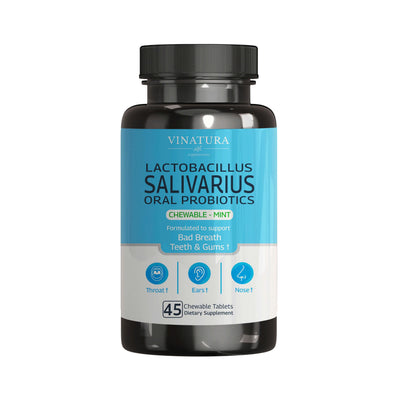
L. Salivarius Oral Probiotic lists Lactobacillus reuteri 1 billion CFU per serving (1 chewable mint tablet), with L. salivarius, L. acidophilus and L. plantarum. Women's Probiotic lists Lactobacillus reuteri Complex 25 mg (1.25 billion CFU) per delayed-release capsule, with five other Lactobacillus complexes. Neither page names strains. The studies above did not test these products.
Frequently asked questions
What are the benefits of Lactobacillus reuteri? Benefits were tested for specific strains, not the species. The most consistent finding is less crying in breastfed infants with colic given DSM 17938. Most other uses have small, mixed or null trials.
What are the side effects of L. reuteri? In trials, side effects were usually mild and similar to placebo. Rare, serious infections have occurred in very sick or preterm patients, and the FDA has warned that probiotics can cause serious infections in preterm infants.
Does L. reuteri help with bone loss? One trial in women aged 75 to 80 with low bone density found less shin bone loss with ATCC PTA 6475. A larger 2-year trial in women in their 50s found no effect, and neither trial was designed to test fractures.
How much did studies use? Trials used about 100 million CFU a day for infants and up to 10 billion CFU a day in the bone trials. These are study amounts, not recommendations. Follow your product label and ask a healthcare professional.
References
- Luo H, et al. Genome-scale insights into the metabolic versatility of Limosilactobacillus reuteri. BMC Biotechnol. 2021;21(1):46. doi:10.1186/s12896-021-00702-w
- Zheng J, et al. A taxonomic note on the genus Lactobacillus: description of 23 novel genera, emended description of the genus Lactobacillus Beijerinck 1901, and union of Lactobacillaceae and Leuconostocaceae. Int J Syst Evol Microbiol. 2020;70(4):2782-2858. doi:10.1099/ijsem.0.004107
- Rosander A, Connolly E, Roos S. Removal of antibiotic resistance gene-carrying plasmids from Lactobacillus reuteri ATCC 55730 and characterization of the resulting daughter strain, L. reuteri DSM 17938. Appl Environ Microbiol. 2008;74(19):6032-6040. doi:10.1128/AEM.00991-08
- Sung V, et al. Lactobacillus reuteri to treat infant colic: a meta-analysis. Pediatrics. 2018;141(1):e20171811. doi:10.1542/peds.2017-1811
- Sung V, et al. Treating infant colic with the probiotic Lactobacillus reuteri: double blind, placebo controlled randomised trial. BMJ. 2014;348:g2107. doi:10.1136/bmj.g2107
- Savino F, et al. Lactobacillus reuteri DSM 17938 in infantile colic: a randomized, double-blind, placebo-controlled trial. Pediatrics. 2010;126(3):e526-e533. doi:10.1542/peds.2010-0433
- Ong TG, et al. Probiotics to prevent infantile colic. Cochrane Database Syst Rev. 2019;3(3):CD012473. doi:10.1002/14651858.CD012473.pub2
- Indrio F, et al. Prophylactic use of a probiotic in the prevention of colic, regurgitation, and functional constipation: a randomized clinical trial. JAMA Pediatr. 2014;168(3):228-233. doi:10.1001/jamapediatrics.2013.4367
- Indrio F, et al. Long-term efficacy of Limosilactobacillus reuteri DSM 17938 in the prevention of functional abdominal pain disorders. Nutrients. 2026;18(4):687. doi:10.3390/nu18040687
- Rodríguez-Brown F, et al. Efficacy and safety of Limosilactobacillus reuteri DSM 17938 in pediatric functional abdominal pain disorders: a systematic review and meta-analysis of randomized controlled trials. Nutrients. 2026;18(17):2795. doi:10.3390/nu18172795
- Weizman Z, Abu-Abed J, Binsztok M. Lactobacillus reuteri DSM 17938 for the management of functional abdominal pain in childhood: a randomized, double-blind, placebo-controlled trial. J Pediatr. 2016;174:160-164.e1. doi:10.1016/j.jpeds.2016.04.003
- Maragkoudaki M, et al. Lactobacillus reuteri DSM 17938 and a placebo both significantly reduced symptoms in children with functional abdominal pain. Acta Paediatr. 2017;106(11):1857-1862. doi:10.1111/apa.13992
- Wallace C, et al. Probiotics for management of functional abdominal pain disorders in children. Cochrane Database Syst Rev. 2023;2(2):CD012849. doi:10.1002/14651858.CD012849.pub2
- Wegner A, et al. The effectiveness of Lactobacillus reuteri DSM 17938 as an adjunct to macrogol in the treatment of functional constipation in children. A randomized, double-blind, placebo-controlled, multicentre trial. Clin Res Hepatol Gastroenterol. 2018;42(5):494-500. doi:10.1016/j.clinre.2018.03.008
- Jadrešin O, et al. Lack of benefit of Lactobacillus reuteri DSM 17938 as an addition to the treatment of functional constipation. J Pediatr Gastroenterol Nutr. 2018;67(6):763-766. doi:10.1097/MPG.0000000000002134
- Wallace C, et al. Probiotics for treatment of chronic constipation in children. Cochrane Database Syst Rev. 2022;3(3):CD014257. doi:10.1002/14651858.CD014257.pub2
- Nilsson AG, et al. Lactobacillus reuteri reduces bone loss in older women with low bone mineral density: a randomized, placebo-controlled, double-blind, clinical trial. J Intern Med. 2018;284(3):307-317. doi:10.1111/joim.12805
- Gregori G, et al. Limosilactobacillus reuteri 6475 and prevention of early postmenopausal bone loss: a randomized clinical trial. JAMA Netw Open. 2024;7(6):e2415455. doi:10.1001/jamanetworkopen.2024.15455
- Reid G, et al. Oral use of Lactobacillus rhamnosus GR-1 and L. fermentum RC-14 significantly alters vaginal flora: randomized, placebo-controlled trial in 64 healthy women. FEMS Immunol Med Microbiol. 2003;35(2):131-134. doi:10.1016/S0928-8244(02)00465-0
- Anukam K, et al. Augmentation of antimicrobial metronidazole therapy of bacterial vaginosis with oral probiotic Lactobacillus rhamnosus GR-1 and Lactobacillus reuteri RC-14: randomized, double-blind, placebo controlled trial. Microbes Infect. 2006;8(6):1450-1454. doi:10.1016/j.micinf.2006.01.003
- Martinez RC, et al. Improved cure of bacterial vaginosis with single dose of tinidazole (2 g), Lactobacillus rhamnosus GR-1, and Lactobacillus reuteri RC-14: a randomized, double-blind, placebo-controlled trial. Can J Microbiol. 2009;55(2):133-138. doi:10.1139/w08-102
- Zhang Y, et al. Probiotic Lactobacillus rhamnosus GR-1 and Lactobacillus reuteri RC-14 as an adjunctive treatment for bacterial vaginosis do not increase the cure rate in a Chinese cohort: a prospective, parallel-group, randomized, controlled study. Front Cell Infect Microbiol. 2021;11:669901. doi:10.3389/fcimb.2021.669901
- Husain S, et al. Effects of oral probiotic supplements on vaginal microbiota during pregnancy: a randomised, double-blind, placebo-controlled trial with microbiome analysis. BJOG. 2020;127(2):275-284. doi:10.1111/1471-0528.15675
- Yang S, et al. Effect of oral probiotic Lactobacillus rhamnosus GR-1 and Lactobacillus reuteri RC-14 on the vaginal microbiota, cytokines and chemokines in pregnant women. Nutrients. 2020;12(2):368. doi:10.3390/nu12020368
- Teughels W, et al. Clinical and microbiological effects of Lactobacillus reuteri probiotics in the treatment of chronic periodontitis: a randomized placebo-controlled study. J Clin Periodontol. 2013;40(11):1025-1035. doi:10.1111/jcpe.12155
- Martin-Cabezas R, et al. Clinical efficacy of probiotics as an adjunctive therapy to non-surgical periodontal treatment of chronic periodontitis: a systematic review and meta-analysis. J Clin Periodontol. 2016;43(6):520-530. doi:10.1111/jcpe.12545
- Akram Z, et al. Clinical efficacy of probiotics in the treatment of gingivitis: a systematic review and meta-analysis. Aust Dent J. 2020;65(1):12-20. doi:10.1111/adj.12733
- EFSA Panel on Nutrition, Novel Foods and Food Allergens (NDA), et al. Orodispersible lozenges containing a combination of Lactobacillus reuteri DSM 17938 and Lactobacillus reuteri ATCC PTA 5289 and normal gum function: evaluation of a health claim pursuant to Article 13(5) of Regulation (EC) No 1924/2006. EFSA J. 2020;18(3):e06004. doi:10.2903/j.efsa.2020.6004
- Yu M, et al. Efficacy of Lactobacillus-supplemented triple therapy for H. pylori eradication: a meta-analysis of randomized controlled trials. PLoS One. 2019;14(10):e0223309. doi:10.1371/journal.pone.0223309
- Moreno Márquez C, et al. Randomized, double-blind, placebo-controlled clinical trial on the usefulness of probiotic Lactobacillus reuteri in bismuth-containing quadruple eradication therapy for infection with Helicobacter pylori. Rev Esp Enferm Dig. 2022;114(2):89-95. doi:10.17235/reed.2021.7931/2021
- Preidis GA, et al. AGA technical review on the role of probiotics in the management of gastrointestinal disorders. Gastroenterology. 2020;159(2):708-738.e4. doi:10.1053/j.gastro.2020.05.060
- American Gastroenterological Association. AGA does not recommend the use of probiotics for most digestive conditions (news release). June 9, 2020. eurekalert.org
- Szajewska H, et al. Probiotics for the management of pediatric gastrointestinal disorders: position paper of the ESPGHAN Special Interest Group on Gut Microbiota and Modifications. J Pediatr Gastroenterol Nutr. 2023;76(2):232-247. doi:10.1097/MPG.0000000000003633
- World Gastroenterology Organisation. Global Guidelines: Probiotics and Prebiotics. February 2023. worldgastroenterology.org
- Rossi F, et al. Lactobacilli infection case reports in the last three years and safety implications. Nutrients. 2022;14(6):1178. doi:10.3390/nu14061178
- Celis Castañeda LA, Morales Camacho WJ, Durán Ochoa NM. [Sepsis due to Lactobacillus reuteri in an extreme preterm newborn: case report]. Arch Argent Pediatr. 2019;117(5):e509-e513. doi:10.5546/aap.2019.e509
- U.S. Food and Drug Administration. Warning Regarding Use of Probiotics in Preterm Infants (letter to healthcare providers). September 29, 2023. fda.gov
- National Institutes of Health, Office of Dietary Supplements. Probiotics: Fact Sheet for Health Professionals. Updated March 25, 2025. ods.od.nih.gov
- ClinicalTrials.gov. Searches of the intervention field for Lactobacillus reuteri, and for L. reuteri with the condition colic. Accessed November 8, 2026. clinicaltrials.gov
Editorial note: This article reviews published research for educational purposes. It does not establish the effects or safety of any specific supplement, including Vinatura products, and is not medical advice. Written by Vinatura Editorial Team. Last reviewed November 2026.
Author

Product Disclaimer
Including an ingredient or study does not evaluate, endorse, or recommend any Vinatura product or any third-party product. Some ingredients discussed may not be used in any Vinatura product.
The content of the articles has not been evaluated by the Food and Drug Administration (FDA) and is not intended to promote or endorse any specific product. Any products sold on this website are not intended to diagnose, treat, cure, or prevent any disease.
Opinions and Endorsements
Any claims, statements, or opinions expressed in the articles are those of the author(s) and do not necessarily reflect the views or opinions of the manufacturers of the dietary supplement products. The products sold on this website are separate from the content of the articles and are not directly endorsed or associated with the information presented here.
Liability Disclaimer
The author(s) of the articles, website, and manufacturers of the dietary supplement products do not assume any liability for any potential consequences arising from the use of the information provided in the articles. Ingredient effects, dosages, and safety vary by individual, formulation, and context; some ingredients interact with medications or may be unsuitable during pregnancy or lactation. It is recommended that individuals consult with a qualified healthcare professional before making any dietary or lifestyle changes, including the use of dietary supplements.
Product Usage
Please refer to the product labels and packaging for specific usage instructions and guidelines for the dietary supplement products sold on this website.
Customer Support
For any concerns or questions regarding the dietary supplement products, please contact our customer support team, who will be more than happy to assist you.


Leave a Comment
Be the first to comment.
What do you think?