

Vitamin D3 for Muscle and Falls: What Large Trials Show
Quick answer. Vitamin D3 (cholecalciferol) is one of two supplement forms of vitamin D; the other is D2. In three large randomized trials of older adults (VITAL, D-Health and DO-HEALTH, more than 49,000 people in total), vitamin D3 did not prevent falls or fractures and did not improve strength, walking or muscle mass in people who were not selected for low vitamin D. Meta-analyses suggest a small strength benefit, larger in the few trials of people with very low blood levels, and the trials of HMB combined with vitamin D cannot show which ingredient did what. A yearly 500,000 IU dose, and higher monthly doses in one small trial, were followed by more falls, and the official adult upper limit in the U.S. and the EU is 4,000 IU (100 µg) a day from all sources.
What vitamin D3 is
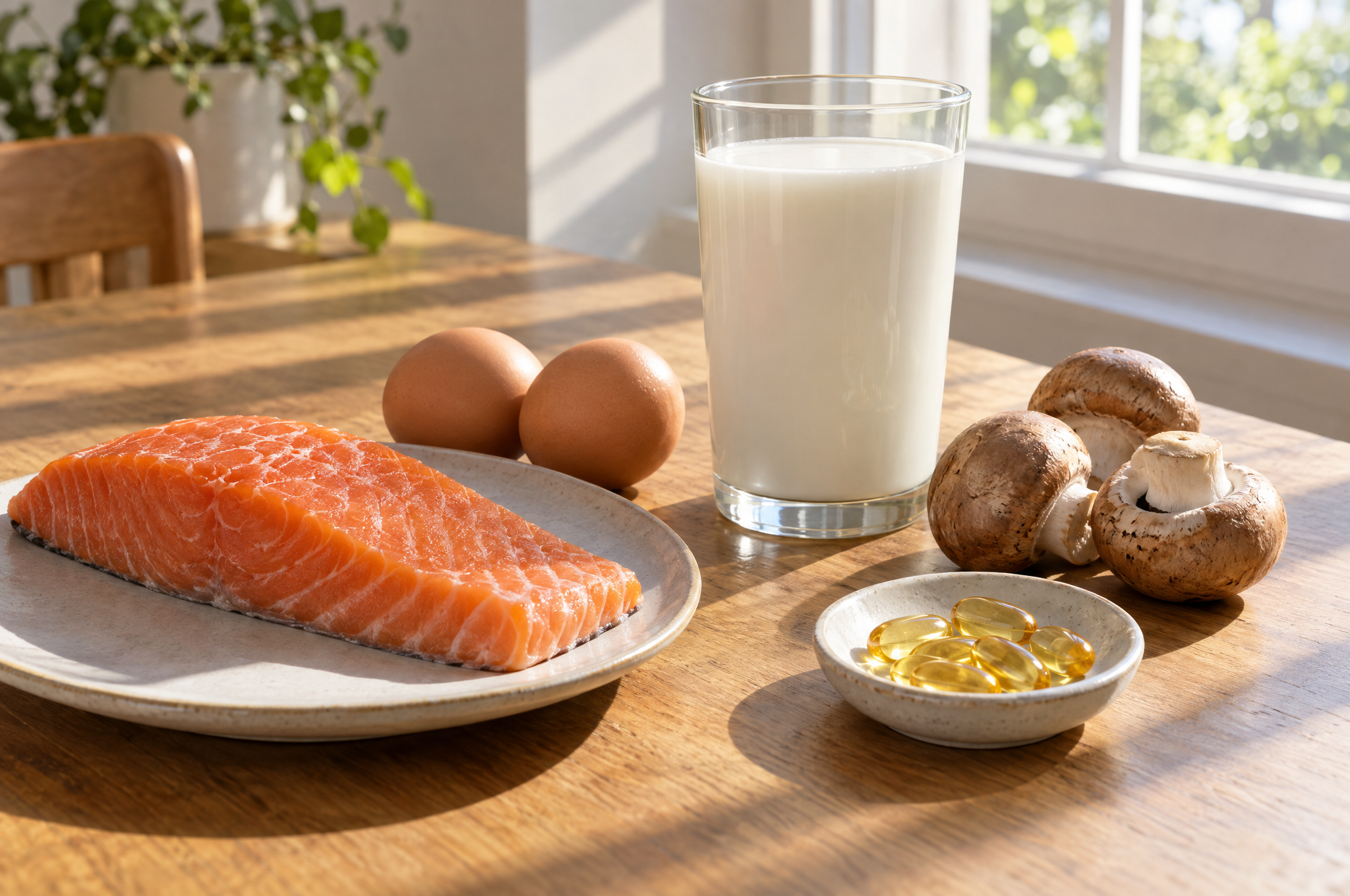
Supplements contain vitamin D as D2 (ergocalciferol) or D3 (cholecalciferol). The body makes vitamin D when bare skin is exposed to the sun, and few foods contain it naturally; fatty fish and fish liver oils are among the best sources, according to the NIH Office of Dietary Supplements (ODS). A 2012 meta-analysis of randomized trials found that D3 raised blood levels more than D2 overall, mainly when given as a large single (bolus) dose; with daily dosing the difference was lost.
Labels give micrograms (mcg or µg) and International Units (IU); ODS pairs 15 mcg with 600 IU, so 40 µg equals 1,600 IU. Status is judged with a blood test for 25-hydroxyvitamin D, written 25(OH)D. ODS says levels of 50 nmol/L (20 ng/mL) or above are adequate for most people, below 30 nmol/L (12 ng/mL) are too low, and above 125 nmol/L (50 ng/mL) are too high.
What human studies have tested
| Study | Who took part | Form and daily amount | Duration | What was measured | Result |
|---|---|---|---|---|---|
| LeBoff et al., 2020 (VITAL falls; randomized, double-blind; U.S.) | 25,871 men 50+ and women 55+ (mean age 67), not selected for low vitamin D | D3 2,000 IU daily vs placebo | Median 5.3 years | Two or more falls; falls needing a doctor or hospital visit | 2 or more falls: 9.8% vs 9.4% (OR 0.97; 95% CI 0.90–1.05). No difference in people starting below 50 nmol/L |
| LeBoff et al., 2022 (VITAL fractures; NIH-funded) | Same 25,871 adults | D3 2,000 IU daily vs placebo | Median 5.3 years | Total, nonvertebral and hip fractures | Total fractures HR 0.98 (0.89–1.08); hip HR 1.01 (0.70–1.47). No change by baseline 25(OH)D |
| Chou et al., 2025 (VITAL substudy) | 1,054 VITAL participants seen in person in Boston | D3 2,000 IU daily vs placebo | 2 years | Grip strength, walking speed, balance, chair stands, Timed Up and Go | No differences. Timed Up and Go slightly worse with vitamin D in people who started above the median 25(OH)D |
| Waterhouse et al., 2021 (D-Health falls; randomized, double-blind; Australia) | 21,315 adults aged 60–84 | D3 60,000 IU once a month vs placebo | Up to 5 years (mean 4.3) | Any fall in the past month | OR 1.02 (0.95–1.10). In people with a BMI under 25, more falls with vitamin D (OR 1.25; 1.09–1.43) |
| Waterhouse et al., 2023 (D-Health fractures) | 20,326 analyzed | D3 60,000 IU once a month vs placebo | Median 5.1 years | Total fractures | 5.6% vs 5.9% (HR 0.94; 0.84–1.06); hip HR 1.11 (0.86–1.45); HR appeared to fall with longer follow-up |
| Bischoff-Ferrari et al., 2020 and 2022; Eggimann et al., 2025 (DO-HEALTH; randomized, double-blind; 5 European countries) | 2,157 adults 70+ in good health; 40.7% below 20 ng/mL | D3 2,000 IU daily (factorial design with omega-3s and home exercise) | 3 years | Physical performance (SPPB), nonvertebral fractures, falls, muscle mass, sarcopenia | No benefit of vitamin D on any of these |
| Shea et al., 2019 (randomized, double-blind; U.S.) | 100 adults 60+ with 25(OH)D 20 ng/mL or lower | D3 800 IU daily (1,600 IU if still under 28 ng/mL at 4 months) vs placebo | 12 months | Leg power, strength, function, lean mass | No differences, although 25(OH)D rose to 32.5 vs 19.8 ng/mL |
| Sanders et al., 2010 (randomized, double-blind; Australia) | 2,256 women 70+ at high fracture risk | D3 500,000 IU once a year vs placebo | 3–5 years | Falls, fractures | More falls (RR 1.15; 1.02–1.30) and fractures (RR 1.26; 1.00–1.59) with vitamin D |
| Bischoff-Ferrari et al., 2016 (randomized, double-blind; Switzerland) | 200 adults 70+ with a prior fall | D3 24,000 IU vs 60,000 IU vs 24,000 IU plus calcifediol, once a month | 12 months | Leg function (SPPB); falls | No difference in function; falls in 66.9% and 66.1% of the higher-dose groups vs 47.9% at 24,000 IU |
| Appel et al., 2021 (STURDY; randomized; U.S.; NIA-funded) | 688 adults 70+ at higher fall risk, 25(OH)D 25–72.5 nmol/L | D3 200 (control), 1,000, 2,000 or 4,000 IU daily | Up to 2 years | Time to first fall or death | 1,000 IU vs 200 IU: HR 0.94 (0.76–1.15). In the dose-finding stage, 2,000 and 4,000 IU had higher event rates than 1,000 IU; serious falls were more common at 1,000 IU or more than at 200 IU (HR 1.87; 1.03–3.41) |
| Fuller et al., 2011 (post hoc analysis of a randomized trial; U.S.) | 77 adults (mean age 76) | HMB with arginine and lysine vs isonitrogenous control; no vitamin D given | 1 year | Strength and fat-free mass, grouped by 25(OH)D below or at least 30 ng/mL | Fat-free mass rose with the HMB mix in both groups; strength rose only in the HMB group with 30 ng/mL or more |
| Rathmacher et al., 2020 (randomized, double-blind; U.S.) | 117 adults 60+ with 25(OH)D 15–30 ng/mL completed (238 enrolled) | Calcium HMB 3 g plus D3 2,000 IU daily vs placebo, with or without exercise | 12 months | Lean mass, strength, a combined function score, falls | Without exercise: lean mass up at 6 months only, knee strength better at 3 months only, better function score. No added benefit with exercise; no change in falls. Only the 117 completers were analyzed |
| Fairfield et al., 2022 (randomized, double-blind; U.S.) | 43 women (mean age 53); 8–10 per group analyzed | Calcium HMB 3 g plus D3 2,000 IU daily vs placebo | 12 weeks, inactive or weight training | Thigh muscle volume, fat within the thigh muscles (IMAT), function | Per-protocol: inactive group gained thigh muscle volume; both groups lost IMAT; no effect on function. Including all randomized women, the MRI differences were not significant (P = 0.1) |
| Meta-analyses: Stockton 2011; Beaudart 2014; Rosendahl-Riise 2017; Bolland 2018 | 17, 30, 15 and 81 randomized trials | Various vitamin D doses | Various | Strength, mobility, falls, fractures | No strength effect above 25 nmol/L, large effect in 2 trials below it (Stockton); small strength gain, larger below 30 nmol/L and at 65+ (Beaudart); no grip change, Timed Up and Go 0.3 s slower (Rosendahl-Riise); no effect on fractures or falls (Bolland) |
OR = odds ratio; HR = hazard ratio; RR = relative risk; CI = confidence interval. SPPB = Short Physical Performance Battery, a test of balance, walking speed and chair stands.
What the findings suggest
Falls: no benefit in generally healthy older adults. VITAL (2,000 IU daily), D-Health (60,000 IU monthly, about 2,000 IU a day on average) and DO-HEALTH (2,000 IU daily) found no reduction in falls, and neither did a 2018 meta-analysis of 37 trials (34,144 people; RR 0.97). A 2009 meta-analysis of 8 smaller trials had reported 19% fewer falls with 700 to 1,000 IU a day; the later, much larger trials did not confirm it. Evidence strength: high.
Fractures: no benefit in people not selected for deficiency or osteoporosis. VITAL, D-Health and a 2018 meta-analysis of 36 trials agree. Evidence strength: high.
Muscle strength, function and mass. Two years of 2,000 IU did not change grip strength, walking speed or a combined performance score in VITAL, and three years did not change physical performance, muscle mass or new sarcopenia (age-related muscle loss) in DO-HEALTH. There, only vitamin D, omega-3s and home exercise combined lowered the odds of becoming "prefrail" (OR 0.61; 0.38–0.98). Evidence strength: moderate to high that vitamin D does not improve muscle when levels are adequate.
Only in people who are deficient? In a 2011 meta-analysis, only two trials enrolled people below 25 nmol/L, and they showed a large gain in hip strength. Yet in 100 older adults starting near 20 ng/mL (about 50 nmol/L), raising 25(OH)D to 32.5 ng/mL did not improve leg power, strength or lean mass, VITAL found no different effect on falls below 50 nmol/L, and STURDY, which enrolled only people at 25 to 72.5 nmol/L, found no fall benefit. The VITAL and DO-HEALTH investigators write that their results may not apply to people with very low levels, poor absorption or osteoporosis. Evidence strength: low.
HMB with vitamin D. HMB is a compound the body makes from the amino acid leucine (see our leucine review); its own evidence is in our HMB review. The idea that vitamin D helps HMB rests mainly on a post hoc analysis of a trial that gave no vitamin D: strength rose only in HMB-mix users whose level was already 30 ng/mL or higher. The one long trial that gave both found a better combined function score in non-exercisers, but lean mass and knee strength gains did not last to 12 months, exercise added nothing, falls did not change, and only the 117 of 238 people who finished were analyzed. Its authors state that the design "did not allow us to distinguish between the independent effects of HMB and of vitamin D." Evidence strength: low.
Where the evidence is limited or conflicting
- Who was studied. The large trials enrolled mostly healthy, active adults; few were frail or very deficient.
- Who ran the HMB trials. The Fuller, Rathmacher and Fairfield papers list authors affiliated with Metabolic Technologies or MTI BioTech, and ClinicalTrials.gov lists Metabolic Technologies Inc. as sponsor of the Rathmacher trial (NCT02043171). Metabolic Technologies supplied the Fairfield capsules.
- Outcome choice. ClinicalTrials.gov lists 12-month muscle strength as the Rathmacher trial's main outcome; the paper's main result was a function score built for the study, and knee strength differed only at 3 months.
- Unreported trial. On November 5, 2026, ClinicalTrials.gov listed a 12-week trial by the same sponsor comparing placebo, vitamin D, HMB and both in 76 adults over 60 with low vitamin D (NCT00874575), completed in July 2013, with no posted results. We found no peer-reviewed report of it.
What buyers say, and what the research shows
Our team analyzed 1,790 public Amazon reviews of 14 HMB products, including Vinatura's, 3 of them combined with vitamin D3, collected in September 2026, after removing reviews linked to Vinatura's own creator campaigns. Reviews show what buyers believe or report, not whether a product caused any change. A theme counts as common on a product when it made up at least 10% of weighted mentions in its positive or critical reviews.
Belief: adding vitamin D3 makes HMB work better. Praise for vitamin D3 in the formula was common on all 3 combination products and on none of the 11 HMB-only products. On Vinatura's listing, 17 reviews praised it, but the theme shrank once Amazon Vine reviews (from reviewers given free products) were set aside: 6.7% of weighted mentions instead of 22.1%. The research cannot confirm the belief: the one long combination trial could not separate HMB from vitamin D, and the trial designed to do so has no peer-reviewed report.
Belief: some HMB combinations contain too much vitamin D. On both other combination products, critical reviews about the vitamin D dose made up about 6% to 7% of the weighted sample. The most-upvoted critical review about the amount (44 helpful votes) noted that 3 g of HMB from one product meant 6,000 IU of vitamin D a day. That exceeds the 4,000 IU adult upper limit.
Belief: the vitamin D3 is there for bone health. Seven reviews on Vinatura's listing named bone or vitamin D health as a reason for buying, 6 from Vine reviewers; it was not common on any of the 13 other products. In people not selected for deficiency or osteoporosis, VITAL and D-Health found no fewer fractures, and a 2018 meta-analysis found no clinically meaningful change in bone density.
Safety
In trials. VITAL reported no substantial differences in adverse events. In D-Health, high blood calcium (hypercalcemia) and kidney stones were no more common with 60,000 IU monthly, and the HMB-plus-vitamin D trial found no clinically significant lab changes at 2,000 IU. In a 3-year trial of 311 healthy Canadian adults aged 55 to 70, 4,000 and 10,000 IU a day lowered wrist bone density compared with 400 IU, with no difference in bone strength.
Large intermittent doses. After a yearly 500,000 IU dose, fall risk was highest in the first 3 months (a post hoc analysis). The Endocrine Society's 2024 guideline suggests daily vitamin D rather than intermittent high doses for people over 50 for whom vitamin D is indicated.
Too much vitamin D. ODS says blood levels above 375 nmol/L (150 ng/mL) can cause nausea, vomiting, muscle weakness, confusion and kidney stones, and extremely high levels can cause kidney failure, irregular heartbeat and death.
Upper limits. The U.S. Tolerable Upper Intake Level for adults is 100 mcg (4,000 IU) a day from all sources. EFSA's 2023 opinion set 100 µg a day for adults, including in pregnancy and breastfeeding, and for ages 11 to 17, based on persistently high urine calcium at 250 µg (10,000 IU) a day in two trials, divided by an uncertainty factor of 2.5.
Medicines. ODS lists orlistat (may reduce absorption), statins (may work less well with high-dose vitamin D), steroids such as prednisone (may lower vitamin D levels) and thiazide diuretics (may raise blood calcium too high). Tell your doctor or pharmacist if you take any of these.
Who should be careful. D-Health excluded people with high blood calcium, kidney stones, hyperparathyroidism or sarcoidosis, so these groups were not studied; they should ask their doctor. People using HMB–vitamin D combinations should count vitamin D from multivitamins and other supplements toward the upper limit.
What research does not establish
- That vitamin D3 prevents falls or fractures in generally healthy older adults.
- That it builds muscle or strength when levels are already adequate.
- That vitamin D makes HMB work better than HMB alone.
- That large monthly or yearly doses are safe for fall-prone older adults.
How we reviewed the evidence
On November 5, 2026, we searched PubMed for the VITAL, D-Health, DO-HEALTH and STURDY reports, trials and meta-analyses of vitamin D and muscle, falls and fractures in older adults, bolus-dose trials, HMB-plus-vitamin D trials and D3–D2 comparisons. We included randomized trials, their secondary analyses, meta-analyses and one post hoc analysis central to the HMB question; we excluded multi-ingredient nutrition drinks and hospital patients. We read both HMB-plus-vitamin D trials in full and the other papers as abstracts, plus both ODS fact sheets, the EFSA opinion, the Endocrine Society guideline and 23 ClinicalTrials.gov records of HMB with vitamin D. Buyer beliefs come from our team's September 2026 review analysis. Vinatura did not run any trials.
Vinatura Research Perspective
We asked whether vitamin D was given daily or in large single doses, how doses compared with the 600 to 800 IU RDA and 4,000 IU upper limit, what the starting blood level was, and whether trials measured falls, fractures or function rather than lab values. The schedule appears to matter: Sanders' 500,000 IU a year averages about 1,370 IU a day, yet given at once it was followed by more falls. Two claims common online go beyond these trials. One is that vitamin D "brings out" HMB's full benefits; it rests on a post hoc split of a trial that gave no vitamin D and on one combination trial whose authors say it cannot separate the two. The other is that 1,600 IU is an optimal amount; none of the trials above tested a fixed 1,600 IU, and the one that raised some people to 1,600 IU found no muscle benefit. Every published HMB-plus-vitamin D trial we found lists authors affiliated with Metabolic Technologies or MTI BioTech, and the sponsor's four-group trial, the one design that could answer the question, has no peer-reviewed report.
Our assessment: high-certainty evidence shows no fall or fracture benefit from daily or monthly vitamin D3 in generally healthy older adults; moderate- to high-certainty evidence shows no muscle benefit when levels are adequate; low-certainty evidence suggests a strength benefit at very low levels; and evidence that vitamin D adds to HMB's effects is limited to one post hoc analysis from the sponsor group. A peer-reviewed report of NCT00874575, an independent factorial trial of HMB and vitamin D, or a trial in frail older adults below 30 nmol/L measuring falls and function would change this assessment.
Where this ingredient appears in Vinatura products
HMB 3000mg and Vitamin D3 lists 40 mcg (1,600 IU) of vitamin D3 (cholecalciferol) with 3,000 mg HMB per serving of 4 capsules. HMB Leucine Creatine Powder with Vitamin D3 - Lemonade lists 40 µg (1,600 IU) of vitamin D3 from lichen per scoop. Akkermansia Muciniphila lists 10 mcg of vitamin D (cholecalciferol, from lichen) per capsule, and Sea Moss Olive Leaf Extract Blue Vervain Ashwagandha 1250mg lists 20 mcg (800 IU) of vitamin D3 (cholecalciferol) per 2-capsule serving on its Supplement Facts label. The studies above did not test these products.
Frequently asked questions
How does 1,600 IU compare with official amounts? 1,600 IU (40 µg) is twice the 800 IU RDA for adults over 70, about 2.7 times the 600 IU RDA for adults 19 to 70, and 40% of the 4,000 IU (100 µg) adult upper limit used in the U.S. and set by EFSA. Follow your product label and ask a healthcare professional if you take other vitamin D.
Should I get my vitamin D level tested first? The Endocrine Society suggests against routine testing in the general population, but its guideline does not cover people with a medical reason for testing; ask your doctor.
Does vitamin D make HMB work better? That has not been shown. The only long trial of the combination could not separate the two, and a trial built to compare them has no peer-reviewed report.
References
- LeBoff MS, et al. VITamin D and OmegA-3 TriaL (VITAL): effects of vitamin D supplements on risk of falls in the US population. J Clin Endocrinol Metab. 2020;105(9):2929–2938. doi:10.1210/clinem/dgaa311
- LeBoff MS, et al. Supplemental vitamin D and incident fractures in midlife and older adults. N Engl J Med. 2022;387(4):299–309. doi:10.1056/NEJMoa2202106
- Chou SH, et al. Effects of supplemental vitamin D3, omega-3 fatty acids on physical performance measures in the VITamin D and OmegA-3 TriaL. J Clin Endocrinol Metab. 2025;110(1):e44–e53. doi:10.1210/clinem/dgae150
- Waterhouse M, et al. Vitamin D supplementation and risk of falling: outcomes from the randomized, placebo-controlled D-Health Trial. J Cachexia Sarcopenia Muscle. 2021;12(6):1428–1439. doi:10.1002/jcsm.12759
- Waterhouse M, et al. The effect of monthly vitamin D supplementation on fractures: a tertiary outcome from the population-based, double-blind, randomised, placebo-controlled D-Health trial. Lancet Diabetes Endocrinol. 2023;11(5):324–332. doi:10.1016/S2213-8587(23)00063-3
- Bischoff-Ferrari HA, et al. Effect of vitamin D supplementation, omega-3 fatty acid supplementation, or a strength-training exercise program on clinical outcomes in older adults: the DO-HEALTH randomized clinical trial. JAMA. 2020;324(18):1855–1868. doi:10.1001/jama.2020.16909
- Bischoff-Ferrari HA, et al. Effects of vitamin D, omega-3 fatty acids, and a simple home strength exercise program on fall prevention: the DO-HEALTH randomized clinical trial. Am J Clin Nutr. 2022;115(5):1311–1321. doi:10.1093/ajcn/nqac022
- Eggimann AK, et al. Effect of vitamin D, omega-3 supplementation, or a home exercise program on muscle mass and sarcopenia: DO-HEALTH trial. J Am Geriatr Soc. 2025;73(4):1049–1059. doi:10.1111/jgs.19266
- Gagesch M, et al. Effects of vitamin D, omega-3 fatty acids and a home exercise program on prevention of pre-frailty in older adults: the DO-HEALTH randomized clinical trial. J Frailty Aging. 2023;12(1):71–77. doi:10.14283/jfa.2022.48
- LeBoff MS, Bischoff-Ferrari HA. The effects of vitamin D supplementation on musculoskeletal health: the VITAL and DO-Health trials. J Gerontol A Biol Sci Med Sci. 2023;78(Suppl 1):73–78. doi:10.1093/gerona/glad073
- Shea MK, Fielding RA, Dawson-Hughes B. The effect of vitamin D supplementation on lower-extremity power and function in older adults: a randomized controlled trial. Am J Clin Nutr. 2019;109(2):369–379. doi:10.1093/ajcn/nqy290
- Sanders KM, et al. Annual high-dose oral vitamin D and falls and fractures in older women: a randomized controlled trial. JAMA. 2010;303(18):1815–1822. doi:10.1001/jama.2010.594
- Bischoff-Ferrari HA, et al. Monthly high-dose vitamin D treatment for the prevention of functional decline: a randomized clinical trial. JAMA Intern Med. 2016;176(2):175–183. doi:10.1001/jamainternmed.2015.7148
- Appel LJ, et al. The effects of four doses of vitamin D supplements on falls in older adults: a response-adaptive, randomized clinical trial. Ann Intern Med. 2021;174(2):145–156. doi:10.7326/M20-3812
- Burt LA, et al. Effect of high-dose vitamin D supplementation on volumetric bone density and bone strength: a randomized clinical trial. JAMA. 2019;322(8):736–745. doi:10.1001/jama.2019.11889
- Stockton KA, et al. Effect of vitamin D supplementation on muscle strength: a systematic review and meta-analysis. Osteoporos Int. 2011;22(3):859–871. doi:10.1007/s00198-010-1407-y
- Beaudart C, et al. The effects of vitamin D on skeletal muscle strength, muscle mass, and muscle power: a systematic review and meta-analysis of randomized controlled trials. J Clin Endocrinol Metab. 2014;99(11):4336–4345. doi:10.1210/jc.2014-1742
- Rosendahl-Riise H, et al. Vitamin D supplementation and its influence on muscle strength and mobility in community-dwelling older persons: a systematic review and meta-analysis. J Hum Nutr Diet. 2017;30(1):3–15. doi:10.1111/jhn.12394
- Bolland MJ, Grey A, Avenell A. Effects of vitamin D supplementation on musculoskeletal health: a systematic review, meta-analysis, and trial sequential analysis. Lancet Diabetes Endocrinol. 2018;6(11):847–858. doi:10.1016/S2213-8587(18)30265-1
- Bischoff-Ferrari HA, et al. Fall prevention with supplemental and active forms of vitamin D: a meta-analysis of randomised controlled trials. BMJ. 2009;339:b3692. doi:10.1136/bmj.b3692
- Fuller JC Jr, et al. Vitamin D status affects strength gains in older adults supplemented with a combination of β-hydroxy-β-methylbutyrate, arginine, and lysine: a cohort study. JPEN J Parenter Enteral Nutr. 2011;35(6):757–762. doi:10.1177/0148607111413903
- Rathmacher JA, et al. Long-term effects of calcium β-hydroxy-β-methylbutyrate and vitamin D3 supplementation on muscular function in older adults with and without resistance training: a randomized, double-blind, controlled study. J Gerontol A Biol Sci Med Sci. 2020;75(11):2089–2097. doi:10.1093/gerona/glaa218
- Fairfield WD, et al. Small-scale randomized controlled trial to explore the impact of β-hydroxy-β-methylbutyrate plus vitamin D3 on skeletal muscle health in middle aged women. Nutrients. 2022;14(21):4674. doi:10.3390/nu14214674
- Tripkovic L, et al. Comparison of vitamin D2 and vitamin D3 supplementation in raising serum 25-hydroxyvitamin D status: a systematic review and meta-analysis. Am J Clin Nutr. 2012;95(6):1357–1364. doi:10.3945/ajcn.111.031070
- Demay MB, et al. Vitamin D for the prevention of disease: an Endocrine Society clinical practice guideline. J Clin Endocrinol Metab. 2024;109(8):1907–1947. doi:10.1210/clinem/dgae290
- EFSA Panel on Nutrition, Novel Foods and Food Allergens (NDA), Turck D, et al. Scientific opinion on the tolerable upper intake level for vitamin D, including the derivation of a conversion factor for calcidiol monohydrate. EFSA J. 2023;21(8):e08145. doi:10.2903/j.efsa.2023.8145
- National Institutes of Health, Office of Dietary Supplements. Vitamin D: Fact Sheet for Consumers. Updated November 8, 2022. ods.od.nih.gov
- National Institutes of Health, Office of Dietary Supplements. Vitamin D: Fact Sheet for Health Professionals. Accessed November 5, 2026. ods.od.nih.gov
- ClinicalTrials.gov. A Double Blind Study on the Efficacy of a Combination of Beta-hydroxy-beta-methylbutyrate and Vitamin D on Muscular Strength and Functionality in Older Adults, NCT00874575. Accessed November 5, 2026. clinicaltrials.gov
- ClinicalTrials.gov. Year-long Double Blind Study on the Efficacy of a Combination of Beta-hydroxy-beta-methylbutyrate and Vitamin D With and Without Exercise on Muscular Strength and Functionality in Older Adults, NCT02043171. Accessed November 5, 2026. clinicaltrials.gov
Editorial note: This article reviews published research for educational purposes. It does not establish the effects or safety of any specific supplement, including Vinatura products, and is not medical advice. Written by Vinatura Editorial Team. Last reviewed November 2026.
Author
Product Disclaimer
Including an ingredient or study does not evaluate, endorse, or recommend any Vinatura product or any third-party product. Some ingredients discussed may not be used in any Vinatura product.
The content of the articles has not been evaluated by the Food and Drug Administration (FDA) and is not intended to promote or endorse any specific product. Any products sold on this website are not intended to diagnose, treat, cure, or prevent any disease.
Opinions and Endorsements
Any claims, statements, or opinions expressed in the articles are those of the author(s) and do not necessarily reflect the views or opinions of the manufacturers of the dietary supplement products. The products sold on this website are separate from the content of the articles and are not directly endorsed or associated with the information presented here.
Liability Disclaimer
The author(s) of the articles, website, and manufacturers of the dietary supplement products do not assume any liability for any potential consequences arising from the use of the information provided in the articles. Ingredient effects, dosages, and safety vary by individual, formulation, and context; some ingredients interact with medications or may be unsuitable during pregnancy or lactation. It is recommended that individuals consult with a qualified healthcare professional before making any dietary or lifestyle changes, including the use of dietary supplements.
Product Usage
Please refer to the product labels and packaging for specific usage instructions and guidelines for the dietary supplement products sold on this website.
Customer Support
For any concerns or questions regarding the dietary supplement products, please contact our customer support team, who will be more than happy to assist you.


Leave a Comment
Be the first to comment.
What do you think?