

Papaya Leaf: What Human Studies Show on Dengue, Parasites and Safety
Quick answer. Papaya leaf comes from the papaya tree, Carica papaya, which also gives the fruit and black seeds. Almost all human research on the leaf comes from short trials in people hospitalized with dengue, mostly in India, where leaf juice or extract was usually followed by faster rises in platelet counts over 3 to 5 days. Reviews rate this evidence low quality, and no trial was designed or large enough to test effects on deaths, organ failure or major bleeding, outcomes the World Health Organization (WHO) treats as critical. The "anti-parasite" reputation comes mainly from two small trials of papaya seed in children, not the leaf. Leaf safety has been checked only in trials of up to 5 days, which reported stomach upset and occasional rash but no serious harms; animal studies raise liver and reproductive concerns.
What papaya leaf is
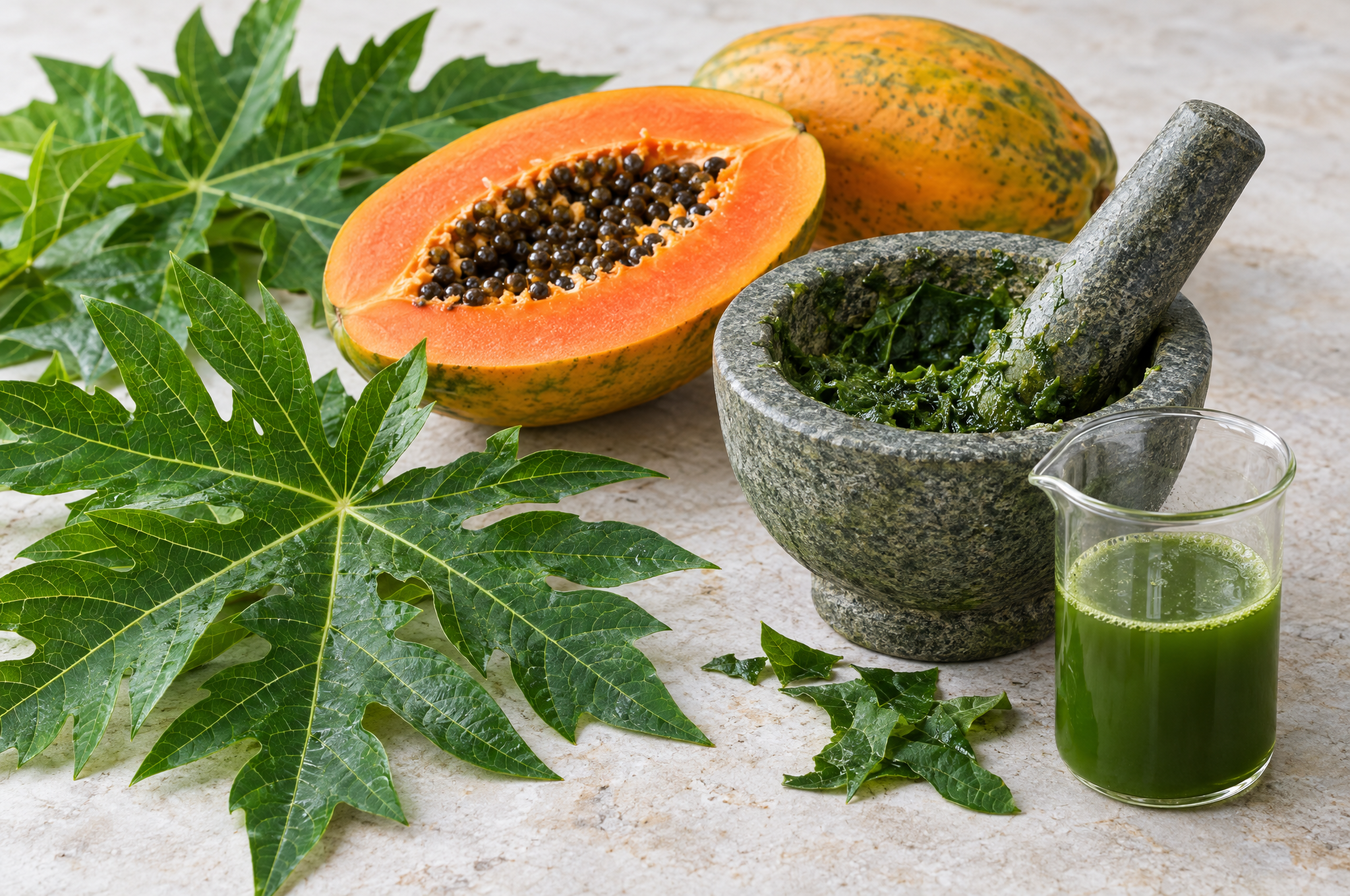
Papaya (Carica papaya) is native to Mexico and South America and is now grown across the tropics. Its parts differ in chemistry, and research on one does not apply to another:
- Leaf. The leaves contain protein-digesting enzymes such as papain and chymopapain, flavonols such as rutin, and alkaloids; the main alkaloid, carpaine, measured 0.02% to 0.31% of dry leaf weight in 29 samples. According to a 2021 safety review, the forms most often tested were leaf juice and a commercial aqueous extract standardized to 40% glycosides.
- Seed. The seeds contain benzyl isothiocyanate, which lab studies link to effects on worms. The parasite trials in people used seeds.
- Fruit and latex. Unripe fruit is rich in a milky latex, which is discussed under Safety.
A Malaysian Herbal Monograph on dried papaya leaf powder says dosage information has "not been established." We found no European, Canadian or U.S. monograph and no official upper intake limit.
What human studies have tested
| Study | Who took part | Form and daily amount | Duration | What was measured | Result |
|---|---|---|---|---|---|
| Subenthiran et al., 2013 (open-label randomized trial; Malaysia) | 290 adults aged 18 to 60 with dengue fever or early-grade dengue hemorrhagic fever and platelets of 100,000/µL or less; 228 analyzed (111 juice, 117 control) | Fresh juice pressed from 50 g of leaves once daily, plus standard care, vs standard care alone | 3 days; blood counts every 8 hours for 48 hours | Platelet count | No overall difference between groups (P=.289), but the juice group's counts were higher at 40 and 48 hours. 62 people were left out of the analysis (38 lost to follow-up, 24 with missing data) |
| Gadhwal et al., 2016 (allocated by odd-even numbers, no placebo; India) | 400 patients over age 16 with dengue fever and low platelets (200 per group) | Leaf-extract capsule 500 mg once daily, plus supportive care, vs supportive care alone | 5 days | Platelets, hospital stay, transfusions | Day 3: 82,960 vs 66,450/µL; day 7: no significant difference (124,470 vs 122,460/µL). Hospital stay 3.65 vs 5.42 days; transfusions in 27.5% vs 46.5% of patients (0.685 vs 1.19 units per patient). No side effects reported. The paper has no funding statement |
| Kasture et al., 2016 (double-blind, placebo-controlled, 5 centers; India) | 300 patients with dengue fever (150 per group) | Leaf-extract tablet 1,100 mg three times daily, plus standard care, vs placebo | 5 days | Platelet count | Platelets rose faster with the extract (P<.01); nausea and vomiting were similar in both groups, and 9 extract patients had a mild rash. The paper has no funding or conflict-of-interest statement; authors' listed affiliations include the medical services department of the extract's maker, the same company as in the next two trials |
| Srikanth et al., 2019 (open-label randomized; India) | 294 children aged 1 to 12 with dengue and platelets of 30,000 to 100,000/µL; 285 analyzed | Leaf-extract syrup, 275 mg (ages 1 to 5) or 550 mg (over 5) three times daily, plus standard care, vs standard care alone | 5 days | Platelet, red and white cell counts | Platelets higher with syrup from day 3 (day 5 mean 168,923/µL; P=.023). Two children reported nausea. The maker supplied the syrup, and 3 of 6 authors were its employees |
| Sathyapalan et al., 2020 (double-blind, placebo-controlled pilot; India) | 50 adults with dengue and platelets of 30,000/µL or less (26 extract, 24 placebo); recruitment stopped at about half the planned 100 | Leaf-extract tablets 1,100 mg three times daily vs placebo | 5 days | Platelet rise, hematocrit, transfusions, hospital stay | Day-3 platelet rise 482% vs 331% (P=.007); median 2 vs 3 days to reach 50,000/µL (not statistically significant). No difference in hematocrit or hospital stay (5 days in both). Platelet transfusions in 8 of 26 vs 4 of 24 (not significant). Funded by the company that made the syrup in the trial above |
| Rajapakse et al., 2019 (systematic review and meta-analysis) | 9 controlled trials: 6 in India and 1 each in Pakistan, Indonesia and Malaysia | Leaf juice, capsules, tablets or syrup; doses varied | Mostly 3 to 5 days | Platelets, hospital stay, clinical outcomes | Day 1 to 5 platelet rise higher with papaya (3 trials, 129 people) and hospital stay 1.98 days shorter (3 trials), both low-quality evidence. No trial examined death; plasma leakage and bleeding were not studied |
| Charan et al., 2016 (systematic review and meta-analysis) | 4 randomized trials, 439 people enrolled, 377 analyzed | Leaf extract, various forms | Various | Platelets, hospital stay, mortality | Higher platelets overall and after day 4, but no difference at 48 hours; hospital stay 1.90 days shorter. Mortality and grade 3 to 4 adverse events could not be pooled |
| Okeniyi et al., 2007 (randomized, placebo-controlled pilot; Nigeria). Seed, not leaf | 60 children without symptoms whose stool showed intestinal parasites | One 20 mL dose of an elixir of air-dried papaya seeds and honey vs honey alone | Single dose; stool rechecked on day 7 | Parasites in stool | Stools cleared in 23 of 30 (76.7%) vs 5 of 30 (16.7%); no harmful effects reported |
| Kugo et al., 2018 (three schools, one per group, assigned at random; Kenya). Seed, not leaf | 324 children aged 4 to 12 enrolled; complete data for 243 | School porridge with ground papaya seed (10 g of seed a day) vs plain porridge vs one 400 mg dose of the drug albendazole | 2 months | Roundworm egg counts | Egg counts fell 63.9% with seed porridge and 78.8% with albendazole, with no significant change on plain porridge. Registered after the study |
What the findings suggest
Platelet counts in dengue. Seven of nine trials in the 2019 review reported faster platelet rises with papaya leaf, typically by day 3 to 5; an early Pakistani trial found no difference, and one could not be compared. Two meta-analyses agree on the direction, as does a 2024 meta-analysis of traditional Indian remedies. Trials measured platelets differently, so the size of the effect is uncertain. Evidence strength: low.
Hospital stay. Pooled results suggest stays about 2 days shorter, but most trials were open-label, so doctors usually knew who received papaya when deciding on discharge. Of two double-blind trials that reported stay, one (described in the 2019 review) found shorter stays and the 50-patient pilot found no difference. Evidence strength: low.
Clinical outcomes. No published trial was designed to test whether papaya leaf prevents death, plasma leakage, shock or severe bleeding, so whether a faster platelet rise leads to better health is unknown. In a 2025 Indian observational study of 170 patients with severe dengue or warning signs, 15% had used papaya leaves or extract; deaths and hospital stays were similar in users and non-users of home remedies.
Parasites. Two small seed trials in children found fewer parasites or eggs in stool after papaya seed. Neither tested the leaf. Evidence strength for seed: very low. For leaf: no human evidence.
Where the evidence is limited or conflicting
- A faster platelet rise is a surrogate, not a clinical result. Platelets in dengue usually recover on their own; in the Gadhwal trial, both groups had similar counts by day 7. The 2019 review notes that platelet levels "correlate only loosely" with plasma leakage and shock. In a separate trial of 372 adults with dengue, preventive platelet transfusions did not reduce bleeding (21% vs 26%, P=.16) and were followed by more adverse events (13 vs 2). WHO's 2025 arboviral guideline counts mortality, major bleeding, organ failure and length of hospital stay among its critical outcomes and suggests against preventive platelet transfusion in suspected or confirmed severe arboviral disease with platelets below 50,000/µL and no active bleeding (a conditional recommendation, low-certainty evidence).
- Risk of bias. The 2019 review found that seven of nine trials did not describe how patients were randomized, only two were double-blind, and most had a high risk of bias. It concluded that routine use of papaya extract for dengue "cannot be recommended" on current evidence. A 2021 review found that only 3 of 13 trials used a placebo and only 2 achieved proper blinding.
- A reporting gap. The Sathyapalan abstract says fewer extract patients received platelet transfusions (1 of 26 vs 2 of 24). Those figures match only transfusions after the first 48 hours; overall, the paper reports 8 of 26 extract and 4 of 24 placebo patients transfused.
- One manufacturer behind much of the evidence. Three of the five leaf trials in our table name the same company as funder or list its staff as authors. Two newer placebo-controlled trials at a Bangladeshi university, completed in December 2023 (250 enrolled) and February 2025 (184 enrolled), had posted no results on ClinicalTrials.gov, and we found no publication of either; the first names the same company's product in its registry record.
- Little other human data. Registered leaf trials outside dengue (low platelets after chemotherapy or liver transplant, healthy adults; one combined with another herb) had posted no results.
- Leaf lab results do not show an anti-parasite effect. Papaya leaf alkaloids, chiefly carpaine, acted against the malaria parasite in lab dishes, but carpaine did not lengthen survival in infected mice. Seed extract blocked threadworm egg hatching in culture, and dried seed reduced tapeworms in rats. None of these are human results.
What buyers believe, and what the research shows
Our team's March 2026 market research on wormwood liquids noted that papaya and pumpkin seed are "well-known in the parasite cleanse community," that papaya leaf is described in this market as a "traditional antiparasitic" with papain for "digestive support," and that some buyers see papaya and pumpkin seed "as more complete coverage." These are beliefs and marketing claims, not evidence.
Belief: "Papaya is a traditional antiparasitic." The human data concern papaya seed, not leaf: two small trials in children reported fewer parasites in stool. In lab work, the seed compound benzyl isothiocyanate damaged rabbit intestinal tissue, and its authors warned that doses toxic to worms may harm the gut. If you think you have a parasitic infection, see a doctor for stool testing and treatment.
Belief: "Papaya leaf's papain supports digestion." The leaf does contain papain, but we found no human trial of papaya leaf for digestion. One placebo-controlled trial of a papaya preparation (plant part not named in the abstract) reported less constipation and bloating in people with chronic indigestion right after 40 days of use, but no benefit after they stopped.
Belief: "Adding papaya leaf makes a wormwood formula more complete." We found no study of papaya leaf combined with wormwood, black walnut, clove or pumpkin seed. Each herb's evidence stands on its own; see our reviews of clove and wormwood.
Safety
In trials. The leaf trials lasted 3 to 5 days in monitored hospital patients, and none reported serious adverse events. A 2021 safety review from Malaysia's Institute for Medical Research found stomach upset most common, at rates similar to control groups, and rash only in the papaya groups of two papers. The adult trials we read in full excluded pregnant and breastfeeding women and people with markedly raised liver enzymes. The 2019 review called it an ethical concern that leaf extracts reached patients without formal phase 1 safety testing, since the leaves are not a routine food.
Liver. We found no published case report of liver injury attributed to papaya leaf alone. A 2025 case report described severe liver and kidney injury in a man taking three herbal products, two of which listed papaya (plant part not stated) among other herbs; the authors did not single out one ingredient. The 2021 review obtained two unpublished Malaysian drug-safety reports of raised liver enzymes after a leaf-extract capsule (600 mg once daily for 3 to 6 days), rated a "possible" cause; one person was recovering after stopping. In animals, repeated doses of leaf juice, extract or decoction raised liver enzymes in rats and rabbits, and one rat study found fatty liver change and scarring. That review advises caution for people with liver disease.
Pregnancy and fertility. There are no human safety data for papaya leaf in pregnancy. As summarized in the 2021 review, a dried-leaf decoction given to rats throughout pregnancy at 60 mg/kg or more affected the length of pregnancy and lowered fertility, litter size and birth weight, and the review advises avoiding use in pregnancy. Leaf decoction also impaired sperm and male hormone measures in two rat studies. Crude papaya latex, abundant in unripe fruit, made rat uterine muscle contract in lab tests, much like the labor hormone oxytocin, and a seed extract lowered sperm counts in dogs.
Allergy. Papain is a known allergen. Among 33 workers exposed to airborne papain, 17 developed symptoms such as wheezing and shortness of breath, and IgE-mediated allergy was confirmed in 14. People with papaya or papain allergy should avoid papaya leaf products.
Medicines. The 2021 review found no clinical reports of interactions, but lab and animal studies showed interactions with metformin and glimepiride (diabetes), digoxin (heart), ciprofloxacin (antibiotic) and artemisinin (malaria). A 2000 pharmacist review listed papain among products with reported possible interactions with the blood thinner warfarin, based mostly on case reports and lab or animal data. If you take any prescription medicine, ask your doctor or pharmacist first.
Dengue. WHO states there is no specific treatment for dengue and advises avoiding ibuprofen and aspirin. Warning signs such as severe abdominal pain, persistent vomiting, bleeding gums or nose, or blood in vomit or stool need immediate medical care; papaya leaf is no substitute.
What research does not establish
- That papaya leaf prevents death, shock, plasma leakage or serious bleeding in dengue.
- That papaya leaf removes intestinal parasites; the human parasite data concern seeds.
- That papaya leaf aids digestion in people.
- A safe or effective amount of papaya leaf for anyone, or its safety beyond 5 days.
- That papaya leaf is safe in pregnancy, breastfeeding, allergy or with medicines.
How we reviewed the evidence
On November 5, 2026, we searched PubMed ("papaya AND dengue," 83 records, all screened, plus searches on papaya and the liver, digestion, newer trials and herb combinations), screened related-article lists, and ran web searches for case reports and official monographs. We read full texts of the five dengue trials in our table, the 2019 meta-analysis, the 2021 review and the Kenyan study; abstracts for the rest. Funding details come from each paper's disclosures or, if none, its author affiliations. We screened 41 ClinicalTrials.gov records for papaya, read WHO's 2025 guideline and dengue fact sheet, and found no retraction notices for cited papers. Seed, lab and animal studies were used only to explain claims and safety signals. Vinatura did not run any trials.
Vinatura Research Perspective
We asked four questions of each study: which plant part and form, how much, in whom, and whether the outcome was a lab number or a clinical event. The leaf trials share one design: hospitalized dengue patients, 3 to 5 days of juice or extract, and platelet count as the main outcome. That is far from routine supplement use, and study amounts cannot be compared with blend labels that do not state how much papaya leaf they contain.
Comparing the papers showed who stands behind the evidence. Three of five leaf trials link to one manufacturer through funding, supplied product or employed authors, and the two newest placebo-controlled trials (434 people enrolled) had no results we could find more than 20 months after the later one ended. One sponsored pilot's abstract reports only the transfusions that favored the extract, while its full results show more, though not significantly more, in the extract group. Online claims run ahead of the trials (the parasite reputation rests on seed studies), and the clearest leaf safety signals (liver enzymes, reproductive effects in rats) come from animal studies and unpublished reports, not the short trials.
Our assessment: low-certainty evidence that papaya leaf preparations speed platelet recovery in dengue; low-certainty, possibly biased evidence for shorter hospital stays; no trial evidence on death, shock or severe bleeding; very low-certainty evidence for papaya seed against intestinal parasites in children; and no human evidence for the leaf against parasites or for digestion. Publication of the Bangladeshi trials, an independent, preregistered, double-blind trial powered for WHO's critical outcomes, or a controlled leaf (not seed) trial with stool testing against a standard drug would change this assessment.
Where this ingredient appears in Vinatura products
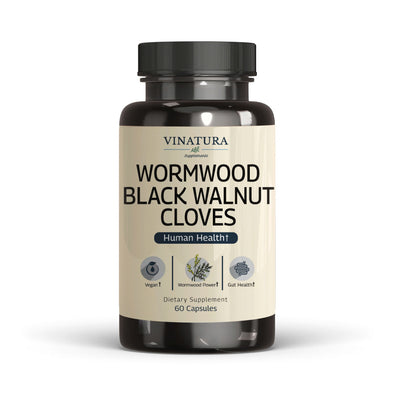
Wormwood Black Walnut Cloves Liquid lists papaya leaf (Carica papaya) with wormwood (Artemisia absinthium), black walnut (Juglans nigra), cloves (Syzygium aromaticum) and pumpkin seed (Cucurbita pepo) in a 1 mL (20-drop) serving, without the amount of each herb. The studies above did not test this product, and none tested papaya leaf in combination with these herbs.
Frequently asked questions
Is papaya leaf the same as papaya seed? No. They come from the same plant but differ in chemistry; the dengue trials used leaf and the parasite trials used seed.
Does papaya leaf cure dengue? No study shows that. Trials found faster platelet recovery over a few days, but none showed fewer deaths or serious complications. Anyone with suspected dengue should be under medical care.
How much papaya leaf did studies use? Adult trials used fresh juice from 50 g of leaves once daily, or extract from 500 mg once daily up to 1,100 mg three times daily, for 3 to 5 days in hospital. These are study amounts, not recommendations. Follow your product label and ask a healthcare professional.
References
- Subenthiran S, et al. Carica papaya leaves juice significantly accelerates the rate of increase in platelet count among patients with dengue fever and dengue haemorrhagic fever. Evid Based Complement Alternat Med. 2013;2013:616737. doi:10.1155/2013/616737
- Gadhwal AK, et al. Effect of Carica papaya leaf extract capsule on platelet count in patients of dengue fever with thrombocytopenia. J Assoc Physicians India. 2016;64(6):22–26. PubMed 27739263
- Kasture PN, Nagabhushan KH, Kumar A. A multi-centric, double-blind, placebo-controlled, randomized, prospective study to evaluate the efficacy and safety of Carica papaya leaf extract, as empirical therapy for thrombocytopenia associated with dengue fever. J Assoc Physicians India. 2016;64(6):15–20. PubMed 27739262
- Srikanth BK, et al. An open-label, randomized prospective study to evaluate the efficacy and safety of Carica papaya leaf extract for thrombocytopenia associated with dengue fever in pediatric subjects. Pediatric Health Med Ther. 2019;10:5–11. doi:10.2147/PHMT.S176712
- Sathyapalan DT, et al. Efficacy & safety of Carica papaya leaf extract (CPLE) in severe thrombocytopenia (≤30,000/μl) in adult dengue – results of a pilot study. PLoS One. 2020;15(2):e0228699. doi:10.1371/journal.pone.0228699
- Rajapakse S, et al. Carica papaya extract in dengue: a systematic review and meta-analysis. BMC Complement Altern Med. 2019;19(1):265. doi:10.1186/s12906-019-2678-2
- Charan J, et al. Efficacy and safety of Carica papaya leaf extract in the dengue: a systematic review and meta-analysis. Int J Appl Basic Med Res. 2016;6(4):249–254. doi:10.4103/2229-516X.192596
- Tewari D, Jain GK, Kumar A. A systematic review and meta-analysis of some traditional Indian remedies against dengue. Discover Medicine. 2024;1:39. doi:10.1007/s44337-024-00048-0
- Rajpal A, et al. Utilization of local remedies among dengue patients admitted to the emergency department of a tertiary care center: an observational study. Indian J Crit Care Med. 2025;29(2):148–150. doi:10.5005/jp-journals-10071-24896
- Lye DC, et al. Prophylactic platelet transfusion plus supportive care versus supportive care alone in adults with dengue and thrombocytopenia: a multicentre, open-label, randomised, superiority trial. Lancet. 2017;389(10079):1611–1618. doi:10.1016/S0140-6736(17)30269-6
- Okeniyi JA, et al. Effectiveness of dried Carica papaya seeds against human intestinal parasitosis: a pilot study. J Med Food. 2007;10(1):194–196. doi:10.1089/jmf.2005.065
- Kugo M, et al. Fortification of Carica papaya fruit seeds to school meal snacks may aid Africa mass deworming programs: a preliminary survey. BMC Complement Altern Med. 2018;18(1):327. doi:10.1186/s12906-018-2379-2
- Julianti T, et al. HPLC-based activity profiling for antiplasmodial compounds in the traditional Indonesian medicinal plant Carica papaya L. J Ethnopharmacol. 2014;155(1):426–434. doi:10.1016/j.jep.2014.05.050
- Julianti T, Oufir M, Hamburger M. Quantification of the antiplasmodial alkaloid carpaine in papaya (Carica papaya) leaves. Planta Med. 2014;80(13):1138–1142. doi:10.1055/s-0034-1382948
- Cabral ERM, et al. In vitro ovicidal and larvicidal activity of Carica papaya seed hexane extract against Strongyloides venezuelensis. Rev Inst Med Trop Sao Paulo. 2019;61:e59. doi:10.1590/S1678-9946201961059
- Sapaat A, et al. Anthelmintic activity of papaya seeds on Hymenolepis diminuta infections in rats. Trop Biomed. 2012;29(4):508–512. PubMed 23202594
- Adebiyi A, Adaikan PG. Modulation of jejunal contractions by extract of Carica papaya L. seeds. Phytother Res. 2005;19(7):628–632. doi:10.1002/ptr.1706
- Ortega-Pacheco A, et al. Effects of chloroformic extracts from washed and unwashed papaya seeds (Carica papaya) on the sperm concentration of dogs. Reprod Domest Anim. 2010;45(6):1126–1129. doi:10.1111/j.1439-0531.2009.01503.x
- Muss C, Mosgoeller W, Endler T. Papaya preparation (Caricol®) in digestive disorders. Neuro Endocrinol Lett. 2013;34(1):38–46. PubMed 23524622
- Lim XY, et al. Carica papaya L. leaf: a systematic scoping review on biological safety and herb-drug interactions. Evid Based Complement Alternat Med. 2021;2021:5511221. doi:10.1155/2021/5511221
- Zacharia GS, et al. Complementary and alternative medicine-induced combined hepatorenal toxicity: a case report. Cureus. 2025;17(12):e100197. doi:10.7759/cureus.100197
- Adebiyi A, Adaikan PG, Prasad RNV. Papaya (Carica papaya) consumption is unsafe in pregnancy: fact or fable? Scientific evaluation of a common belief in some parts of Asia using a rat model. Br J Nutr. 2002;88(2):199–203. doi:10.1079/BJNBJN2002598
- Baur X, et al. Clinical symptoms and results of skin test, RAST and bronchial provocation test in thirty-three papain workers: evidence for strong immunogenic potency and clinically relevant "proteolytic effects of airborne papain." Clin Allergy. 1982;12(1):9–17. doi:10.1111/j.1365-2222.1982.tb03121.x
- Heck AM, DeWitt BA, Lukes AL. Potential interactions between alternative therapies and warfarin. Am J Health Syst Pharm. 2000;57(13):1221–1227. PubMed 10902065
- Malaysian Herbal Monograph. Betik leaves (Carica papaya L.). GlobinMed (Malaysia). Accessed November 5, 2026. globinmed.com
- World Health Organization. WHO guidelines for clinical management of arboviral diseases: dengue, chikungunya, Zika and yellow fever. July 4, 2025. who.int
- World Health Organization. Dengue and severe dengue (fact sheet). August 21, 2025. who.int
- ClinicalTrials.gov. NCT06121934 (Efficacy and Safety of Carica Papaya in Dengue Fever) and NCT06945679 (Effects of Carica Papaya Leaf Extract in the Outcome of Hospitalized Dengue Patients); search of the intervention field for papaya. Accessed November 5, 2026. clinicaltrials.gov
Editorial note: This article reviews published research for educational purposes. It does not establish the effects or safety of any specific supplement, including Vinatura products, and is not medical advice. Written by Vinatura Editorial Team. Last reviewed November 2026.
Author
Product Disclaimer
Including an ingredient or study does not evaluate, endorse, or recommend any Vinatura product or any third-party product. Some ingredients discussed may not be used in any Vinatura product.
The content of the articles has not been evaluated by the Food and Drug Administration (FDA) and is not intended to promote or endorse any specific product. Any products sold on this website are not intended to diagnose, treat, cure, or prevent any disease.
Opinions and Endorsements
Any claims, statements, or opinions expressed in the articles are those of the author(s) and do not necessarily reflect the views or opinions of the manufacturers of the dietary supplement products. The products sold on this website are separate from the content of the articles and are not directly endorsed or associated with the information presented here.
Liability Disclaimer
The author(s) of the articles, website, and manufacturers of the dietary supplement products do not assume any liability for any potential consequences arising from the use of the information provided in the articles. Ingredient effects, dosages, and safety vary by individual, formulation, and context; some ingredients interact with medications or may be unsuitable during pregnancy or lactation. It is recommended that individuals consult with a qualified healthcare professional before making any dietary or lifestyle changes, including the use of dietary supplements.
Product Usage
Please refer to the product labels and packaging for specific usage instructions and guidelines for the dietary supplement products sold on this website.
Customer Support
For any concerns or questions regarding the dietary supplement products, please contact our customer support team, who will be more than happy to assist you.



Leave a Comment
Be the first to comment.
What do you think?