

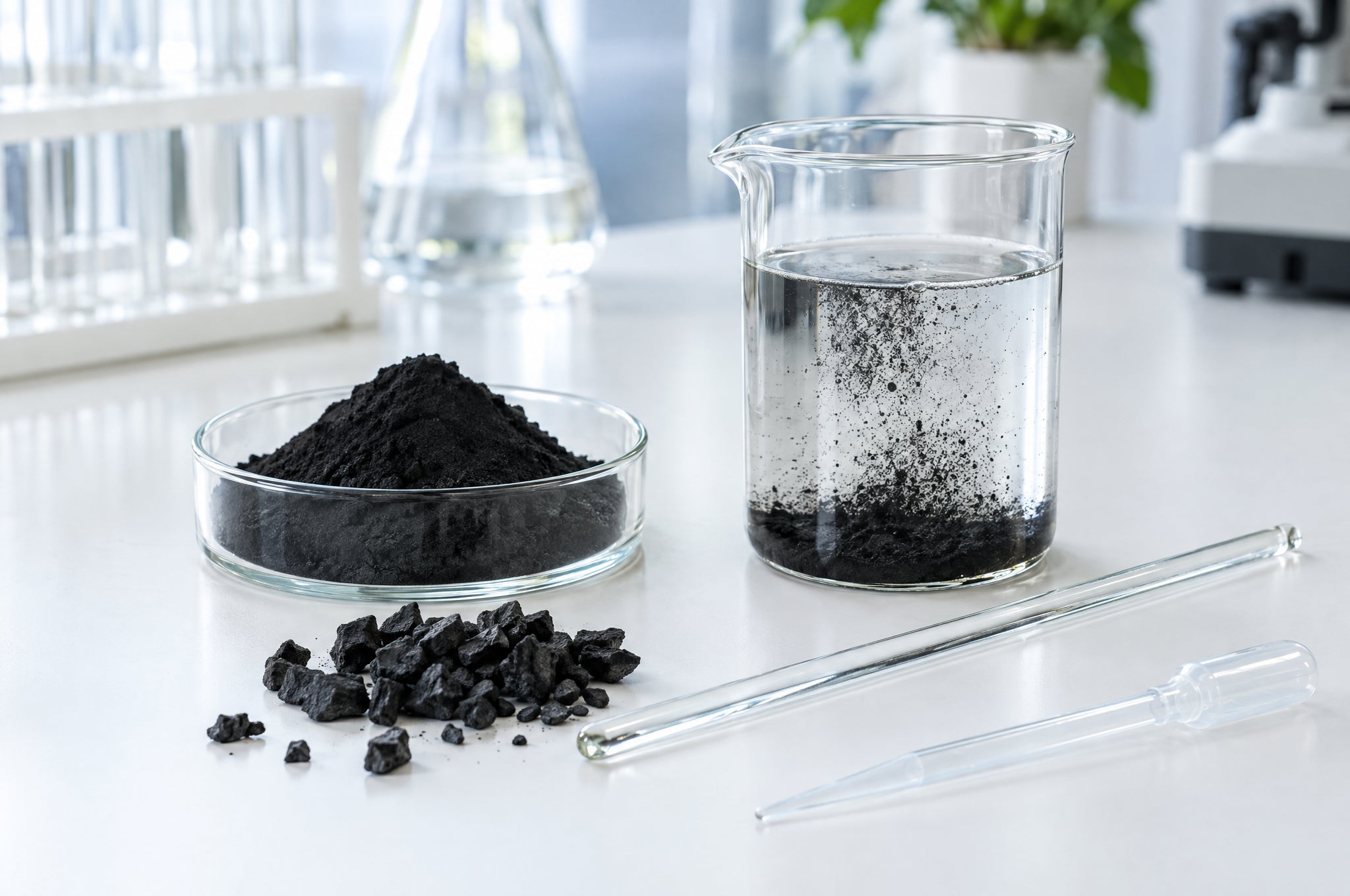
Activated Charcoal: What Research Shows, From Poisoning to Daily Use
Quick answer. Activated charcoal is a fine, highly porous carbon that holds many drugs and chemicals on its surface while they are still in the gut. Its established use is medical: in a hospital, one large dose, often 50 g, can reduce absorption of a swallowed poison, mostly when given soon after the poison, although the largest randomized trial found no drop in deaths and a 2026 expert consensus sees no role for it in alcohol, iron, lithium, lead or arsenic poisoning. Evidence for everyday uses is small, old and mixed: gas trials conflict, cholesterol fell in a few tiny 1980s studies at 4 to 32 g a day, and we found no trial of "detox" use in healthy people. The main safety point is that the same binding works on medicines: charcoal taken close to a pill can block much of it, and a case report linked charcoal use to HIV treatment failure.
What activated charcoal is
Activated charcoal (also called activated carbon) is charcoal that has been treated to open up a dense network of tiny pores. The charcoal used in one large poisoning trial had a surface area of about 2,000 square meters per gram. Substances stick to this surface, a process called adsorption, and are carried out in the stool, since charcoal itself is not absorbed. It does not bind everything: in 9 volunteers, two 60 g doses of a "superactive" charcoal with magnesium citrate, given 1 and 3 hours after drinking, did not lower overall blood alcohol levels.
Forms differ. For poisoning, charcoal is given as a water-based suspension by mouth or through a tube into the stomach. Supplements usually supply a few hundred milligrams per serving. Some kidney-disease trials used a purpose-made drug, AST-120, a spherical carbon adsorbent. The World Health Organization lists activated charcoal on its Model List of Essential Medicines as a non-specific antidote for poisoning.
Regulatory status. In the United States, FDA lists activated charcoal among ingredients in over-the-counter antidiarrheal and digestive-aid drug products for which "there are inadequate data to establish general recognition of the safety and effectiveness" (21 CFR 310.545). In the European Union, a food may state that activated charcoal "contributes to reducing excessive flatulence after eating" only if it supplies 1 g per portion, with the advice to take 1 g at least 30 minutes before and 1 g shortly after a meal. That wording followed a 2011 EFSA opinion.
What human studies have tested
| Study | Who took part | Form and daily amount | Duration | What was measured | Result |
|---|---|---|---|---|---|
| Poisoning | |||||
| de Silva et al., 2003 (single-blind, placebo-controlled RCT; Sri Lanka) | 401 people poisoned by yellow oleander seeds | All got one dose on admission, then 50 g every 6 hours vs sterile water | 3 days | Deaths (main), heart rhythm problems | Deaths 2.5% vs 8% (P=0.025); fewer life-threatening arrhythmias |
| Eddleston et al., 2008 (open-label RCT; Sri Lanka) | 4,632 people aged 14 or older with self-poisoning, mostly pesticides or oleander | No charcoal vs one 50 g dose vs six 50 g doses every 4 hours | 20–24 hours | Deaths in hospital | Deaths 6.3% (six doses) vs 6.8% (none); adjusted OR 0.96 (95% CI 0.70–1.33). No benefit with one dose or in early arrivals |
| Hoegberg et al., 2021 (systematic review) | 296 human studies, plus animal and lab studies | Single and multiple doses | Varied | Absorption, toxicity, survival | 83% of studies judged low or very low quality; higher-quality data cover a few poisons |
| Medicines taken at normal doses | |||||
| Laine et al., 1997 (randomized, parallel groups; Finland) | 32 healthy volunteers | 25 g once, immediately, 2 hours or 6 hours after 10 mg amlodipine | Single dose | Amlodipine absorption (AUC) | Absorption cut 99% immediately, 49% at 2 hours, 15% (not significant) at 6 hours |
| Elomaa et al., 2001 (within-woman comparison with control cycles; Finland) | 11 women on combined birth-control pills | 5 g four times a day, starting 3 hours after the pill | 3 days mid-cycle | Ovulation (ultrasound, hormones) | No woman ovulated |
| Intestinal gas and indigestion | |||||
| Hall et al., 1981 (double-blind, placebo) | Participants (number not in abstract) | Charcoal after a gas-producing meal | Single meal | Flatus events, breath hydrogen | Fewer flatus events and lower breath hydrogen than placebo |
| Potter et al., 1985 (double-blind) | Participants (number not in abstract) | 4 g after a baked-bean meal | Single meal | Breath hydrogen, flatus | No difference from placebo |
| Jain et al., 1986 (double-blind; U.S. and India) | 99 people (30 U.S., 69 India) | Charcoal vs placebo with lactulose (amount not in abstract) | Not stated in abstract | Breath hydrogen, bloating, cramps | All lower with charcoal (P<0.05) |
| Suarez et al., 1999 (before-and-after; U.S.) | 5 healthy adults | 0.52 g four times a day | 1 week | Sulfur gases and total gas from stool, symptoms | No significant change |
| Lecuyer et al., 2009 (placebo-controlled RCT; France) | 132 adults with indigestion (dyspepsia) | Charcoal plus simethicone combination | 3 months | Symptom score | More responders than placebo (P=0.043) |
| Coffin et al., 2011 (placebo-controlled RCT; France) | 276 adults with functional dyspepsia | Charcoal, simethicone and magnesium oxide combination | 1 month | Symptom intensity | Lower than placebo (P=0.01) |
| Blood lipids | |||||
| Kuusisto et al., 1986 (no control group described; Finland) | 7 adults with high cholesterol | 8 g three times a day (24 g) | 4 weeks | Cholesterol | Total −25%, LDL −41%, HDL +8% |
| Neuvonen et al., 1989 (crossover, dose-ranging; Finland) | 7 adults, then 10 with severe high cholesterol | 4, 8, 16 or 32 g; 16 g vs cholestyramine | 3 weeks per phase | Lipids, vitamins A, E, D | LDL down up to 41%, dose-dependent; vitamins unchanged |
| Kidney disease | |||||
| Schulman et al., 2015, EPPIC-1 and -2 (placebo-controlled RCTs; multinational) | 2,035 adults with moderate to severe CKD | AST-120 spherical carbon, 9 g | Until 291 events per trial | Dialysis, transplant or doubled creatinine | No difference (HR 1.03 and 0.91, both not significant). Registry lists a pharmaceutical sponsor |
| Gao et al., 2019 (placebo-controlled RCT; China) | 97 adults with stage 3–4 CKD and normal phosphorus | 0.6–1.2 g three times a day with food | 12 months | New high phosphorus | 28.6% vs 79.2%; 7 patients (10.6%) on charcoal had stomach or bowel side effects |
| Rahman et al., 2023 (open-label RCT; Iraq) | 28 adults on hemodialysis analyzed (15 charcoal, 13 usual care); the paper reports enrolment inconsistently | Amount not stated | 8 weeks | Urea, phosphorus, indoxyl sulfate | Urea and phosphorus fell with charcoal and rose without it; indoxyl sulfate and kidney function did not differ |
| Itching | |||||
| Pederson et al., 1980 (double-blind crossover) | 11 people on hemodialysis with itching | 6 g | 8 weeks | Itching, skin lesions | Itching relieved in 10 of 11 vs placebo (P=0.01) |
| Giovannetti et al., 1995 (Italy) | 23 people on hemodialysis with severe itching | 6 g | Not stated in abstract | Itching | Complete relief in 10, partial in 10. Design not described in abstract |
| Kaaja et al., 1994 (randomized, no placebo; Finland) | 20 pregnancies with cholestasis of pregnancy | 50 g three times a day vs usual follow-up | 8 days | Bile acids, itching | Bile acids lower; itching not changed |
What the findings suggest
Poisoning (medical use). In volunteers given safe doses of drugs, at least 50 g of charcoal cut absorption by an average of 47% when taken 30 minutes later, 40% at 60 minutes and 16.5% to 21% at 2 to 3 hours, according to the 2005 position paper of the American Academy of Clinical Toxicology and the European Association of Poison Centres and Clinical Toxicologists. That paper found no well-designed clinical study showing better patient outcomes, advised against routine use, and said charcoal "may be considered" up to 1 hour after a potentially toxic amount of a poison it binds. Their 1999 statement limited repeated doses to life-threatening poisoning with carbamazepine, dapsone, phenobarbital, quinine or theophylline. A 2026 international toxicology consensus loosened the time limit, judging charcoal appropriate, after an individual risk assessment, up to 6 hours for many poisons, but listed alcohol, methanol, ethylene glycol, iron, lithium, lead, arsenic and metformin as poisonings where it has no role. In trials, one oleander-poisoning trial found fewer deaths, while a larger trial of 4,632 patients found none, including in oleander poisoning. Strength: moderate that early charcoal reduces absorption; low for patient outcomes. This is hospital treatment, decided case by case.
Gas and indigestion. Two 1980s trials found less gas with charcoal; a third found none, and a 1999 study found that about 2 g a day did not reduce gas from stool. The two larger French trials that found symptom relief used combination products, so charcoal's share of the effect is unknown. Strength: low and conflicting.
Cholesterol. In small Finnish studies of 7 and 10 patients, 4 to 32 g a day lowered LDL cholesterol, more at higher doses; the group's follow-up analysis linked this to interrupted recycling of bile acids. A 1988 double-blind trial, known to us only from its title, reported "no effect of activated charcoal on hyperlipidaemia." Strength: very low, and no study has tested supplement amounts.
Kidney disease. The largest trials tested AST-120, a pharmaceutical carbon, and it did not slow kidney disease. Two smaller trials of other oral charcoal products, one a medicinal charcoal and one unspecified, lowered blood phosphorus and urea, laboratory values, not patient outcomes. Strength: low; negative for the main outcome in the largest trials.
Itching. A 1980 trial of 11 dialysis patients and an Italian series found less itching at 6 g a day. In cholestasis of pregnancy, 150 g a day lowered bile acids but not itching. Strength: very low.
Where the evidence is limited or conflicting
- Doses do not match. Emergency doses are 50 to 100 g; the single-ingredient studies of everyday uses that we found gave about 2 to 32 g a day, and one pregnancy study 150 g. None tested the few hundred milligrams in a typical supplement serving.
- No "detox" trials. In PubMed searches on November 16, 2026, we found no trial testing daily oral activated charcoal for "detox" or "cleansing" in healthy people (searches logged). Claims that charcoal removes heavy metals conflict with the 2026 consensus, which found no role for it in lead or arsenic poisoning. Our review of EDTA chelation therapy covers how lead poisoning is treated.
- Combination products. Most positive indigestion data come from multi-ingredient products.
- Old, small studies. The gas, cholesterol and itching studies date mostly from 1980 to 1995; those that report numbers enrolled 5 to 99 people.
Safety
In hospital use. A retrospective review of 878 patients in 8 North American hospitals who received repeated doses found clinically significant aspiration (charcoal entering the lungs) in 0.6% and no bowel obstruction; high blood sodium (6.0%) and magnesium (3.1%) were more common. Charcoal is contraindicated unless the airway is intact or protected, and repeated doses should not be given with bowel obstruction. Poison Control adds gastrointestinal bleeding and bowel perforation as reasons not to use it, and lists nausea and vomiting among side effects.
Everyday use. Charcoal turns stools black; the Iraqi kidney trial was left open-label for that reason. In the 12-month Chinese trial, 7 patients (10.6%) on charcoal had stomach or bowel side effects, mostly constipation, bloating or pain, and one withdrew for severe constipation. A 2008 case report, available to us only as a title, links pigmentation of the lower small bowel (melanosis ilei) to long-term eating of edible charcoal.
Medicines. Charcoal binds many oral drugs. Taken right after a dose, 25 g blocked 99% of amlodipine and more than 96% of fluoxetine in volunteers. Waiting helps but does not always eliminate the effect: 2 hours later, charcoal still cut amlodipine absorption by 49%, and slow-release verapamil absorption by about a third at both 2 and 4 hours. A woman whose HIV medicines had stopped working was found to have been taking activated charcoal for stomach symptoms; her drug levels had been undetectable, and the virus developed resistance. These studies used large doses, and we found no study of how far apart a few hundred milligrams of charcoal and a medicine need to be. Anyone taking prescription medicines, including heart, seizure or HIV drugs, should ask a pharmacist before using charcoal.
Birth control. In 11 women, 5 g of charcoal four times a day, started 3 hours after the pill, did not lead to ovulation. The authors concluded it can be used for diarrhea if taken at least 3 hours after and 12 hours before the pill. Other timings were not tested.
Nutrients. In the Finnish dose-ranging cholesterol study, the authors report that blood vitamin A, E and D levels were unaffected during 3-week treatment phases. Charcoal did lower blood phosphorus in kidney patients. In a PubMed title search for charcoal with iron, zinc, vitamins, folate, calcium, magnesium or nutrients (24 records, November 16, 2026), we found no study of daily supplement-size doses and vitamin or mineral status in healthy people.
Who should be careful. Apart from one 8-day study in cholestasis of pregnancy, the studies we reviewed did not test regular use in pregnancy or in children; anyone who is pregnant, is giving charcoal to a child, or has bowel disease or slow bowel movements should ask a doctor first. Do not use charcoal at home to treat a suspected poisoning: Poison Control advises against it and notes that matching an emergency dose of 50 to 100 g would take hundreds of 250 mg tablets. Call Poison Control or 911 instead. We found no official upper intake level.
What research does not establish
- That daily activated charcoal "detoxifies" healthy people or removes heavy metals, alcohol or stored toxins.
- That charcoal improves survival in poisoning in general; benefit depends on the poison, the dose and the timing.
- That supplement amounts of a few hundred milligrams a day reduce gas, cholesterol or kidney toxins; trials used grams.
- That a 2-hour gap fully protects every medicine.
- That long-term daily use is safe for nutrient status, the bowel or people taking medicines.
How we reviewed the evidence
On November 16, 2026, we searched PubMed for position statements and systematic reviews on activated charcoal in poisoning, randomized trials of multiple doses, and human studies of charcoal for gas or flatulence (15 records), cholesterol (8 records), kidney disease and uremic toxins (21 records), itching and cholestasis (17 records), birth-control pills, drug absorption in volunteers (38 records), complications, nutrients (24 records) and "detox" or "cleanse" trials (11 records, none in healthy people). We checked ClinicalTrials.gov (161 records naming activated charcoal as an intervention, many unrelated). We read the full texts of the 2008 Sri Lankan trial and the Chinese and Iraqi kidney trials, abstracts of the others (titles only where no abstract exists), and official pages from FDA (21 CFR 310.545 on eCFR), the EU health-claims regulation, the WHO essential medicines list and Poison Control. None of the cited PubMed records is retracted. Vinatura did not run any trials of activated charcoal.
Vinatura Research Perspective
We asked four questions of each study: how much charcoal, given when relative to the substance it was meant to bind, in whom, and whether the result was a lab or absorption number or something people experience. The answers sort the research into two worlds. In the medical world, 50 g or more given within an hour or so of a poison lowers how much of it reaches the blood; whether that saves lives depends on the poison, and the largest trial found it did not. In the everyday world, studies used about 2 to 32 g a day in small groups, mostly before 1995, with conflicting results. We also found that the most consistent finding, that charcoal binds what is in the gut at the same time, is the reason for caution: in volunteers it blocked ordinary doses of heart and mood medicines when timing overlapped, while a 3-hour gap after birth-control pills did not lead to ovulation in 11 women. The kidney evidence carries a second lesson about form: the largest trials used a purpose-made pharmaceutical carbon, and it did not slow kidney disease.
Our assessment: moderate evidence that large early doses reduce absorption of many poisons, with low evidence for better survival; low and conflicting evidence for gas relief at gram doses; very low evidence for cholesterol and itching; evidence against benefit for kidney disease progression with AST-120; and no human evidence for "detox" use. Randomized trials of supplement-size doses with measured outcomes, and controlled studies of how far apart to space charcoal and common medicines, would change this assessment.
Where this ingredient appears in Vinatura products
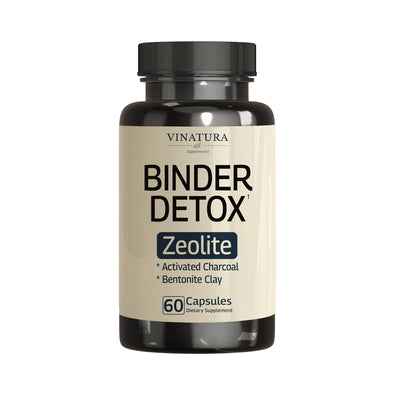
Binder Detox lists 300 mg activated charcoal powder per 2-capsule serving, with 400 mg clinoptilolite zeolite, 200 mg calcium bentonite clay, a 200 mg blend of apple pectin, diatomaceous earth and fulvic acid (as shilajit), and 75 mcg molybdenum. The page tells users to take it at least 2 hours before or after medications and other dietary supplements. It does not state the charcoal's source material or how it was activated. Our zeolite review covers another ingredient in this formula. The studies above did not test this product, and none tested charcoal combined with these ingredients.
Frequently asked questions
Should I keep activated charcoal at home for poisoning? Poison Control advises against treating a poisoning at home with charcoal. Call Poison Control or emergency services; in hospitals, the decision depends on the poison, the time since swallowing it and the person's airway.
Does activated charcoal help with a hangover or alcohol? In 9 volunteers, two 60 g doses did not lower overall blood alcohol levels, and the 2026 toxicology consensus sees no role for charcoal in alcohol poisoning.
How much did studies use? Poisoning trials used 50 g per dose and volunteer drug studies 25 g; the gas studies that report a dose used about 2 to 4 g; cholesterol studies 4 to 32 g a day; dialysis itching studies 6 g a day. These are study amounts, not recommendations. Follow your product label and ask a healthcare professional.
Can I take charcoal with my medicines? Charcoal can block many oral drugs, and a 2-hour gap reduced but did not eliminate the effect for some drugs in volunteers. Ask your pharmacist before combining them.
References
- Chyka PA, et al. Position paper: single-dose activated charcoal. Clin Toxicol (Phila). 2005;43(2):61-87. doi:10.1081/clt-200051867
- American Academy of Clinical Toxicology; European Association of Poisons Centres and Clinical Toxicologists. Position statement and practice guidelines on the use of multi-dose activated charcoal in the treatment of acute poisoning. J Toxicol Clin Toxicol. 1999;37(6):731-751. doi:10.1081/clt-100102451
- Hoegberg LCG, et al. Systematic review on the use of activated charcoal for gastrointestinal decontamination following acute oral overdose. Clin Toxicol (Phila). 2021;59(12):1196-1227. doi:10.1080/15563650.2021.1961144
- Hoegberg LCG, et al. Recommendations from the Clinical Toxicology Recommendations Collaborative on the administration of activated charcoal in acute oral overdose. Clin Toxicol (Phila). 2026;64(6):419-475. doi:10.1080/15563650.2025.2609807
- de Silva HA, et al. Multiple-dose activated charcoal for treatment of yellow oleander poisoning: a single-blind, randomised, placebo-controlled trial. Lancet. 2003;361(9373):1935-1938. doi:10.1016/s0140-6736(03)13581-7
- Eddleston M, et al. Multiple-dose activated charcoal in acute self-poisoning: a randomised controlled trial. Lancet. 2008;371(9612):579-587. doi:10.1016/S0140-6736(08)60270-6
- Dorrington CL, et al. The frequency of complications associated with the use of multiple-dose activated charcoal. Ann Emerg Med. 2003;41(3):370-377. doi:10.1067/mem.2003.86
- Katona BG, et al. The effect of "superactive" charcoal and magnesium citrate solution on blood ethanol concentrations and area under the curve in humans. J Toxicol Clin Toxicol. 1989;27(1-2):129-137. doi:10.3109/15563658909038576
- Laine K, et al. Prevention of amlodipine absorption by activated charcoal: effect of delay in charcoal administration. Br J Clin Pharmacol. 1997;43(1):29-33. doi:10.1111/j.1365-2125.1997.tb00029.x
- Laine K, et al. The effect of activated charcoal on the absorption of fluoxetine, with special reference to delayed charcoal administration. Pharmacol Toxicol. 1996;79(5):270-273. doi:10.1111/j.1600-0773.1996.tb00272.x
- Laine K, Kivistö KT, Neuvonen PJ. Effect of delayed administration of activated charcoal on the absorption of conventional and slow-release verapamil. J Toxicol Clin Toxicol. 1997;35(3):263-268. doi:10.3109/15563659709001210
- Elomaa K, et al. Charcoal treatment and risk of escape ovulation in oral contraceptive users. Hum Reprod. 2001;16(1):76-81. doi:10.1093/humrep/16.1.76
- Tseng AL, la Porte C, Salit IE. Significant interaction between activated charcoal and antiretroviral therapy leading to subtherapeutic drug concentrations, virological breakthrough and development of resistance. Antivir Ther. 2013;18(5):735-738. doi:10.3851/IMP2685
- Hall RG, Thompson H, Strother A. Effects of orally administered activated charcoal on intestinal gas. Am J Gastroenterol. 1981;75(3):192-196. PubMed 7015846
- Potter T, Ellis C, Levitt M. Activated charcoal: in vivo and in vitro studies of effect on gas formation. Gastroenterology. 1985;88(3):620-624. doi:10.1016/0016-5085(85)90129-5
- Jain NK, Patel VP, Pitchumoni CS. Efficacy of activated charcoal in reducing intestinal gas: a double-blind clinical trial. Am J Gastroenterol. 1986;81(7):532-535. PubMed 3521259
- Suarez FL, et al. Failure of activated charcoal to reduce the release of gases produced by the colonic flora. Am J Gastroenterol. 1999;94(1):208-212. doi:10.1111/j.1572-0241.1999.00798.x
- Lecuyer M, et al. Efficacy of an activated charcoal-simethicone combination in dyspeptic syndrome: results of a randomized prospective study in general practice. Gastroenterol Clin Biol. 2009;33(6-7):478-484. doi:10.1016/j.gcb.2008.09.021
- Coffin B, et al. Efficacy of a simethicone, activated charcoal and magnesium oxide combination (Carbosymag®) in functional dyspepsia: results of a general practice-based randomized trial. Clin Res Hepatol Gastroenterol. 2011;35(6-7):494-499. doi:10.1016/j.clinre.2011.02.009
- EFSA Panel on Dietetic Products, Nutrition and Allergies. Scientific Opinion on the substantiation of health claims related to activated charcoal and reduction of excessive intestinal gas accumulation (ID 1938) and reduction of bloating (ID 1938). EFSA J. 2011;9(4):2049. doi:10.2903/j.efsa.2011.2049
- Kuusisto P, et al. Effect of activated charcoal on hypercholesterolaemia. Lancet. 1986;2(8503):366-367. doi:10.1016/s0140-6736(86)90054-1
- Neuvonen PJ, et al. Activated charcoal in the treatment of hypercholesterolaemia: dose-response relationships and comparison with cholestyramine. Eur J Clin Pharmacol. 1989;37(3):225-230. doi:10.1007/BF00679774
- Neuvonen PJ, et al. The mechanism of the hypocholesterolaemic effect of activated charcoal. Eur J Clin Invest. 1989;19(3):251-254. doi:10.1111/j.1365-2362.1989.tb00226.x
- Hoekstra JB, Erkelens DW. No effect of activated charcoal on hyperlipidaemia. A double-blind prospective trial. Neth J Med. 1988;33(5-6):209-216. PubMed 3065658
- Schulman G, et al. Randomized placebo-controlled EPPIC trials of AST-120 in CKD. J Am Soc Nephrol. 2015;26(7):1732-1746. doi:10.1681/ASN.2014010042
- Gao Y, et al. Effects of oral activated charcoal on hyperphosphatemia and vascular calcification in Chinese patients with stage 3–4 chronic kidney disease. J Nephrol. 2019;32(2):265-272. doi:10.1007/s40620-018-00571-1
- Rahman WK, Rabea IS, Meizel MM. Protective effect of activated charcoal against progression of chronic kidney disease: a randomized clinical study. J Med Life. 2023;16(9):1310-1315. doi:10.25122/jml-2023-0128
- Pederson JA, et al. Relief of idiopathic generalized pruritus in dialysis patients treated with activated oral charcoal. Ann Intern Med. 1980;93(3):446-448. doi:10.7326/0003-4819-93-3-446
- Giovannetti S, et al. Oral activated charcoal in patients with uremic pruritus. Nephron. 1995;70(2):193-196. doi:10.1159/000188582
- Kaaja RJ, et al. Treatment of cholestasis of pregnancy with peroral activated charcoal. A preliminary study. Scand J Gastroenterol. 1994;29(2):178-181. doi:10.3109/00365529409090459
- Lee TH, et al. Melanosis ilei associated with chronic ingestion of edible charcoal. Gastrointest Endosc. 2008;67(7):1174. doi:10.1016/j.gie.2007.12.030
- U.S. Code of Federal Regulations (eCFR). 21 CFR 310.545: Drug products containing certain active ingredients offered over-the-counter (OTC) for certain uses. Up to date as of October 23, 2026; accessed November 16, 2026. ecfr.gov
- European Commission. Commission Regulation (EU) No 432/2012 establishing a list of permitted health claims made on foods (consolidated text, August 20, 2025). eur-lex.europa.eu
- World Health Organization. Model List of Essential Medicines: activated charcoal (section 4.1, non-specific antidotes). Accessed November 16, 2026. list.essentialmeds.org
- Poison Control, National Capital Poison Center. Activated charcoal. Accessed November 16, 2026. poison.org
- ClinicalTrials.gov. A study of AST-120 for evaluating prevention of progression in chronic kidney disease (EPPIC-1), NCT00500682. clinicaltrials.gov
Editorial note: This article reviews published research for educational purposes. It does not establish the effects or safety of any specific supplement, including Vinatura products, and is not medical advice. Written by Vinatura Editorial Team. Last reviewed November 2026.
Author
Product Disclaimer
Including an ingredient or study does not evaluate, endorse, or recommend any Vinatura product or any third-party product. Some ingredients discussed may not be used in any Vinatura product.
The content of the articles has not been evaluated by the Food and Drug Administration (FDA) and is not intended to promote or endorse any specific product. Any products sold on this website are not intended to diagnose, treat, cure, or prevent any disease.
Opinions and Endorsements
Any claims, statements, or opinions expressed in the articles are those of the author(s) and do not necessarily reflect the views or opinions of the manufacturers of the dietary supplement products. The products sold on this website are separate from the content of the articles and are not directly endorsed or associated with the information presented here.
Liability Disclaimer
The author(s) of the articles, website, and manufacturers of the dietary supplement products do not assume any liability for any potential consequences arising from the use of the information provided in the articles. Ingredient effects, dosages, and safety vary by individual, formulation, and context; some ingredients interact with medications or may be unsuitable during pregnancy or lactation. It is recommended that individuals consult with a qualified healthcare professional before making any dietary or lifestyle changes, including the use of dietary supplements.
Product Usage
Please refer to the product labels and packaging for specific usage instructions and guidelines for the dietary supplement products sold on this website.
Customer Support
For any concerns or questions regarding the dietary supplement products, please contact our customer support team, who will be more than happy to assist you.


Leave a Comment
Be the first to comment.
What do you think?