


Bentonite Clay: What Research Shows on Aflatoxin, Diarrhea and Lead
Quick answer. Bentonite is a clay rock made mostly of montmorillonite, a layered mineral that holds water and attaches certain molecules to its surfaces. In people, the best-studied form is a refined calcium montmorillonite tested in placebo-controlled trials in Ghana, Texas and Kenya: 1.5 to 3 grams a day lowered blood or urine markers of aflatoxin, a mold toxin in corn and peanuts, compared with placebo over 1 to 12 weeks; in several trials urine levels were roughly half those on placebo. A related medicinal clay, diosmectite, shortened acute diarrhea in children by about a day in pooled trials rated low certainty. No trial has shown that either clay prevents disease, and the results belong to those specific materials. The main safety issues are lead in some clay products, which led the U.S. Food and Drug Administration (FDA) to warn consumers about two bentonite powders in 2016, and binding of medicines taken at the same time.
What bentonite clay is
The U.S. Code of Federal Regulations describes bentonite as mainly a colloidal hydrated aluminum silicate whose fine particles give it a large surface area and "pronounced adsorptive capability." Its main mineral is montmorillonite, a member of the smectite group. Montmorillonite is built from thin sheets of silicon, oxygen and aluminum. Gaps in its charge pull calcium, sodium and other ions into the spaces between layers, which is why clays are named calcium or sodium bentonite.
Several clay materials appear in the research, and results from one should not be assumed for another:
- NovaSil and its refined versions (UPSN, ACCS100). A calcium montmorillonite first sold as an anticaking agent for animal feed. Researchers tested it in people as a binder of aflatoxin, then refined versions with a more uniform particle size and lower levels of dioxins and furans. The Texas trial batch was checked for heavy metals and dioxins before use.
- Diosmectite (dioctahedral smectite). A purified medicinal clay sold as a nonprescription or prescription diarrhea medicine in France and other countries. It is regulated as a medicine there, not as a supplement.
- Clays sold as powders or in supplements. These vary by source, and the trials above did not test them. A review by the NovaSil research group notes that clay minerals are chemically diverse, that many bind aflatoxin poorly, and that some can carry hazardous contaminants.
In U.S. food law, bentonite is generally recognized as safe as a processing aid, used at levels that leave "no significant residue in foods." In the European Union, a 2013 regulation authorized bentonite with at least 70% montmorillonite as an animal feed additive to reduce aflatoxin B1 contamination, and required labels to say it should not be given by mouth at the same time as macrolide antibiotics. Our reviews of zeolite and activated charcoal cover two other materials marketed for binding.
What human studies have tested
| Study | Who took part | Form and daily amount | Duration | What was measured | Result |
|---|---|---|---|---|---|
| Aflatoxin biomarkers (calcium montmorillonite) | |||||
| Wang 2005, phase I RCT (U.S.) | 50 healthy adults aged 20–45 | NovaSil capsules, 1.5 or 3 g (no placebo group) | 2 weeks | Safety: blood counts, liver and kidney tests, vitamins A and E, minerals | No differences between doses; mild stomach effects such as flatulence (8%) and abdominal pain (6%) |
| Afriyie-Gyawu 2008 and Wang 2008, phase IIa RCT (Ghana) | 177 adults with aflatoxin exposure (162 completed) | NovaSil capsules, 1.5 or 3 g vs placebo, before meals | 3 months | Side effects; serum aflatoxin–albumin adduct; urinary aflatoxin M1 | Side effects similar across groups; adduct lower than placebo at 3 months in both clay groups; urinary M1 down up to 58% (3 g group). No change at 1 month |
| Robinson 2012 (same Ghana trial) | Urine from trial participants (186 samples) | NovaSil 1.5 or 3 g vs placebo | Weeks 8 and 10 | Urinary fumonisin B1, another corn toxin | Median level more than 90% lower with 3 g than placebo |
| Pollock 2016, phase II RCT (Texas) | 234 adults aged 18–77 with detectable aflatoxin adduct (147 completed) | ACCS100 capsules, 1.5 or 3 g vs placebo | 3 months, then 1 month off | Serum aflatoxin–lysine adduct | Adduct fell in all groups, placebo included; only 1.5 g differed significantly from placebo (about 33% below baseline at 3 months, vs about 24% with placebo); 3 g did not. NIH-funded; clay provided at no cost by a clay company |
| Mitchell 2014, RCT (Ghana) | 63 children aged 3–9 | UPSN mixed into meals, 0.75 or 1.5 g vs calcium carbonate | 14 days | Safety; urinary aflatoxin M1 | 52% lower median M1 with 1.5 g; no difference in blood tests; adverse events similar (mostly in children with malaria). Funded by USAID |
| Kumi 2022, RCT (Ghana) | 200 children aged 2–9 | NovaSil, 1.5 g in breakfast porridge vs calcium carbonate | 60 days | Urinary M1, blood counts, chemistry | M1 fell about 60% from baseline with clay and rose with placebo (within-group changes; no between-group test reported); small rises in hemoglobin and blood calcium. Funded by the clay's manufacturer |
| Awuor 2017, crossover RCT (Kenya) | 50 adults in an area with past aflatoxin outbreaks (49 analyzed) | ACCS100, 1 g in water 3 times a day vs calcium carbonate | 7 days each, 5-day washout | Urinary M1; taste; side effects | M1 about half as high on clay (ratio 0.49); no single day differed significantly; side effects similar. Clay and placebo provided by a clay company |
| Diarrhea (diosmectite) | |||||
| Pérez-Gaxiola 2018, Cochrane review | 18 trials, 2,616 children with acute infectious diarrhea | Smectite, usually 1.5–3 g per dose | 3 to 6 days or until recovery | Duration, cure by day 3, need for hospital admission | About 24 hours shorter diarrhea; more cured by day 3; no evidence of an effect on hospital admission or IV fluids; low certainty. Eight trials funded by the manufacturer |
| Das 2015, meta-analysis | 13 RCTs, 2,164 children aged 1–60 months | Diosmectite, 3–6 g a day | 3 days to recovery | Duration, cure rate | About 23 hours shorter; no rise in adverse events; low-quality evidence, mostly open-label |
| Hombrink 2000, RCT (Germany) | 176 adults receiving pelvic or abdominal radiotherapy | Smectite, 6 g twice daily vs placebo | Throughout radiotherapy | Time to first diarrhea | No significant difference |
| Medicine absorption | |||||
| Wang 2025, open-label PK study (China) | 18 healthy adults | Montmorillonite powder, 3 g, taken 2 hours after the cancer drug pyrotinib | Single doses | Pyrotinib blood levels | Total exposure (AUC) 32–33% lower, peak 27% lower; peak reached about 1.5 hours earlier |
What the findings suggest
Aflatoxin exposure markers. In five placebo-controlled trials in Ghana, Texas and Kenya, refined calcium montmorillonite at 1.5 to 3 g a day lowered urine or blood markers of aflatoxin compared with placebo (the 2022 children's trial reported only before-and-after changes within each group). The Texas trial authors summarize reductions of 33% to 78% across human trials of these clays. These are exposure markers, not health outcomes: no trial measured liver cancer, liver disease, child growth or acute aflatoxin poisoning. Strength of evidence: moderate that these specific clays lower aflatoxin markers in short trials in exposed populations; none for disease prevention.
Dose. The trials do not show a clear dose response. In Texas, only 1.5 g a day differed significantly from placebo; in Ghana, urinary markers fell significantly only at 3 g. The group's own papers differ on whether 1.5 g or 3 g a day matches the lowest level that protected animals.
Acute diarrhea in children. Two meta-analyses agree that diosmectite, given alongside oral rehydration, shortens diarrhea by about a day. Both rate the evidence low because many trials were unblinded or poorly randomized. The Cochrane review found no evidence that it reduced hospital admission or the need for IV fluids. European pediatric gastroenterology and infectious disease societies (ESPGHAN and ESPID), in their 2014 guideline, listed diosmectite among the treatments that may reduce the duration and severity of diarrhea, alongside certain probiotics and racecadotril. Strength: low, for children with acute infectious diarrhea, using a pharmaceutical-grade clay.
Where the evidence is limited or conflicting
- One research group, few products. Every aflatoxin trial in our table used NovaSil or its refined forms, and the same senior author co-authored all of them except the 2022 children's trial, which was led by a co-author of earlier trials. The Texas trial was NIH-funded, but a clay company provided the clay free and is the registry's listed sponsor; the same company supplied clay and placebo in Kenya; the 2022 children's trial was funded by the clay's manufacturer, and one author worked there. We found no independent replication with other clays.
- Changing exposure. In Texas, aflatoxin levels fell in the placebo group too, and the authors suggest people changed their diets after the dietary survey. In Kenya, the decline between the start and end of the study could not be separated from changes in diet.
- Short follow-up. The longest trial lasted 3 months. Long-term safety in people is unknown; the 6-month safety data come from rats.
- Null results. A German trial of 176 adults found that smectite did not prevent radiation-induced diarrhea. The 1-month results in the Ghana adult trial showed no difference from placebo.
- No evidence for "general detox." On November 16, 2026, a PubMed search for trials of bentonite, montmorillonite or smectite with lead, mercury, cadmium, arsenic, heavy metals or detoxification returned one record, the radiotherapy trial above. We found no human trial showing that clay removes heavy metals from the body.
Safety
In trials. Side effects in the aflatoxin trials were mostly mild stomach complaints, such as bloating, nausea, constipation and diarrhea, at similar rates with clay and placebo. Constipation is the most frequently reported side effect on the French diosmectite label, which advises caution in people with severe chronic constipation.
Lead and other contaminants. Clays come from the ground and can contain lead. In January and March 2016, FDA warned consumers not to use two bentonite clay powders sold online and in stores after its laboratories found elevated lead. Their labeling or sellers said the clay could be swallowed or applied to the skin. FDA said it had not confirmed any lead poisoning cases, but advised anyone who had used the products, or given them to a child, to see a health care professional. California lists lead under Proposition 65 as a cause of cancer and reproductive harm; in September 2025 a private enforcer filed a legal notice alleging lead exposure from a cosmetic bentonite clay powder. In 2019, France's medicines agency (ANSM) said clay-based diarrhea medicines may contain small amounts of naturally occurring lead. A study submitted by the maker showed no lead entering the blood of adults taking diosmectite for 5 weeks, but the agency said the risk "cannot be excluded" in children under 2 and advised, as a precaution, against diosmectite in that age group. ANSM knew of no cases of lead poisoning.
Geophagia (eating earth or clay). Eating clay is a traditional practice in many cultures, including during pregnancy in parts of sub-Saharan Africa. In 2013, Public Health England warned about calabash chalk, a clay-based morning-sickness remedy sold in London, after finding elevated lead and occasionally arsenic. In a Cameroonian study of pregnant women, cord blood lead averaged 39.2 µg/dL in babies of women who ate a similar chalk and 25.3 µg/dL in those who did not; the difference was not statistically significant, and both levels were high. A New York City review of 44 pregnant people with very high blood lead (2004 to 2023) found that half of those from Mexico and the Caribbean reported pica, eating non-food items.
Pregnancy and breastfeeding. No clay trial included pregnant women; they were excluded. The French diosmectite label does not recommend it during pregnancy or breastfeeding. The U.S. Centers for Disease Control and Prevention (CDC) advises breastfeeding women never to eat clay or soil because it may contain lead.
Medicines and nutrients. Clay can bind medicines in the gut. In 18 healthy adults, 3 g of montmorillonite powder taken 2 hours after a single dose of the cancer drug pyrotinib still lowered the drug's blood levels by about a third; the study was sponsored by the drug's manufacturer. A 1985 study found that smectite slightly lowered and delayed peak levels of diazepam but not of phenylbutazone. The French diosmectite label advises taking other medicines more than 2 hours apart where possible. For nutrients, the Ghana trial found no difference from placebo in blood vitamins A and E or in nutrient minerals, though strontium rose with 3 g of clay. Ask a pharmacist before using any clay product alongside medicines, especially those that need steady blood levels.
What research does not establish
- That bentonite or montmorillonite prevents liver cancer, liver disease or any illness linked to aflatoxin.
- That clay removes lead, mercury or other heavy metals from the body, or that it "detoxifies" in a general sense.
- That results for NovaSil, its refined forms or pharmaceutical diosmectite apply to other bentonite powders or supplements.
- That clay is safe in pregnancy, breastfeeding, young children or for use beyond 3 months.
- That spacing clay 2 hours from a medicine always prevents an interaction.
How we reviewed the evidence
On November 16, 2026, we searched PubMed for human studies of NovaSil, calcium montmorillonite and hydrated sodium calcium aluminosilicate with aflatoxin (47 records, all titles screened), systematic reviews of smectite or diosmectite for diarrhea (11 records, all read), clay and lead or arsenic in geophagia and edible clays (43 records; 20 titles screened), trials of clays with medicines (19 records, all screened) and trials of clays with heavy metals or detoxification (1 record). We searched ClinicalTrials.gov (15 records naming montmorillonite, bentonite, NovaSil or ACCS100). We read the full texts of the Texas, Kenya and Cochrane reports and the NovaSil group's 2019 review, the full texts of the two Ghana children's trials and the pyrotinib study through PubMed Central, and abstracts of the other studies. We read FDA's two 2016 consumer warnings (dated January 29 and March 23, 2016, on FDA pages), 21 CFR 184.1155, EU Regulation 1060/2013, ANSM's 2019 notice and the current French diosmectite label, Public Health England's 2013 notice, the CDC lead page and California's Proposition 65 lead fact sheet. We included human trials, meta-analyses and observational studies, and used animal and lab work only for background. None of the cited papers is retracted. Vinatura did not run any trials of bentonite.
Vinatura Research Perspective
We asked four questions of each study: which clay (source, refinement and contaminant testing), how much a day, in whom, and what was measured. One is a single, refined calcium montmorillonite tested at 1.5 to 3 g a day as an aflatoxin binder in exposed populations in Ghana, Texas and Kenya, by one research network, often with clay supplied by a clay company. The other is pharmaceutical diosmectite, given at 3 to 12 g a day in trials, mostly as a short diarrhea treatment in children. The aflatoxin-trial clays were tested for dioxins and heavy metals, France's medicines agency still flagged possible lead in diosmectite, and neither study set tested a general bentonite powder. Online claims that bentonite "pulls out" heavy metals turn the evidence upside down: official warnings point to some clays as a possible source of lead, and no human trial shows that clay removes it.
The medicine study is the clearest warning sign we found: a 2-hour gap did not prevent a one-third drop in a drug's blood levels.
Our assessment: moderate evidence that specific refined calcium montmorillonites lower aflatoxin exposure markers in the short term; low evidence that diosmectite shortens acute diarrhea in children; no human evidence for heavy-metal removal or disease prevention; and consistent official concern about lead in some clay products. Independently funded trials lasting a year or more that measure liver or growth outcomes, test commercial clays with published lead content, and study drug interactions at different dosing gaps would change this assessment.
Where this ingredient appears in Vinatura products
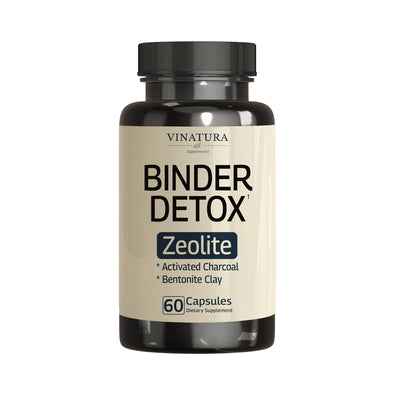
Binder Detox lists 200 mg calcium bentonite clay per 2-capsule serving, with 400 mg clinoptilolite zeolite, 300 mg activated charcoal powder, a 200 mg blend of apple pectin, diatomaceous earth and fulvic acid (as shilajit), and 75 mcg molybdenum. The page does not specify the clay's montmorillonite content or particle size. The studies above did not test this product, and none tested this combination.
Frequently asked questions
Is bentonite the same as montmorillonite? Not exactly. Bentonite is a clay rock; montmorillonite is the mineral that usually makes up most of it. Products differ in purity, other minerals and contaminants.
How much clay did studies use? Aflatoxin trials used 1.5 to 3 g a day for up to 3 months in adults, and 0.75 to 1.5 g a day in children. These are study amounts, not recommendations. Follow your product label and ask a healthcare professional.
Can I take bentonite with my medicines? Clay can reduce how much of a medicine is absorbed, even when taken 2 hours later in one study. Ask a pharmacist before combining them.
Is bentonite safe in pregnancy? It has not been studied in pregnancy. Pregnant women were excluded from the trials, and health agencies have warned pregnant and breastfeeding women about lead in clay products.
References
- Wang JS, et al. Short-term safety evaluation of processed calcium montmorillonite clay (NovaSil) in humans. Food Addit Contam. 2005;22(3):270-279. doi:10.1080/02652030500111129
- Afriyie-Gyawu E, et al. NovaSil clay intervention in Ghanaians at high risk for aflatoxicosis. I. Study design and clinical outcomes. Food Addit Contam Part A Chem Anal Control Expo Risk Assess. 2008;25(1):76-87. doi:10.1080/02652030701458105
- Wang P, et al. NovaSil clay intervention in Ghanaians at high risk for aflatoxicosis: II. Reduction in biomarkers of aflatoxin exposure in blood and urine. Food Addit Contam Part A Chem Anal Control Expo Risk Assess. 2008;25(5):622-634. doi:10.1080/02652030701598694
- Afriyie-Gyawu E, et al. NovaSil clay does not affect the concentrations of vitamins A and E and nutrient minerals in serum samples from Ghanaians at high risk for aflatoxicosis. Food Addit Contam Part A Chem Anal Control Expo Risk Assess. 2008;25(7):872-884. doi:10.1080/02652030701854758
- Robinson A, et al. Calcium montmorillonite clay reduces urinary biomarkers of fumonisin B1 exposure in rats and humans. Food Addit Contam Part A Chem Anal Control Expo Risk Assess. 2012;29(5):809-818. doi:10.1080/19440049.2011.651628
- Pollock BH, et al. Intervention trial with calcium montmorillonite clay in a south Texas population exposed to aflatoxin. Food Addit Contam Part A Chem Anal Control Expo Risk Assess. 2016;33(8):1346-1354. doi:10.1080/19440049.2016.1198498
- Mitchell NJ, et al. Short-term safety and efficacy of calcium montmorillonite clay (UPSN) in children. Am J Trop Med Hyg. 2014;91(4):777-785. doi:10.4269/ajtmh.14-0093
- Kumi J, et al. Safety and efficacy of Novasil clay (calcium montmorillonite) in children exposed to aflatoxin in Ejura-Sekyedumase District in Ghana. Glob Pediatr Health. 2022;9:2333794X221121243. doi:10.1177/2333794X221121243
- Awuor AO, et al. Evaluation of the efficacy, acceptability and palatability of calcium montmorillonite clay used to reduce aflatoxin B1 dietary exposure in a crossover study in Kenya. Food Addit Contam Part A Chem Anal Control Expo Risk Assess. 2017;34(1):93-102. doi:10.1080/19440049.2016.1224933
- Marroquín-Cardona A, et al. Characterization and safety of uniform particle size NovaSil clay as a potential aflatoxin enterosorbent. Appl Clay Sci. 2011;54(3-4):248-257. doi:10.1016/j.clay.2011.09.009
- Afriyie-Gyawu E, et al. Chronic toxicological evaluation of dietary NovaSil clay in Sprague-Dawley rats. Food Addit Contam. 2005;22(3):259-269. doi:10.1080/02652030500110758
- Phillips TD, et al. NovaSil clay for the protection of humans and animals from aflatoxins and other contaminants. Clays Clay Miner. 2019;67(1):99-110. doi:10.1007/s42860-019-0008-x
- Pérez-Gaxiola G, et al. Smectite for acute infectious diarrhoea in children. Cochrane Database Syst Rev. 2018;4(4):CD011526. doi:10.1002/14651858.CD011526.pub2
- Das RR, Sankar J, Naik SS. Efficacy and safety of diosmectite in acute childhood diarrhoea: a meta-analysis. Arch Dis Child. 2015;100(7):704-712. doi:10.1136/archdischild-2014-307632
- Guarino A, et al. European Society for Pediatric Gastroenterology, Hepatology, and Nutrition/European Society for Pediatric Infectious Diseases evidence-based guidelines for the management of acute gastroenteritis in children in Europe: update 2014. J Pediatr Gastroenterol Nutr. 2014;59(1):132-152. doi:10.1097/MPG.0000000000000375
- Hombrink J, et al. Prevention of radiation-induced diarrhea by smectite. Results of a double-blind randomized, placebo-controlled multicenter study [in German]. Strahlenther Onkol. 2000;176(4):173-179. doi:10.1007/s000660050053
- Wang Y, et al. Evaluation of the pharmacokinetic interactions of montmorillonite powder or loperamide on pyrotinib in healthy volunteers. Front Pharmacol. 2025;16:1563556. doi:10.3389/fphar.2025.1563556
- Albengres E, et al. Interactions between smectite, a mucus stabilizer, and acidic and basic drugs. In vitro and in vivo studies. Eur J Clin Pharmacol. 1985;28(5):601-605. doi:10.1007/BF00544074
- Vofo BN, et al. High umbilical cord blood lead levels and "calabar chalk" consumption amongst pregnant women in two hospitals in Cameroon. Pan Afr Med J. 2019;33:109. doi:10.11604/pamj.2019.33.109.13999
- Trim A, et al. Blood lead levels ≥ 45 mcg/dL in pregnancy: an observational study. BJOG. 2026;133(8):1652-1657. doi:10.1111/1471-0528.70220
- U.S. Food and Drug Administration. Drug safety page warning consumers not to use a bentonite clay powder sold online, after FDA testing found elevated lead (the official title names the product). March 23, 2016. fda.gov
- U.S. Food and Drug Administration. Drug safety page warning consumers about a bentonite clay product labeled for ingestion and skin use, after FDA testing found elevated lead (the official title names the brand). Content current as of January 29, 2016 (date on FDA's Spanish version of the page). fda.gov
- U.S. Code of Federal Regulations. 21 CFR 184.1155, Bentonite. Accessed November 16, 2026. law.cornell.edu
- European Union. Commission Implementing Regulation (EU) No 1060/2013 of 29 October 2013 concerning the authorisation of bentonite as a feed additive for all animal species. OJ L 289, 31.10.2013, p. 33. eur-lex.europa.eu
- Agence nationale de sécurité du médicament et des produits de santé (ANSM). Médicaments à base d'argile dans le traitement symptomatique de la diarrhée aiguë chez l'enfant. February 28, 2019; updated March 16, 2021. ansm.sante.fr
- Base de données publique des médicaments. Summary of product characteristics for a 3 g diosmectite powder for oral suspension (the French reference diosmectite medicine; the official title names the brand). Updated April 22, 2025. base-donnees-publique.medicaments.gouv.fr
- Public Health England. Alert issued to pregnant women in London following reports of toxic 'antidote' to morning sickness. July 12, 2013. gov.uk
- Centers for Disease Control and Prevention. Lead and Breastfeeding. Last reviewed January 27, 2025. cdc.gov
- California Office of Environmental Health Hazard Assessment. Lead and lead compounds (Proposition 65 fact sheet). Updated February 2018. p65warnings.ca.gov
- California Office of the Attorney General. Proposition 65 60-day notice 2025-04521 (bentonite clay, lead). September 25, 2025. oag.ca.gov
- ClinicalTrials.gov. Search of the intervention field for montmorillonite, bentonite, NovaSil or ACCS100. Accessed November 16, 2026. clinicaltrials.gov
Editorial note: This article reviews published research for educational purposes. It does not establish the effects or safety of any specific supplement, including Vinatura products, and is not medical advice. Written by Vinatura Editorial Team. Last reviewed November 2026.
Author
Product Disclaimer
Including an ingredient or study does not evaluate, endorse, or recommend any Vinatura product or any third-party product. Some ingredients discussed may not be used in any Vinatura product.
The content of the articles has not been evaluated by the Food and Drug Administration (FDA) and is not intended to promote or endorse any specific product. Any products sold on this website are not intended to diagnose, treat, cure, or prevent any disease.
Opinions and Endorsements
Any claims, statements, or opinions expressed in the articles are those of the author(s) and do not necessarily reflect the views or opinions of the manufacturers of the dietary supplement products. The products sold on this website are separate from the content of the articles and are not directly endorsed or associated with the information presented here.
Liability Disclaimer
The author(s) of the articles, website, and manufacturers of the dietary supplement products do not assume any liability for any potential consequences arising from the use of the information provided in the articles. Ingredient effects, dosages, and safety vary by individual, formulation, and context; some ingredients interact with medications or may be unsuitable during pregnancy or lactation. It is recommended that individuals consult with a qualified healthcare professional before making any dietary or lifestyle changes, including the use of dietary supplements.
Product Usage
Please refer to the product labels and packaging for specific usage instructions and guidelines for the dietary supplement products sold on this website.
Customer Support
For any concerns or questions regarding the dietary supplement products, please contact our customer support team, who will be more than happy to assist you.


Leave a Comment
Be the first to comment.
What do you think?