

Creatine Monohydrate: Research on Muscle, Memory, Kidneys and Hair
Quick answer. Creatine is a compound the body makes from amino acids and stores mostly in muscle; most research uses creatine monohydrate. In meta-analyses of randomized trials, adults who took creatine during resistance training gained more strength and about 1 kg more lean mass than with training alone, but part of that is likely water, and results were weaker in women and older adults. For memory and thinking, the European Food Safety Authority (EFSA) concluded in 2024 that a cause-and-effect relationship has not been established. Creatine raises blood creatinine, which can make a routine kidney test look worse, while small 12-week trials found no change in directly measured filtration; people with kidney disease have barely been studied. A 2025 trial found no effect on DHT or hair, but it skipped the high-dose loading phase of the 2009 study behind the hair-loss concern.
What creatine is
The liver and kidneys make about 1 g of creatine a day from the amino acids glycine, arginine and methionine, and beef and salmon each supply about 2 g per pound, according to the NIH Office of Dietary Supplements (ODS). About 95% of the body's creatine is in skeletal muscle, partly stored as phosphocreatine, which helps rebuild ATP, the cell's energy molecule, during short, hard efforts. About 1% to 2% of muscle creatine breaks down each day into creatinine, a waste product the kidneys clear.
Creatine monohydrate is creatine bound to one water molecule; it is 87.9% creatine by weight, so 5 g supplies about 4.4 g of creatine. Creapure is a branded monohydrate made by AlzChem in Germany. A 2021 review by researchers linked to the International Society of Sports Nutrition (ISSN) found no published evidence that other forms, such as creatine salts (including HCl), ethyl ester or buffered creatine, raise muscle creatine more than the monohydrate; two small trials comparing HCl with monohydrate since then disagree. Trials that paired creatine with HMB are covered in our review of HMB research.
What human studies have tested
| Study | Who took part | Form and daily amount | Duration | What was measured | Result |
|---|---|---|---|---|---|
| Desai et al., 2024 (meta-analysis, 12 studies, preregistered) | Adults under 50 doing resistance training | Creatine vs training alone | Varied | Lean mass, body fat | Lean mass +1.14 kg; fat mass −0.73 kg |
| Wang et al., 2024 (meta-analysis, 23 studies) | Adults under 50: 447 men, 40 women, 22 in a mixed study | Creatine with resistance training vs placebo | Varied | Upper- and lower-body strength | Upper body +4.43 kg, lower body +11.35 kg; significant in men, not in women |
| Delpino et al., 2022 (meta-analysis, 35 RCTs) | 1,192 adults without disease | Creatine with or without exercise | Varied | Lean mass | +1.10 kg with resistance training; no effect without exercise; men +1.46 kg, women +0.29 kg (not significant) |
| Burke et al., 2023 (meta-analysis, 10 RCTs) | Healthy adults | Creatine with resistance training | 6 weeks or more | Muscle size by MRI, CT or ultrasound | Very small effect (standardized 0.11; 95% credible interval −0.02 to 0.25); muscle thickness +0.10 to 0.16 cm |
| Chilibeck et al., 2017 (meta-analysis, 22 RCTs) | 721 older adults, mean age 57 to 70 | Creatine with resistance training | 7 to 52 weeks | Lean mass, chest and leg press | Lean mass +1.37 kg; small strength gains |
| Yao et al., 2026 (meta-analysis, 11 RCTs) | Adults 60 and older | Creatine with resistance training | Varied | Strength, muscle mass, function | Small strength gain (moderate certainty); muscle mass and function not significant (low and very low certainty) |
| Naddafha et al., 2026 (meta-analysis, 7 RCTs) | 608 postmenopausal women | Creatine with or without resistance training | 12 to 104 weeks | Lean mass, strength, bone density | Lean mass +0.37 kg; leg press +7.5 kg; bone unchanged; effects with 5 g or more plus training, none with 3 g or less without training |
| Rae et al., 2003 (crossover RCT) | 45 young vegetarians | 5 g | 6 weeks | Working memory, reasoning | Large improvements on both tests |
| Sandkühler et al., 2023 (preregistered crossover RCT) | 123 adults, about half vegetarian | 5 g (Creapure) | 6 weeks per phase | Same two tests plus 8 others | Neither main test reached significance (working memory borderline, p = 0.064); Bayesian analysis suggested a small benefit, far below the 2003 effect; no effect on the other tests; vegetarians did not benefit more; side effects reported about 4 times as often with creatine |
| van der Merwe et al., 2009 (crossover RCT) | 20 male college rugby players | 25 g for 7 days, then 5 g for 14 days | 3 weeks | Testosterone, DHT | DHT +56% after loading, +40% at the end; testosterone unchanged; hair not measured |
| Lak et al., 2025 (RCT, double-blind) | 38 resistance-trained men aged 18 to 40 completed | 5 g, no loading phase | 12 weeks | Testosterone, DHT, hair density, follicle counts, thickness | No difference from placebo in any hormone or hair measure |
| Lugaresi et al., 2013 (RCT, double-blind) | 26 resistance-trained men on high-protein diets analyzed (46 randomized) | 20 g for 5 days, then 5 g | 12 weeks | Kidney filtration measured with a tracer | No difference from placebo |
| Tsiaras et al., 2026 (meta-analysis, 20 randomized studies) | Mixed groups | Various | Under and over 1 month | Serum creatinine, urea, estimated filtration (eGFR) | Creatinine +0.13 mg/dL; no significant difference in urea (12 trials) or eGFR (8 trials, wide confidence interval) |
| Ostojic and Ahmetovic, 2008 (RCT) | 59 male soccer players | One 10 g dose, two 5 g doses, or placebo | 28 days | Stomach and bowel symptoms | Diarrhea in 55.6% with one 10 g dose, 28.6% with two 5 g doses, 35.0% with placebo |
RCT = randomized controlled trial. DHT = dihydrotestosterone, a hormone made from testosterone. eGFR = kidney filtration estimated from blood creatinine.
What the findings suggest
Strength and lean mass in younger adults: consistent, modest in size. Adults who took creatine during resistance training gained more strength than those on placebo and about 1.1 kg more lean mass, and a 2025 analysis of 61 trials found lean-mass gains in both new and experienced lifters. Those lean-mass figures come from whole-body methods; trials that imaged muscle directly found a very small effect whose credible interval included zero. Without exercise, lean mass did not change.
Older adults: smaller gains, mostly in strength. A 2017 meta-analysis of 22 trials found more lean mass and strength, but a 2026 analysis limited to people 60 and older found a small strength gain and no significant effect on muscle mass or function. In older women, upper-body strength rose, and lower-body strength rose only in trials of 24 weeks or more; in postmenopausal women, small gains appeared with at least 5 g a day plus training. EFSA concluded in 2016 that creatine with resistance training improves muscle strength in adults over 55, and the European Union authorized that claim in 2017 (3 g a day, training at least three times a week); AlzChem was the applicant.
Memory and thinking: inconsistent. A 2003 trial in 45 young vegetarians reported large gains on a working-memory test and a reasoning test. A larger, preregistered 2023 trial in 123 adults used the same dose and tests: neither main result reached statistical significance (working memory was borderline), and the authors concluded that any benefit is likely small. A 2023 meta-analysis found better memory in adults 66 to 76 but not in younger people; critics argued it counted related tests from the same people more than once, and a 2026 commentary reports that after reanalysis only the older-adult effect remained. Reviewing an AlzChem application in 2024, EFSA noted that working-memory effects seen at 20 g a day for 5 to 7 days did not appear at lower doses or with longer use, and concluded that a cause-and-effect relationship has not been established.
Hair and DHT: one direct test, with a different protocol. In 2009, DHT rose 56% during a 25 g-a-day loading week and was still 40% above baseline after two more weeks at 5 g a day; values stayed within normal limits, and hair was not measured. The 2025 trial, the first to measure hair, used 5 g a day without loading for 12 weeks and found no difference from placebo in DHT, testosterone or hair measures assessed by dermatologists. Its authors suggest the missing loading phase and the longer duration may explain the difference.
Kidney tests: creatinine rises; measured filtration did not change in short trials. The 2026 meta-analysis found higher serum creatinine but no significant difference in urea or estimated filtration. Three 12-week randomized trials from one Brazilian research group measured filtration directly with a tracer, in resistance-trained men on high-protein diets, postmenopausal women and adults with type 2 diabetes, and found no change. A 21-month open-label study of 98 college football players found no differences in 69 blood and urine markers.
Where the evidence is limited or conflicting
- Water versus muscle. Whole-body lean-mass measures include water, and the 2023 analysis found only 10 trials that imaged muscle directly.
- Women are underrepresented. In the 2024 strength meta-analysis, 2 of 23 studies enrolled only women, and several analyses found no significant effect in women.
- Null results. In 30 men with prostate cancer on hormone therapy, creatine added nothing to 12 weeks of resistance training. In 67 children aged 10 to 12, a week of creatine changed no cognitive test.
- Short trials. Few randomized trials last more than a year; the 2013 kidney trial was planned for 12 months and cut to 12 weeks after many dropouts.
- Industry ties. Support to prepare the 2017 ISSN position stand came from the Council for Responsible Nutrition, a supplement industry trade group. Five of the 11 authors of the 2021 review, which recommends German-sourced creatine, disclosed seats on AlzChem's scientific advisory board. In the 2025 hair trial, one author disclosed advising Creapure and other brands, and another disclosed creatine donations from Creapure.
What buyers say, and what the research shows
Our team read about 1,900 public Amazon reviews of 11 creatine, HMB and creatine-plus-HMB products, including our own, collected in September 2026. The counts below are numbers of other brands' listings; a theme counts as common on a listing when it made up at least 10% of the weighted mentions in its reviews, or in its critical reviews for complaints. Reviews show what buyers believe or report; they cannot show whether a product caused any change.
Belief: creatine builds strength. Strength was a common reason for buying on all 6 creatine-plus-HMB powders. Trials agree, but gains required resistance training and were most consistent in younger men.
Belief: creatine sharpens focus. A theme combining energy, focus and brain was a common reason for buying on 3 of the 6 powders. The 2023 trial did not reproduce the large 2003 result, and EFSA found the evidence insufficient.
Belief: creatine causes bloating or stomach upset. This was a common complaint on 3 of the 6 powders and on 1 of the 2 plain creatines. In trials, diarrhea was more frequent when soccer players took 10 g at once than two 5 g doses, and pooled studies of women found no more stomach and bowel complaints than with placebo.
Belief: creatine that doesn't fully dissolve is defective. Mixing complaints were common on 5 of the 6 powders and on both plain creatines. Creatine monohydrate dissolves at only about 14 g per liter at 20°C (68°F), so by our calculation 5 g needs about 360 mL (12 fl oz) of room-temperature water to dissolve fully; warmer water dissolves more, and a 2021 review states that solubility does not affect uptake into tissue. Even the creatine used in the 2023 memory trial slowly settled in water.
Belief: creatine causes headaches, allergic reactions or kidney problems. A theme grouping these three was the largest critical theme on the one creatine HCl capsule and was common on 1 of the 6 powders; the data cannot separate kidney worries from the other two. In healthy adults, trials found higher blood creatinine but unchanged measured filtration; people with kidney disease were rarely studied.
Safety
Side effects in trials. The ISSN describes weight gain as the only consistently reported side effect. ODS reports gains of 1 to 2 kg in a month in people who strength train, attributes them to water retention and possibly more muscle protein building, and calls reports of nausea, diarrhea, cramps and heat intolerance anecdotal. In the 2023 memory trial, side effects were reported about four times as often on creatine, though no one stopped because of them, while a 2020 pooled analysis of 29 studies in women (951 participants) found no difference from placebo in adverse events, weight gain, or kidney and liver markers.
Kidney tests. In a man with a single kidney, 35 days of creatine raised serum creatinine from 1.03 to 1.27 mg/dL while filtration measured with a tracer did not change, so tell your doctor you take creatine before kidney blood tests. The kidney case reports we screened involved pre-existing kidney disease (including the 1998 report often cited as the origin of the concern), several supplements at once, muscle breakdown during illness or after surgery, or creatinine rises without kidney damage. A few other case reports describe blood clots in people taking creatine, one linked by its authors to high doses and dehydration; case reports cannot show cause.
Who should be careful. Health Canada's monograph covers adults 18 and older and tells people who are pregnant, breastfeeding or have kidney disease to consult a healthcare practitioner first. A 2014 Cochrane review found no randomized trials of creatine in pregnancy, and our searches found none since. In the one randomized trial in bipolar depression included in a 2026 review, 2 of 17 people taking 6 g a day switched to hypomania or mania, so people with bipolar disorder should involve their psychiatrist.
Medicines and upper limits. We found no controlled studies of interactions between creatine and medicines, and none of the 40 case reports we screened described an interaction with a specific drug, but that does not rule interactions out; ask a pharmacist if you take medicines that affect the kidneys. We found no official upper intake level from NIH, EFSA or Health Canada. The industry-supported ISSN position stand states that up to 30 g a day for 5 years has been safe and well tolerated in healthy people and several patient groups.
What research does not establish
- That creatine improves memory or thinking in healthy adults.
- That creatine causes, or does not cause, hair loss over the long term, in women, or with a loading phase.
- That creatine is safe for people with kidney disease or during pregnancy.
- That creatine HCl, ethyl ester or other forms work better than the monohydrate.
- That creatine builds muscle without resistance training.
How we reviewed the evidence
On October 25, 2026, we searched PubMed for meta-analyses of creatine and resistance training (39 records, screened by title), reviews of creatine and cognition (13), trials of creatine and hair or androgens (11), kidney meta-analyses (6) and trials that measured kidney filtration directly, case reports and interaction studies (40, all screened), creatine in pregnancy (72; the 40 most recent screened) and comparisons of forms. We read the abstracts of all cited studies, the full texts and disclosure statements of key papers, the ODS fact sheet, Health Canada's monograph, both EFSA opinions, EU Regulation 2017/672 and ClinicalTrials.gov records. We excluded a 2019 kidney meta-analysis whose abstract contradicts its own statistics, a 2025 kidney meta-analysis with inconsistent units, and multi-ingredient products. We did not screen every result formally. Buyer beliefs come from our team's September 2026 review analysis. Vinatura did not run any trials of creatine.
Vinatura Research Perspective
We asked four questions of the creatine research: which form and daily amount were tested, whether people also did resistance training, whether muscle was imaged directly or estimated from whole-body methods, and who wrote or funded the evidence summaries. The strength evidence holds up; several popular claims rest on weaker ground. The roughly 1 kg of extra lean mass measured with whole-body methods is not matched when muscle is imaged directly, which fits creatine's known effect on muscle water. Researchers who disclosed AlzChem advisory roles in the 2021 review also co-wrote several of the meta-analyses we cite, including those in older adults, women and memory, so EFSA is a useful independent check: assessing two applications from AlzChem companies, it supported the strength claim for adults over 55 who train and found the cognition evidence insufficient. On hair, the 2025 trial was not a repeat of the 2009 study, and a 6-month DHT and hair trial planned for 2020, with a supplement company as collaborator, was withdrawn before enrolling anyone. On kidneys, the randomized trials that measured filtration directly were small, lasted 12 weeks and came from one research group.
Our assessment: strong evidence that creatine taken with resistance training increases strength and lean mass in adults under 50, especially men; moderate evidence for a small strength gain in older adults who train; insufficient and conflicting evidence for memory and thinking in healthy people; and no sign of kidney harm in healthy adults over the periods studied, with little data for people with kidney disease. Four things would change this view: a large, independently funded trial in women or older adults that images muscle directly and tracks function; results from registered trials in mild cognitive impairment, such as a 140-person, 26-week trial at Western University in Canada that was recruiting in October 2026; a hair trial that includes a loading phase and lasts at least 6 months; and multi-year trials with measured kidney filtration, including in people with kidney disease.
Where this ingredient appears in Vinatura products
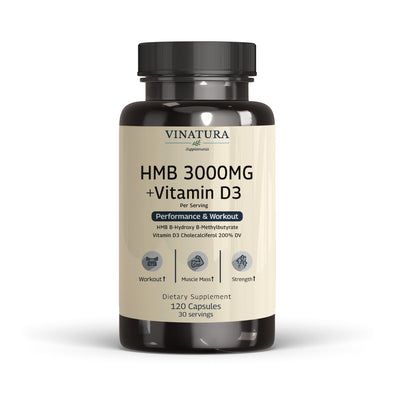
HMB Leucine Creatine Powder with Vitamin D3 contains 5 g creatine monohydrate per serving (one 15.5 g scoop), with 3 g calcium HMB (myHMB®) providing 390 mg calcium, 3 g L-leucine and 40 mcg (1,600 IU) vitamin D3, in 30 servings; the product page states it is NSF Contents Certified. The studies above did not test this product or this combination of ingredients.
Frequently asked questions
Is a loading phase needed? About 20 g a day for 5 to 7 days fills muscle stores fastest, according to the ISSN, while about 3 g a day for 28 days raises them more gradually. These are study amounts, not recommendations; follow your product label and ask a healthcare professional if you have a medical condition.
Is creatine a steroid? No. The body makes creatine from amino acids, while anabolic steroids are drugs with a different chemical structure and are controlled substances in the United States. In the 2009 and 2025 trials, testosterone did not change differently with creatine than with placebo.
Does creatine work for women? The evidence is thinner: few trials enrolled only women, and effects were smaller or not significant in several meta-analyses.
References
- NIH Office of Dietary Supplements. Dietary Supplements for Exercise and Athletic Performance: Fact Sheet for Health Professionals. Accessed October 25, 2026. ods.od.nih.gov
- Kreider RB, et al. International Society of Sports Nutrition position stand: safety and efficacy of creatine supplementation in exercise, sport, and medicine. J Int Soc Sports Nutr. 2017;14:18. doi:10.1186/s12970-017-0173-z
- Antonio J, et al. Common questions and misconceptions about creatine supplementation: what does the scientific evidence really show? J Int Soc Sports Nutr. 2021;18(1):13. doi:10.1186/s12970-021-00412-w
- Health Canada. Natural Health Products Ingredients Database: Creatine monohydrate monograph. Page dated February 24, 2023; accessed October 25, 2026. webprod.hc-sc.gc.ca
- EFSA Panel on Dietetic Products, Nutrition and Allergies. Creatine in combination with resistance training and improvement in muscle strength: evaluation of a health claim pursuant to Article 13(5) of Regulation (EC) No 1924/2006. EFSA Journal. 2016;14(2):4400. efsa.europa.eu
- European Commission. Commission Implementing Regulation (EU) 2017/672 of 7 April 2017 authorising a health claim made on foods, other than those referring to the reduction of disease risk and to children's development and health. Official Journal of the European Union. April 8, 2017. legislation.gov.uk
- EFSA Panel on Nutrition, Novel Foods and Food Allergens, et al. Creatine and improvement in cognitive function: evaluation of a health claim pursuant to article 13(5) of regulation (EC) No 1924/2006. EFSA J. 2024;22(11):e9100. doi:10.2903/j.efsa.2024.9100
- Desai I, et al. The effect of creatine supplementation on resistance training-based changes to body composition: a systematic review and meta-analysis. J Strength Cond Res. 2024;38(10):1813–1821. doi:10.1519/JSC.0000000000004862
- Wang Z, et al. Effects of creatine supplementation and resistance training on muscle strength gains in adults <50 years of age: a systematic review and meta-analysis. Nutrients. 2024;16(21):3665. doi:10.3390/nu16213665
- Delpino FM, et al. Influence of age, sex, and type of exercise on the efficacy of creatine supplementation on lean body mass: a systematic review and meta-analysis of randomized clinical trials. Nutrition. 2022;103–104:111791. doi:10.1016/j.nut.2022.111791
- Burke R, et al. The effects of creatine supplementation combined with resistance training on regional measures of muscle hypertrophy: a systematic review with meta-analysis. Nutrients. 2023;15(9):2116. doi:10.3390/nu15092116
- Ashtary-Larky D, et al. Creatine supplementation and resistance training: a comparison between novice and experienced lifters — a systematic review and dose-response meta-analysis. J Int Soc Sports Nutr. 2025;22(sup1):2586523. doi:10.1080/15502783.2025.2586523
- Chilibeck PD, et al. Effect of creatine supplementation during resistance training on lean tissue mass and muscular strength in older adults: a meta-analysis. Open Access J Sports Med. 2017;8:213–226. doi:10.2147/OAJSM.S123529
- Yao L, et al. Effects of resistance training combined with creatine supplementation on muscle strength, physical function, and muscle mass in older adults: a systematic review and three-level meta-analysis. Front Nutr. 2026;13:1919884. doi:10.3389/fnut.2026.1919884
- Dos Santos EEP, et al. Efficacy of creatine supplementation combined with resistance training on muscle strength and muscle mass in older females: a systematic review and meta-analysis. Nutrients. 2021;13(11):3757. doi:10.3390/nu13113757
- Naddafha S, et al. Creatine monohydrate for lean mass, strength, and bone density in postmenopausal women: a systematic review and meta-analysis. J Int Soc Sports Nutr. 2026;23(1):2668435. doi:10.1080/15502783.2026.2668435
- Fairman CM, et al. Creatine supplementation does not add to resistance training effects in prostate cancer patients under androgen deprivation therapy: a double-blind randomized trial. J Sci Med Sport. 2025;28(2):118–124. doi:10.1016/j.jsams.2024.09.002
- Rae C, et al. Oral creatine monohydrate supplementation improves brain performance: a double-blind, placebo-controlled, cross-over trial. Proc Biol Sci. 2003;270(1529):2147–2150. doi:10.1098/rspb.2003.2492
- Sandkühler JF, et al. The effects of creatine supplementation on cognitive performance — a randomised controlled study. BMC Med. 2023;21(1):440. doi:10.1186/s12916-023-03146-5
- Prokopidis K, et al. Effects of creatine supplementation on memory in healthy individuals: a systematic review and meta-analysis of randomized controlled trials. Nutr Rev. 2023;81(4):416–427. doi:10.1093/nutrit/nuac064
- Eckert I, Pascher E. Letter to the Editor: Double-counting due to inadequate statistics leads to false-positive findings in "Effects of creatine supplementation on memory in healthy individuals". Nutr Rev. 2023;81(11):1495–1496. doi:10.1093/nutrit/nuac108
- Citherlet T. Commentary: The effects of creatine supplementation on cognitive function in adults: a systematic review and meta-analysis. Front Nutr. 2026;13:1716285. doi:10.3389/fnut.2026.1716285
- Merege-Filho CAA, et al. Does brain creatine content rely on exogenous creatine in healthy youth? A proof-of-principle study. Appl Physiol Nutr Metab. 2017;42(2):128–134. doi:10.1139/apnm-2016-0406
- van der Merwe J, et al. Three weeks of creatine monohydrate supplementation affects dihydrotestosterone to testosterone ratio in college-aged rugby players. Clin J Sport Med. 2009;19(5):399–404. doi:10.1097/JSM.0b013e3181b8b52f
- Lak M, et al. Does creatine cause hair loss? A 12-week randomized controlled trial. J Int Soc Sports Nutr. 2025;22(sup1):2495229. doi:10.1080/15502783.2025.2495229
- ClinicalTrials.gov. NCT04298840: Influence of creatine monohydrate supplementation on androgens and global hair assessments (sponsor: Texas Tech University; status: withdrawn, 0 enrolled). Accessed October 25, 2026. clinicaltrials.gov
- ClinicalTrials.gov. NCT06948149: Examining the effects of creatine supplementation and resistance training on cognition and brain health in older adults with mild cognitive impairment (sponsor: Western University, Canada; status: recruiting). Accessed October 25, 2026. clinicaltrials.gov
- Tsiaras A, et al. The effect of creatine supplementation on kidney function: a systematic review and meta-analysis of randomized controlled trials. J Ren Nutr. 2026 [online ahead of print]. doi:10.1053/j.jrn.2026.04.010
- Lugaresi R, et al. Does long-term creatine supplementation impair kidney function in resistance-trained individuals consuming a high-protein diet? J Int Soc Sports Nutr. 2013;10(1):26. doi:10.1186/1550-2783-10-26
- Neves M, et al. Effect of creatine supplementation on measured glomerular filtration rate in postmenopausal women. Appl Physiol Nutr Metab. 2011;36(3):419–422. doi:10.1139/h11-014
- Gualano B, et al. Creatine supplementation does not impair kidney function in type 2 diabetic patients: a randomized, double-blind, placebo-controlled, clinical trial. Eur J Appl Physiol. 2011;111(5):749–756. doi:10.1007/s00421-010-1676-3
- Kreider RB, et al. Long-term creatine supplementation does not significantly affect clinical markers of health in athletes. Mol Cell Biochem. 2003;244(1–2):95–104. PubMed 12701816
- Gualano B, et al. Effect of short-term high-dose creatine supplementation on measured GFR in a young man with a single kidney. Am J Kidney Dis. 2010;55(3):e7–e9. doi:10.1053/j.ajkd.2009.10.053
- Pritchard NR, Kalra PA. Renal dysfunction accompanying oral creatine supplements. Lancet. 1998;351(9111):1252–1253. doi:10.1016/s0140-6736(05)79319-3
- Thorsteinsdottir B, et al. Acute renal failure in a young weight lifter taking multiple food supplements, including creatine monohydrate. J Ren Nutr. 2006;16(4):341–345. doi:10.1053/j.jrn.2006.04.025
- Williamson L, New D. How the use of creatine supplements can elevate serum creatinine in the absence of underlying kidney pathology. BMJ Case Rep. 2014;2014:bcr2014204754. doi:10.1136/bcr-2014-204754
- Tan CW, et al. Creatine supplementation and venous thrombotic events. Am J Med. 2014;127(8):e7–e8. doi:10.1016/j.amjmed.2014.04.008
- Lee SH, et al. A case of pulmonary thromboembolism possibly associated with the use of creatine supplements. Respirol Case Rep. 2022;10(4):e0932. doi:10.1002/rcr2.932
- Ostojic SM, Ahmetovic Z. Gastrointestinal distress after creatine supplementation in athletes: are side effects dose dependent? Res Sports Med. 2008;16(1):15–22. doi:10.1080/15438620701693280
- Dickinson H, et al. Creatine for women in pregnancy for neuroprotection of the fetus. Cochrane Database Syst Rev. 2014;(12):CD010846. doi:10.1002/14651858.CD010846.pub2
- de Guingand DL, et al. Risk of adverse outcomes in females taking oral creatine monohydrate: a systematic review and meta-analysis. Nutrients. 2020;12(6):1780. doi:10.3390/nu12061780
- Jeryous Fares B, et al. The effect of creatine monohydrate on mental disorders: a systematic review of randomized controlled trials. Can J Psychiatry. 2026;71(10):741–751. doi:10.1177/07067437251408171
- Eghbali E, et al. Supplementing with which form of creatine (hydrochloride or monohydrate) alongside resistance training can have more impacts on anabolic/catabolic hormones, strength and body composition? Physiol Res. 2024;73(5):739–753. doi:10.33549/physiolres.935323
- Duan C, et al. Creatine formulations and repeated sprint training: effects on physical and physiological adaptations in soccer players during the short-term preparation phase. J Int Soc Sports Nutr. 2026;23(sup1):2721147. doi:10.1080/15502783.2026.2721147
Editorial note: This article reviews published research for educational purposes. It does not establish the effects or safety of any specific supplement, including Vinatura products, and is not medical advice. Written by Vinatura Editorial Team. Last reviewed October 2026.
Author

Product Disclaimer
Including an ingredient or study does not evaluate, endorse, or recommend any Vinatura product or any third-party product. Some ingredients discussed may not be used in any Vinatura product.
The content of the articles has not been evaluated by the Food and Drug Administration (FDA) and is not intended to promote or endorse any specific product. Any products sold on this website are not intended to diagnose, treat, cure, or prevent any disease.
Opinions and Endorsements
Any claims, statements, or opinions expressed in the articles are those of the author(s) and do not necessarily reflect the views or opinions of the manufacturers of the dietary supplement products. The products sold on this website are separate from the content of the articles and are not directly endorsed or associated with the information presented here.
Liability Disclaimer
The author(s) of the articles, website, and manufacturers of the dietary supplement products do not assume any liability for any potential consequences arising from the use of the information provided in the articles. Ingredient effects, dosages, and safety vary by individual, formulation, and context; some ingredients interact with medications or may be unsuitable during pregnancy or lactation. It is recommended that individuals consult with a qualified healthcare professional before making any dietary or lifestyle changes, including the use of dietary supplements.
Product Usage
Please refer to the product labels and packaging for specific usage instructions and guidelines for the dietary supplement products sold on this website.
Customer Support
For any concerns or questions regarding the dietary supplement products, please contact our customer support team, who will be more than happy to assist you.


Leave a Comment
Be the first to comment.
What do you think?