

Sweet Wormwood (Artemisia annua): Human Studies and Liver Safety
Quick answer. Sweet wormwood (Artemisia annua) is a daisy-family herb whose leaves contain small, highly variable amounts of artemisinin, the compound behind today's artemisinin malaria drugs. Human studies of the plant itself are few and small: in malaria, parasites often came back after tea treatment, and single trials in joint pain, rheumatoid arthritis and HIV are too limited to establish a benefit. We found no published human trial for digestion or gut health. The main safety concern is the liver: regulators acted on liver injury reports with one sweet wormwood extract, and case reports link the tea and artemisinin supplements to liver injury. Anyone with liver disease, who is pregnant or who takes prescription medicine should ask a doctor first.
What sweet wormwood is
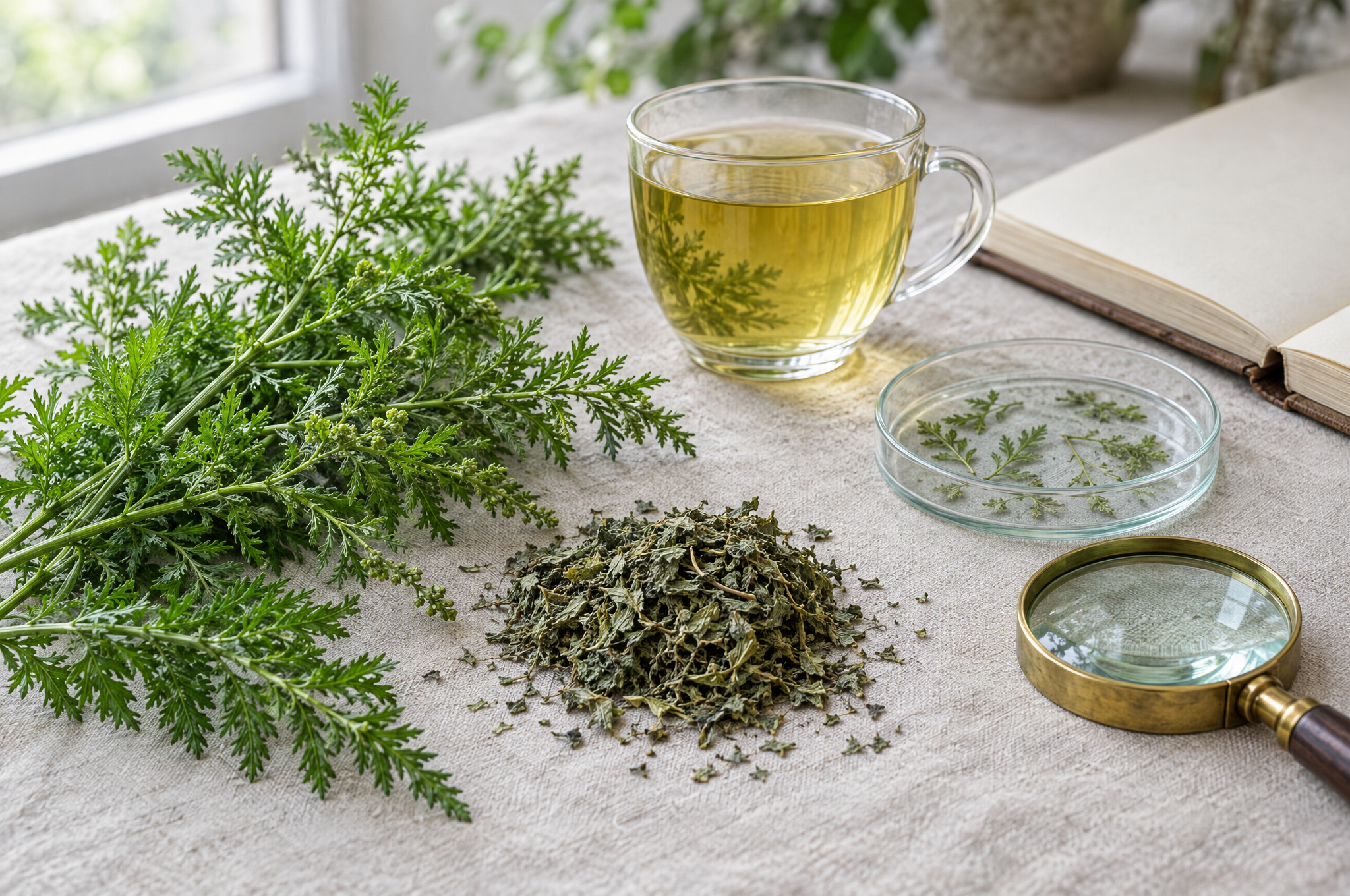
Sweet wormwood, also called sweet Annie, annual wormwood and qing hao, is an annual daisy-family herb native to China. It is a different species from wormwood (Artemisia absinthium), the bitter herb in absinthe; our article Sweet wormwood vs wormwood compares the two.
Artemisinin was first isolated and tested in China in the 1970s, and Youyou Tu shared the 2015 Nobel Prize in Physiology or Medicine "for her discoveries concerning a novel therapy against Malaria." Malaria medicines pair a measured dose of an artemisinin derivative, such as artesunate, with a second drug. The leaf has no fixed dose: a 2019 background document prepared for WHO's Malaria Policy Advisory Committee (not an official WHO publication) cited 0.02% to 1.07% artemisinin by dry weight in wild plants, and 8 to 117 mg per liter in teas from 5 or 9 g of hybrid leaves. The leaf also contains arteannuin B, flavonoids and an essential oil.
Products include leaf powder, tea, extracts (such as a supercritical carbon dioxide, or CO₂, extract sold for joint health in New Zealand) and purified artemisinin. Results from one form do not automatically apply to another.
What human studies have tested
The table covers sweet wormwood preparations, not artemisinin drugs. "WHO committee document" marks figures taken from that 2019 document because the full paper was unavailable to us.
| Study | Who took part | Form and daily amount | Duration | What was measured | Result |
|---|---|---|---|---|---|
| Räth et al., 2004 (pharmacokinetic study, no control group) | 14 healthy men | 1 liter of tea from 9 g dried leaves (94.5 mg artemisinin), once | 1 day | Artemisinin in blood | Peak 240 ng/mL, from about 19% of a daily drug dose. Authors: enough for clinical effects, but no substitute for the drugs |
| Mueller et al., 2004 (open-label randomized pilot; eastern DR Congo) | 132 patients with uncomplicated malaria | 1 liter a day of tea from 5 g or 9 g leaves (about 47 or 94 mg artemisinin), vs quinine | 7 days | Cure, return of parasites | Day-7 cure 74% vs 91%. By day 35, parasites back in 66% and 70% of the tea groups vs 21% (WHO committee document) |
| Blanke et al., 2008 (randomized, double-blind; Tanzania) | Semi-immune adults with uncomplicated malaria | Tea (5 g or 9 g leaf per liter, WHO committee document) vs sulfadoxine-pyrimethamine | 28 days | Cure | Day 7: 7 of 10 vs 7 of 9. Day 28: 1 of 9 vs 3 of 8. Stopped early as parasites returned in all groups (WHO committee document) |
| Ogwang et al., 2012 (randomized, placebo-controlled; Uganda) | 132 flower-farm workers | Tea once a week (amount not in the abstract), vs placebo | 9 months | Repeat malaria episodes | More than one episode: 12 of 67 vs 26 of 65. Only 84 followed up, and more bed-net use with tea (WHO committee document) |
| Stebbings et al., 2016 (randomized, placebo-controlled pilot; New Zealand) | 42 adults with hip or knee osteoarthritis | CO₂ extract (Arthrem), 150 or 300 mg twice a day, vs placebo | 12 weeks | Pain, stiffness, function | Better than baseline at the low dose only; no between-group test in the abstract. Two of four authors from the company that markets it. One high-dose hepatitis case, possibly related. In a 6-month open-label extension at 150 mg twice a day (Hunt et al., 2016; 28 of 34 finished), reported well tolerated; one withdrawal for raised liver enzymes, judged unrelated |
| Yang et al., 2017 (randomized, no placebo; China) | 159 adults with active rheumatoid arthritis | Extract "30 g/d" (preparation not described) plus methotrexate and leflunomide, vs the drugs alone | 48 weeks | Joints, pain, disability, side effects | Several measures better with the extract, fewer side effects. Abstract only |
| Twinomujuni et al., 2024 (randomized, double-blind, placebo-controlled; Uganda) | 282 adults with HIV on treatment, CD4 350 cells/µL or less; 248 finished | 4 g leaf powder a day, alone or with 10 g moringa, vs cornstarch placebo | 12 months | CD4, viral load, drug levels, liver and kidney tests | CD4 rose 60.8 cells/µL more than with placebo at 12 months, not at 6. Viral load fell significantly only with moringa. Efavirenz and nevirapine levels unchanged. Liver and kidney tests "not different" (data not shown) |
What the findings suggest
Malaria. Parasites cleared quickly but often returned. WHO "does not support the promotion or use of Artemisia plant material in any form for the prevention or treatment of malaria," citing variable artemisinin content, too little artemisinin to kill all parasites, and the risk of speeding drug resistance. The one prevention trial reported fewer repeat episodes with weekly tea, but follow-up was incomplete and bed-net use differed; a French traveler developed severe malaria despite regular tea. Evidence strength: consistent that the tea is not adequate treatment; weak for prevention.
Joint pain and rheumatoid arthritis. One small, company-linked pilot reported improvement at the lower dose only, and the rheumatoid arthritis trial had no placebo. Evidence strength: very limited.
HIV. One single-site trial, not yet repeated, found a larger CD4 rise at 12 months. Evidence strength: preliminary.
Digestion and gut health. PubMed searches on October 25, 2026 found no published human trial for digestion, gut symptoms or gut bacteria. A placebo-controlled safety trial of 5 g dried leaf a day in up to 32 adults with small intestinal bacterial overgrowth (SIBO) is still listed as recruiting, past its January 2026 completion date, with no results posted.
COVID-19 and cancer. Lab and animal studies report activity of extracts against the COVID-19 virus and cancer cells, which does not show effects in people. Two terminated COVID-19 trials (one, with 13 people, posted results on ClinicalTrials.gov) and two completed cancer trials of a sweet wormwood decaf coffee have no journal publication we could find; the only published cancer outcome is a single case.
Where the evidence is limited or conflicting
- Retracted trials. Two large tea trials, in malaria (957 enrolled, per the WHO committee document) and schistosomiasis, were retracted in 2020 at the editor-in-chief's request, over concerns about timely ethics approval, consent to publication and data reliability that the authors could not explain. The malaria trial was the only one we found reporting tea beating standard drugs.
- Uncontrolled reports. In a 2017 report, 18 people with drug-unresponsive severe malaria recovered on dried-leaf tablets (1 g a day for 5 days), with no comparison group or, the WHO committee document noted, further follow-up.
- Content and form. Artemisinin levels differ more than 50-fold between wild plants. In lab digestion models, one study found gelatin or cellulose capsules cut artemisinin release from dried leaf by more than half; a later study from the same group found four capsule types made no difference. Neither has been tested in people.
- Who ran the studies. Company staff co-wrote the osteoarthritis studies, and a company collaborates on both coffee trials. The HIV trial's collaborator and one co-author come from ANAMED, an aid group whose partners promote local use of sweet wormwood.
- Animal and lab results. In mice, whole dried leaf lowered parasites more than matched pure artemisinin and slowed resistance. In lab studies, leaf teas blocked two liver drug-processing enzymes; leaf compounds switched them on. Neither shows effects in people.
What buyers believe, and what the research shows
We have no review analysis for sweet wormwood. These beliefs come from our team's March 2026 market research (search and marketplace data).
Belief: 2 to 3 capsules a day for 2 to 4 weeks is the standard way to take it. Our research described this as the common community pattern. No study has tested capsules or any schedule, and a short course is no safety guarantee: in the New Zealand liver reports, 19 of 23 reactions with known timing began within 12 weeks, the earliest after 7 days. Follow your product label. Our article on taking clove, black walnut and wormwood together reviews common routines for the combination.
Belief: a sweet wormwood capsule is a way to take artemisinin. Our research identified buyers searching for an "artemisinin supplement." At 0.02% to 1.07% artemisinin, 300 mg of leaf would hold roughly 0.06 to 3.2 mg, or about 4 mg at the 1.4% measured in the Congo trial's leaf (our calculation). The tea in the 2004 pharmacokinetic study held 94.5 mg, itself about one-fifth of a daily drug dose.
Safety
In trials. The WHO committee document noted no adverse effects reported in the malaria tea studies; the prevention trial reported no serious ones, with bitter taste the most common complaint. HIV trial liver tests did not differ from placebo (data not shown); one of 14 people on the higher osteoarthritis extract dose developed hepatitis. These studies were too small to detect rare reactions.
Liver injury reports. By January 2019, New Zealand's pharmacovigilance center had 29 reports of liver problems in people aged 47 to 93 taking the CO₂ extract Arthrem, mostly for joint pain. Reviewers rated 12 as probably and 13 as possibly linked; 27 recovered or improved after stopping, and 8 or 9 were hospitalized (the paper gives both figures). Medsafe said the information "strongly suggests" the extract "may harm the liver in some people." Australia's TGA, with no Australian reports, issued a liver safety advisory in 2018, and in 2019 the sponsor cancelled the product's Australian registration. Health Canada said in 2021 it "could not confirm a link" from 4 Canadian reports and 61 poorly documented international cases.
Case reports. A 51-year-old man in Switzerland developed severe cholestatic hepatitis about 5 weeks after starting 1.25 g of sweet wormwood powder a day, mostly as tea, for malaria prevention; doctors rated the link probable. Other cases, including one described by the U.S. CDC in 2009, involved concentrated artemisinin products, at about 250 to 784 mg a day for 1 to 6 weeks where doses were reported; one patient needed plasma exchange. NIH's LiverTox links artemisinin derivatives to idiosyncratic liver injury. Case reports cannot prove cause. Stop and contact a doctor if you notice yellow skin or eyes, dark urine, pale stools, itching, nausea or stomach pain.
Pregnancy. Artemisinin drugs cause dose-dependent embryo death and damage in rats, rabbits and monkeys. A meta-analysis of 30,618 pregnancies found no higher miscarriage risk with first-trimester artemisinin malaria treatment than with quinine, but those were short drug courses, not ongoing herbal use. A survey of an aid group's partners counted about 54 first-trimester pregnancies among roughly 3,000 tea-treated cases, and two miscarriages. Australia's TGA requires listed medicines containing sweet wormwood to warn "Do not use if pregnant or likely to become pregnant."
Allergy. Sweet wormwood pollen is an important hay fever allergen in northern China; we found no study of reactions to the swallowed leaf in pollen-allergic people.
Medicines. In the HIV trial, with the leaf taken 8 hours apart from antiretroviral drugs, efavirenz and nevirapine levels did not change over 2 weeks. In 75 healthy adults given artemisinin drugs for 5 days, artemisinin changed the activity of liver enzymes that process medicines, including CYP3A and CYP2C19. The SIBO trial excludes people taking warfarin, tacrolimus or clopidogrel; we found no human data on sweet wormwood with them. Ask a pharmacist before combining it with prescription medicine.
Upper limits. We found no official upper intake level on the WHO, EMA, Medsafe, TGA, Health Canada or NIH pages we read.
What research does not establish
- That sweet wormwood benefits digestion, gut bacteria or immunity in healthy people.
- That sweet wormwood tea, powder or capsules prevent or treat malaria or any other infection.
- That results from artemisinin drugs, purified artemisinin or a CO₂ extract apply to leaf powder.
- How much artemisinin a given leaf capsule provides, or what amount is safe long term.
- That it is safe in pregnancy, in liver disease or with prescription medicines.
How we reviewed the evidence
On October 25, 2026, we searched PubMed for human studies of Artemisia annua leaf, tea, powder and extracts, and for studies on its artemisinin content, liver injury, pregnancy, allergy, interactions, digestion and COVID-19, screening about 210 records. We included human trials, case series, case reports and pharmacovigilance reviews, using animal and lab studies only for mechanisms. We excluded pollen immunotherapy trials, artemisinin drug studies, a polyherbal study of uncertain species, and, as evidence, the two retracted trials. We read full texts where available, abstracts otherwise, and name the committee document or summary where a trial paper was unavailable. We also read six ClinicalTrials.gov records and WHO, Medsafe, TGA, Health Canada, NIH, CDC and EMA pages. Vinatura did not run any of these studies.
Vinatura Research Perspective
We asked of each study which preparation was used, how much a day, in whom, and whether the outcome was a lab value, a symptom score or a clinical event. The answers show a gap between what is sold and what was tested. Human studies of the leaf used 1 to 9 g a day, 3 to 30 times the leaf in a 300 mg capsule, almost always in people with malaria or HIV. The only placebo-controlled joint trial and the largest liver injury signal involved the same CO₂ extract, so neither result transfers to leaf powder. Most other liver cases involved concentrated artemisinin, but one involved 1.25 g of sweet wormwood powder a day, about four 300 mg capsules' worth. Key malaria figures circulate only through a committee pre-read, and the one tea trial that beat standard drugs was retracted. The often-quoted "2,000 years of use" refers to qing hao, which two species supplied; the 4th-century physician Ge Hong's recipe used fresh-plant juice, not warm infusions of dried leaf.
Our assessment: consistent evidence that the tea is not adequate malaria treatment; weak evidence on prevention; preliminary evidence from one HIV trial; very limited evidence for joint pain; none in people for digestion. Liver injury appears rare but credible. Results from the SIBO trial, a placebo-controlled trial of leaf powder at supplement amounts in healthy adults with liver tests, and labels stating artemisinin content would change this assessment.
Where this ingredient appears in Vinatura products
Wormwood Black Walnut Cloves contains 300 mg sweet wormwood (Artemisia annua, leaf), 200 mg black walnut (Juglans nigra, hull) and 100 mg cloves (Syzygium aromaticum, flower bud) per 1-capsule serving, 60 capsules per bottle. The label does not state an artemisinin content or extract ratio; the product page lists it as NSF Contents Certified, and it contains tree nut (walnut). The studies above did not test this product, and none tested sweet wormwood combined with black walnut and clove.
Frequently asked questions
Is sweet wormwood the same as artemisinin? No. Artemisinin is one compound in the leaf, in small, variable amounts. Malaria medicines contain measured doses of artemisinin derivatives plus a second drug.
Can sweet wormwood tea prevent malaria when I travel? WHO does not support any Artemisia plant material for preventing or treating malaria, and travelers have developed severe malaria while drinking the tea. Ask a travel clinic about prevention medicines.
Can I take sweet wormwood with my medicines? Human data cover only two HIV drugs. Purified artemisinin changes liver enzymes that process many medicines, so ask a pharmacist first, especially if you take a blood thinner or a transplant drug.
References
- Tu Y. Artemisinin—a gift from traditional Chinese medicine to the world (Nobel lecture). Angew Chem Int Ed Engl. 2016;55(35):10210-10226. doi:10.1002/anie.201601967
- Hsu E. The history of qing hao in the Chinese materia medica. Trans R Soc Trop Med Hyg. 2006;100(6):505-508. doi:10.1016/j.trstmh.2005.09.020
- Räth K, et al. Pharmacokinetic study of artemisinin after oral intake of a traditional preparation of Artemisia annua L. (annual wormwood). Am J Trop Med Hyg. 2004;70(2):128-132. PubMed 14993622
- Mueller MS, et al. Randomized controlled trial of a traditional preparation of Artemisia annua L. (annual wormwood) in the treatment of malaria. Trans R Soc Trop Med Hyg. 2004;98(5):318-321. doi:10.1016/j.trstmh.2003.09.001
- Artemisia annua and its potential to treat malaria [structured summary of Mueller et al. 2004, with commentary by Pittler MH]. Focus Altern Complement Ther. 2004;9(3):207-209. doi:10.1211/fact.2004.00179
- Blanke CH, et al. Herba Artemisiae annuae tea preparation compared to sulfadoxine-pyrimethamine in the treatment of uncomplicated falciparum malaria in adults: a randomized double-blind clinical trial. Trop Doct. 2008;38(2):113-116. doi:10.1258/td.2007.060184
- Ogwang PE, et al. Artemisia annua L. infusion consumed once a week reduces risk of multiple episodes of malaria: a randomised trial in a Ugandan community. Trop J Pharm Res. 2012;11(3):445-453. doi:10.4314/tjpr.v11i3.14
- Stebbings S, et al. A pilot randomized, placebo-controlled clinical trial to investigate the efficacy and safety of an extract of Artemisia annua administered over 12 weeks, for managing pain, stiffness, and functional limitation associated with osteoarthritis of the hip and knee. Clin Rheumatol. 2016;35(7):1829-1836. doi:10.1007/s10067-015-3110-z
- Hunt S, et al. An open-label six-month extension study to investigate the safety and efficacy of an extract of Artemisia annua for managing pain, stiffness and functional limitation associated with osteoarthritis of the hip and knee. N Z Med J. 2016;129(1444):97-102. PubMed 27806033
- Yang M, et al. Effect of Artemisia annua extract on treating active rheumatoid arthritis: a randomized controlled trial. Chin J Integr Med. 2017;23(7):496-503. doi:10.1007/s11655-016-2650-7
- Twinomujuni SS, et al. Evaluation of the effects of Artemisia annua L. and Moringa oleifera Lam. on CD4 count and viral load among PLWH on ART at Mbarara Regional Referral Hospital: a double-blind randomized controlled clinical trial. AIDS Res Ther. 2024;21(1):22. doi:10.1186/s12981-024-00609-4
- Daddy NB, et al. Artemisia annua dried leaf tablets treated malaria resistant to ACT and i.v. artesunate: case reports. Phytomedicine. 2017;32:37-40. doi:10.1016/j.phymed.2017.04.006
- Retraction notice to: Artemisia annua and Artemisia afra tea infusions vs. artesunate-amodiaquine (ASAQ) in treating Plasmodium falciparum malaria in a large scale, double blind, randomized clinical trial [Phytomedicine 57C (2019) 49-56]. Phytomedicine. 2020;78:153304. doi:10.1016/j.phymed.2020.153304
- Retraction notice to: Effect of Artemisia annua and Artemisia afra tea infusions on schistosomiasis in a large clinical trial [Phytomedicine 51C (2018) 233-240]. Phytomedicine. 2020;78:153303. doi:10.1016/j.phymed.2020.153303
- Cohen O, et al. A severe case of Plasmodium falciparum malaria imported by a French traveler from Cameroon to French Guiana despite regular intake of Artemisia annua herbal tea. Rev Inst Med Trop Sao Paulo. 2023;65:e3. doi:10.1590/S1678-9946202365003
- Michaelsen FW, et al. Activity of Artemisia annua and artemisinin derivatives, in prostate carcinoma. Phytomedicine. 2015;22(14):1223-1231. doi:10.1016/j.phymed.2015.11.001
- Elfawal MA, et al. Dried whole plant Artemisia annua as an antimalarial therapy. PLoS One. 2012;7(12):e52746. doi:10.1371/journal.pone.0052746
- Elfawal MA, et al. Dried whole-plant Artemisia annua slows evolution of malaria drug resistance and overcomes resistance to artemisinin. Proc Natl Acad Sci U S A. 2015;112(3):821-826. doi:10.1073/pnas.1413127112
- Kane NF, et al. Artemisia extracts differ from artemisinin effects on human hepatic CYP450s 2B6 and 3A4 in vitro. J Ethnopharmacol. 2022;298:115587. doi:10.1016/j.jep.2022.115587
- Zhang X, et al. Differential effects of components in Artemisia annua extract on the induction of drug-metabolizing enzyme expression mediated by nuclear receptors. Planta Med. 2020;86(12):867-875. doi:10.1055/a-1178-0852
- Weathers PJ, et al. Simulated digestion of dried leaves of Artemisia annua consumed as a treatment (pACT) for malaria. J Ethnopharmacol. 2014;151(2):858-863. doi:10.1016/j.jep.2013.11.043
- Desrosiers MR, Weathers PJ. Effect of leaf digestion and artemisinin solubility for use in oral consumption of dried Artemisia annua leaves to treat malaria. J Ethnopharmacol. 2016;190:313-318. doi:10.1016/j.jep.2016.06.041
- Nair MS, et al. Artemisia annua L. extracts inhibit the in vitro replication of SARS-CoV-2 and two of its variants. J Ethnopharmacol. 2021;274:114016. doi:10.1016/j.jep.2021.114016
- Lang SJ, et al. Antitumor activity of an Artemisia annua herbal preparation and identification of active ingredients. Phytomedicine. 2019;62:152962. doi:10.1016/j.phymed.2019.152962
- Savage RL, et al. Suspected hepatotoxicity with a supercritical carbon dioxide extract of Artemisia annua in grapeseed oil used in New Zealand. Front Pharmacol. 2019;10:1448. doi:10.3389/fphar.2019.01448
- Ruperti-Repilado FJ, et al. Danger of herbal tea: a case of acute cholestatic hepatitis due to Artemisia annua tea. Front Med (Lausanne). 2019;6:221. doi:10.3389/fmed.2019.00221
- Kumar S. Cholestatic liver injury secondary to artemisinin. Hepatology. 2015;62(3):973-974. doi:10.1002/hep.27900
- Zhan J, et al. Herb-induced hepatitis secondary to artemisinin: a case report. Front Med (Lausanne). 2022;9:1033906. doi:10.3389/fmed.2022.1033906
- Mathavan A, et al. Immune-mediated herb-induced liver injury: a potential association with herbal artemisinin use as supported by the updated RUCAM. BMJ Case Rep. 2023;16(5):e251852. doi:10.1136/bcr-2022-251852
- Thio J, et al. Artemisinin-induced cholestatic liver injury and intrahepatic ductopenia. Oxf Med Case Reports. 2024;2024(7):omae070. doi:10.1093/omcr/omae070
- Willcox ML, et al. Evaluation and pharmacovigilance of projects promoting cultivation and local use of Artemisia annua for malaria. Malar J. 2011;10:84. doi:10.1186/1475-2875-10-84
- González R, et al. Systematic review of artemisinin embryotoxicity in animals: implications for malaria control in human pregnancy. Toxicol Appl Pharmacol. 2020;402:115127. doi:10.1016/j.taap.2020.115127
- Dellicour S, et al. First-trimester artemisinin derivatives and quinine treatments and the risk of adverse pregnancy outcomes in Africa and Asia: a meta-analysis of observational studies. PLoS Med. 2017;14(5):e1002290. doi:10.1371/journal.pmed.1002290
- Lou H, et al. Artemisia annua-sublingual immunotherapy for seasonal allergic rhinitis: a randomized controlled trial. Allergy. 2020;75(8):2026-2036. doi:10.1111/all.14218
- Asimus S, et al. Artemisinin antimalarials moderately affect cytochrome P450 enzyme activity in healthy subjects. Fundam Clin Pharmacol. 2007;21(3):307-316. doi:10.1111/j.1472-8206.2007.00471.x
- World Health Organization. The use of non-pharmaceutical forms of Artemisia. October 10, 2019. who.int
- World Health Organization, Malaria Policy Advisory Committee. WHO technical document of the use of non-pharmaceutical forms of Artemisia (WHO/CDS/GMP/MPAC/2019.10; meeting pre-read, not an official WHO document). October 2019. cdn.who.int
- European Medicines Agency, HMPC. European Union herbal monograph on Artemisia absinthium L., herba. EMA/HMPC/751490/2016 Corr. 1. ema.europa.eu
- Medsafe (New Zealand). Artemisia annua (sweet wormwood, sweet Annie, qing hao) extract marketed as Arthrem: risk of harm to the liver. Published November 27, 2018; revised August 29, 2023. medsafe.govt.nz
- Therapeutic Goods Administration (Australia). Arthrem capsules: safety advisory, potential risk of harm to the liver. March 19, 2018; updated September 19, 2019. tga.gov.au
- Therapeutic Goods Administration (Australia). Listed medicines containing Artemisia species requiring warning statements (targeted review begun 2024). Accessed October 25, 2026. tga.gov.au
- Health Canada. Summary Safety Review: Artemisia annua-containing products, assessing the potential risk of liver injury. March 24, 2021. dhpp.hpfb-dgpsa.ca
- Centers for Disease Control and Prevention. Hepatitis temporally associated with an herbal supplement containing artemisinin, Washington, 2008. MMWR. 2009;58(31):854. cdc.gov
- National Institutes of Health, LiverTox. Antimalarial agents. References updated February 2, 2017; accessed October 25, 2026. ncbi.nlm.nih.gov
- The Nobel Prize. The Nobel Prize in Physiology or Medicine 2015: summary. Accessed October 25, 2026. nobelprize.org
- ClinicalTrials.gov. Evaluation of the effect of Artemisia annua and Moringa oleifera on immunological response in HAART HIV patients, NCT03366922. Accessed October 25, 2026. clinicaltrials.gov
- ClinicalTrials.gov. Herbal Evaluation of Artemisia annua for Small Intestinal Bacterial Overgrowth (HERBA-SIBO), NCT06721884. Accessed October 25, 2026. clinicaltrials.gov
- ClinicalTrials.gov. Camostat and Artemisia annua vs placebo in COVID-19 outpatients, NCT04530617. Accessed October 25, 2026. clinicaltrials.gov
- ClinicalTrials.gov. Novel agents for treatment of high-risk COVID-19 positive patients, NCT04374019. Accessed October 25, 2026. clinicaltrials.gov
- ClinicalTrials.gov. Phase 1 dose escalation of Artemisia annua decaffeinated coffee in advanced ovarian cancer, NCT04805333. Accessed October 25, 2026. clinicaltrials.gov
- ClinicalTrials.gov. Phase II trial of Artemisia annua decaffeinated coffee for biochemically recurrent prostate cancer, NCT05478239. Accessed October 25, 2026. clinicaltrials.gov
Editorial note: This article reviews published research for educational purposes. It does not establish the effects or safety of any specific supplement, including Vinatura products, and is not medical advice. Written by Vinatura Editorial Team. Last reviewed October 2026.
Author
Product Disclaimer
Including an ingredient or study does not evaluate, endorse, or recommend any Vinatura product or any third-party product. Some ingredients discussed may not be used in any Vinatura product.
The content of the articles has not been evaluated by the Food and Drug Administration (FDA) and is not intended to promote or endorse any specific product. Any products sold on this website are not intended to diagnose, treat, cure, or prevent any disease.
Opinions and Endorsements
Any claims, statements, or opinions expressed in the articles are those of the author(s) and do not necessarily reflect the views or opinions of the manufacturers of the dietary supplement products. The products sold on this website are separate from the content of the articles and are not directly endorsed or associated with the information presented here.
Liability Disclaimer
The author(s) of the articles, website, and manufacturers of the dietary supplement products do not assume any liability for any potential consequences arising from the use of the information provided in the articles. Ingredient effects, dosages, and safety vary by individual, formulation, and context; some ingredients interact with medications or may be unsuitable during pregnancy or lactation. It is recommended that individuals consult with a qualified healthcare professional before making any dietary or lifestyle changes, including the use of dietary supplements.
Product Usage
Please refer to the product labels and packaging for specific usage instructions and guidelines for the dietary supplement products sold on this website.
Customer Support
For any concerns or questions regarding the dietary supplement products, please contact our customer support team, who will be more than happy to assist you.


Leave a Comment
Be the first to comment.
What do you think?