

Curcumin and Turmeric: What Human Research Shows
Quick answer. Curcumin is the main yellow compound in turmeric root (Curcuma longa), and supplements may contain the ground spice or a concentrated curcuminoid extract. Taken alone, very little curcumin reaches the blood, so many products add black pepper's piperine or use special formulations, which raise blood levels in short absorption studies. In knee osteoarthritis, small trials of up to 16 weeks found less pain than placebo, and some found results similar to anti-inflammatory painkillers (NSAIDs), but the trials tested many different extracts, were often supplied by the extract's maker, and vary widely in results. Turmeric is now an established, though rare, cause of liver injury, and NIH LiverTox links several cases to high-absorption forms, including some made with piperine.
What curcumin is
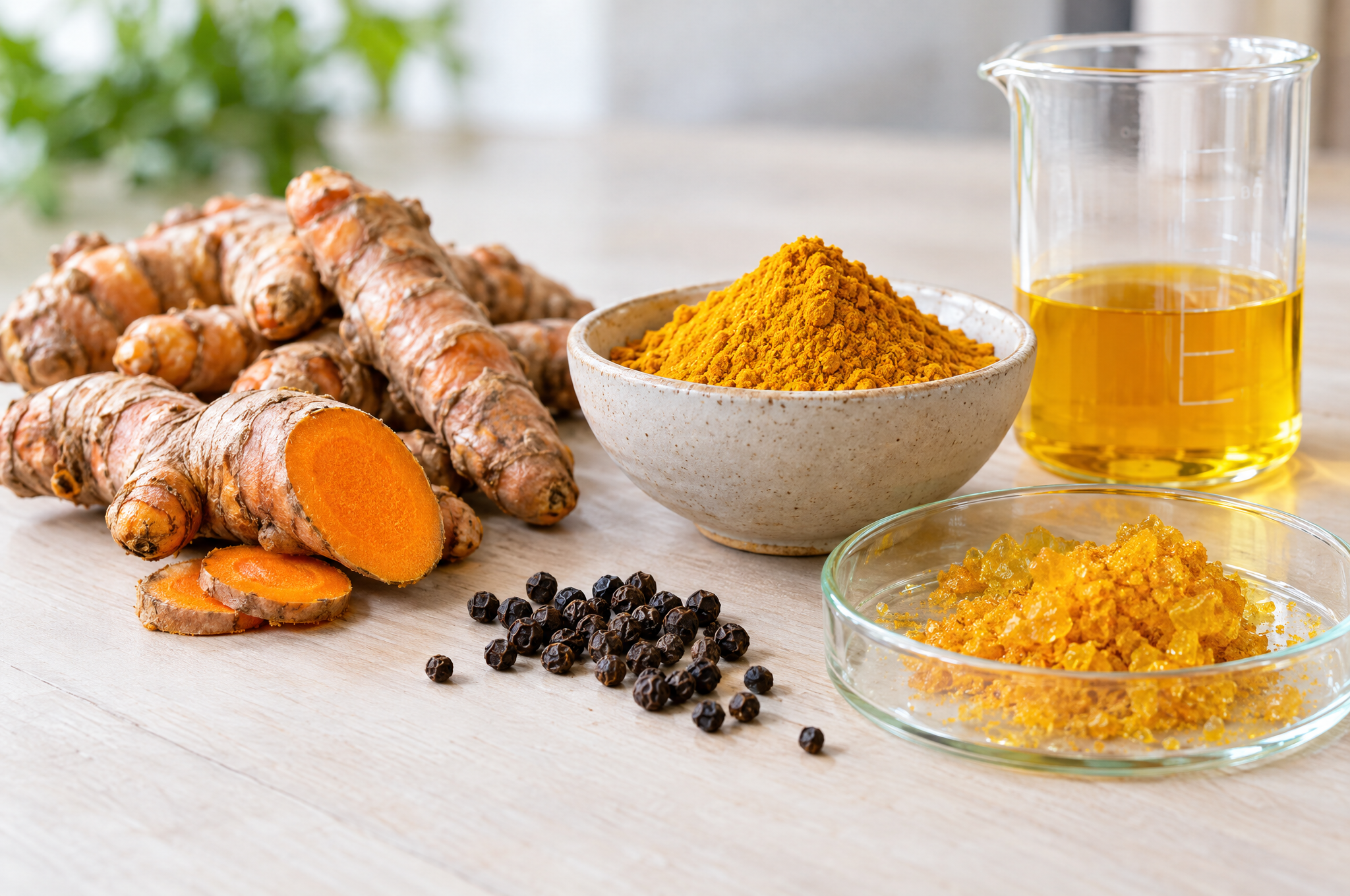
Turmeric is the underground stem (rhizome) of Curcuma longa. Its yellow pigments, the curcuminoids, are curcumin (the largest share), demethoxycurcumin and bisdemethoxycurcumin.
The spice and the extract are different amounts. In a lab analysis of 28 spice products, pure turmeric powder averaged 3.14% curcumin by weight. Extracts used in trials are far more concentrated. One Thai trial's ethanol extract held 75% to 85% curcuminoids, and the capsules in an Indian trial held at least 88%. A label that says "turmeric 500 mg" and one that says "curcuminoids 500 mg" describe very different products.
Formulations. Because curcumin dissolves poorly in water, manufacturers sell modified forms. Those tested in the studies below include curcuminoids with turmeric essential oil (BCM-95), a surface-controlled, water-dispersible form (Theracurmin), a form with the emulsifier polysorbate 80 (which its trial paper describes as approved by Belgian authorities), and phospholipid complexes. Each is a separate ingredient, and a result for one does not transfer to another or to plain turmeric.
Other Curcuma species. "Black turmeric" is Curcuma caesia, a different species. None of the curcumin trials discussed here tested it.
What human studies have tested
| Study | Who took part | Form and daily amount | Duration | What was measured | Result |
|---|---|---|---|---|---|
| Absorption studies | |||||
| Shoba 1998 | Healthy volunteers (also rats) | Curcumin 2 g, with or without piperine 20 mg, single dose | 1 day | Serum curcumin | Curcumin alone undetectable or very low; with piperine, levels higher at 0.25–1 hour and bioavailability 2,000% greater (154% in rats) |
| Lao 2006 | 24 healthy adults | Curcuminoid extract (C3 Complex), single doses of 500 to 12,000 mg | 1 day | Tolerance; serum curcumin | No curcumin detected up to 8,000 mg; low levels in 2 people at 10,000 or 12,000 mg |
| Schiborr 2014 | 23 healthy adults (13 women) | 500 mg curcuminoids as native powder, micronized powder or liquid micelles | Single doses, crossover | Blood curcuminoids over 24 hours | Micronized 9-fold, micellar 185-fold higher than native; women absorbed more than men |
| Jäger 2014 | 12 healthy adults (11 men) | Standard curcumin 1,800 mg vs three formulations at 376 mg curcuminoids | Single doses, crossover | Total curcuminoids after enzyme treatment, adjusted for dose | Phytosome 7.9-fold; turmeric-oil form 1.3-fold; a form with a hydrophilic carrier 45.9-fold. Funded by the maker of the hydrophilic-carrier form |
| Knee osteoarthritis trials | |||||
| Kuptniratsaikul 2014, RCT (Thailand) | 367 adults with knee OA and pain ≥5 of 10 | C. domestica ethanol extract (75–85% curcuminoids) 1,500 mg vs ibuprofen 1,200 mg | 4 weeks | WOMAC total, pain, stiffness, function | Noninferior to ibuprofen on total, pain and function; stiffness trend (P=0.060). Fewer abdominal pain events; 1 vs 7 dropouts for side effects. Extract made by the hospital's pharmacy department; funded by Thai public research bodies |
| Shep 2019, open-label RCT (India) | 139 adults with knee OA | BCM-95 500 mg 3 times a day vs diclofenac 50 mg twice a day | 28 days | Pain (VAS), KOOS | No significant difference in pain or KOOS. Side effects 13% vs 38%; acid-reducing drugs needed by 0% vs 28%. The extract's maker provided the capsules; authors declared no competing interests |
| Panahi 2014, RCT (Iran) | 40 adults with mild to moderate knee OA | Curcuminoids 1,500 mg in 3 doses vs placebo | 6 weeks | WOMAC, VAS, Lequesne index | Greater drop in WOMAC (P=0.001), VAS (P<0.001) and Lequesne (P=0.013); stiffness not improved |
| Nakagawa 2014, RCT (Japan) | 50 adults over 40 with grade II–III knee OA | Theracurmin, 180 mg curcumin vs placebo | 8 weeks | Pain (VAS), Japanese knee scores, NSAID use | Pain did not differ across all 41 people analyzed (P=0.10); it was lower than placebo after excluding 6 with the mildest baseline pain. Less celecoxib use at 8 weeks. The authors' group developed the form |
| Henrotin 2019, RCT (Belgium) | 150 adults with knee OA | Polysorbate-based extract (46.67 mg per capsule), 186.6 mg (4 capsules) or about 280 mg (6 capsules) vs placebo | 3 months | Global disease activity and a cartilage blood marker (co-primary); pain | Global activity fell more than with placebo (reported as a positive trend); cartilage marker did not differ between groups. Pain −29.5 and −36.5 mm vs −8 mm. More product-related events at the higher dose. Funded by the product's maker; one author worked there and the lead author consulted for it |
| Wang 2020, RCT (Australia) | 70 adults with knee OA and joint fluid swelling (effusion-synovitis) | C. longa water-based extract with 20% curcuminoids, 1,000 mg (2 capsules) vs placebo | 12 weeks | Pain (VAS) and effusion-synovitis volume on MRI | Pain −9.1 mm vs placebo (95% CI −17.8 to −0.4), smaller than the 18 mm the trial was designed to detect; no change in effusion or cartilage. Funded by the university and, in part, the extract's maker; the paper states the funders had no role in design, analysis or reporting |
| Lopresti 2021, RCT (Australia) | 101 adults with knee OA | Curcugen (50% curcuminoids) 500 mg twice a day vs placebo | 8 weeks | KOOS, pain ratings, walking tests | Knee pain improved (KOOS pain P=0.009); several other KOOS scales did not. Funded by the extract's maker, which supplied it and took part in study design and writing; one author worked there |
| Yuan 2026 (ATLAS), RCT (Australia) | 84 adults with knee OA | Curcumin 500 mg + piperine 5 mg + Boswellia, pine bark extract and MSM vs placebo | 12 weeks | Knee pain (VAS) | No difference: 0.16 mm (95% CI −6.81 to 7.12); an 18 mm difference was set in advance as clinically meaningful. Registry lists a government research grant as funder |
| Meta-analyses | |||||
| Onakpoya 2017 | 7 RCTs, 797 people, all in Asia | Oral curcuminoids, various | Varied | Pain, function | Less pain than placebo (very high variation between trials, I²=95%); smaller pain relief than ibuprofen |
| Wang 2021 | 16 RCTs, 1,810 adults | Turmeric extracts, various | Up to 16 weeks | Pain, function, side effects | Pain SMD −0.82 (−1.17 to −0.47; I²=86%) vs placebo; similar to NSAIDs; less benefit at higher BMI; 12% fewer side effects than NSAIDs |
| Zhang 2025, network meta-analysis | 39 RCTs, 4,599 people, 7 supplements | Curcumin among others, vs placebo | Varied | WOMAC, VAS | Curcumin helped some outcomes; Boswellia ranked highest for pain |
What the findings suggest
Absorption. In healthy people, plain curcumin barely shows up in the blood, even at 8 g. Piperine and newer formulations raised blood curcuminoids from about 1.3-fold to 185-fold in single-dose studies, depending on the form and the study. Strength: consistent, but from small single-dose studies in healthy adults that measured blood levels, not effects.
Knee osteoarthritis pain. Most placebo-controlled trials found less pain over 4 to 16 weeks, and pooled analyses agree. Head-to-head trials against ibuprofen or diclofenac found similar pain scores with fewer stomach side effects, but one meta-analysis found less pain relief than with ibuprofen, and the diclofenac trial was open-label. No trial showed changes in joint structure: the Australian MRI trial found no effect on joint fluid or cartilage, and a meta-analysis found no imaging differences. Strength: low to moderate for short-term pain; none for structure or long-term use.
Other conditions. NCCIH, part of the U.S. National Institutes of Health, says there is not enough evidence to conclude whether oral turmeric or curcumin helps any health condition, and calls the osteoarthritis evidence "initial" and positive. In a 24-week trial in 36 people with Alzheimer's disease, curcuminoids at 2 or 4 g a day did not differ from placebo, and blood curcumin stayed low. In 50 people with ulcerative colitis already on mesalamine, adding 3 g of curcumin a day for 1 month led to remission in 53.8% vs 0% on placebo. Both were small single trials.
Where the evidence is limited or conflicting
- No two trials test the same thing. Our table lists seven preparations, from 180 mg of curcumin to 1,500 mg of extract a day. Meta-analyses pool ingredients that absorb very differently.
- High variation between trials. Variation statistics (I²) of 86% to 95% mean the trials disagree on effect size, and Wang 2021 linked part of this to body weight.
- Short and small. No knee trial in our table ran longer than 3 months. The largest, with 367 people, lasted 4 weeks.
- Industry ties. In several trials the extract's maker funded the work, supplied the product or employed an author; one absorption study was paid for by the maker of its best-performing form. The Thai ibuprofen trial and ATLAS were publicly funded. ATLAS, the one null placebo-controlled trial in our table, tested a five-ingredient combination, so it does not isolate curcumin.
- Absorption numbers move. Jäger and colleagues measured 1.3-fold for the turmeric-oil form, where an earlier study had reported 6.9-fold. Several studies, including theirs, treat blood samples with enzymes and report total curcuminoids, mostly bound forms. After 4 g of curcuminoids plus 24 mg piperine, free curcumin stayed below the assay's detection limit.
- A chemistry critique. A 2017 review by medicinal chemists led by Kathryn Nelson argued that curcumin is unstable, reactive and poorly bioavailable, and that its activity in lab and animal tests is likely often false (it is classed as a "PAINS" compound, one that interferes with lab assays). The review stated that no double-blind, placebo-controlled curcumin trial had been successful, and that curcumin had never been shown to be "conclusively effective" in such a trial for any condition. Other placebo-controlled trials, including several in our table and the colitis trial above, have reported benefits over placebo.
Safety
In trials. Side effects were mostly mild stomach complaints. In the Alzheimer's trial, 3 of 24 people on curcumin stopped because of them. NCCIH lists nausea, vomiting, acid reflux, stomach upset, diarrhea and constipation.
Liver injury. NIH LiverTox, a federal reference on drug and supplement liver injury, rates turmeric "A": a well-documented cause of clinically apparent liver injury. Its June 2025 entry describes onset usually 1 to 4 months after starting, injury that is usually hepatocellular and often comes with jaundice, and recovery within 1 to 3 months after stopping in most cases. It estimates the risk at roughly 1 in 10,000 to 1 in 100,000 users. It states that high-bioavailability forms made with piperine or lipid particles "were subsequently linked to several cases of liver injury," notes that some cases involved plain ground turmeric or turmeric tea, and warns that restarting can cause more severe injury.
- United States. The NIH Drug-Induced Liver Injury Network found 10 turmeric cases from 2004 to 2022, all since 2011. Five people were hospitalized and one died. All 7 products tested contained turmeric and 3 also contained piperine. Seven people carried the immune gene variant HLA-B*35:01, which LiverTox reports in over 70% of cases vs 10% to 15% of controls.
- Italy. Several cases of acute cholestatic hepatitis after use of C. longa supplements were reported in Italy. Reviewing the 7 Tuscan cases reported to the national phytovigilance system up to September 2019, researchers found that all involved high-bioavailability products at high curcumin or curcuminoid doses. Most improved after stopping.
- Australia. In 2023, the Therapeutic Goods Administration (TGA) said it had received 18 reports of liver problems in people taking turmeric or curcumin products up to June 29, 2023; 9 had enough information to suggest a liver injury the product may have caused, 2 were severe and 1 was fatal. The TGA said the risk "may be higher for products with enhanced absorption or bioavailability and/or higher doses," and advised against these products for people with current or past liver problems.
Signs of liver injury include yellow skin or eyes, dark urine and unusual tiredness; stop the product and see a doctor if they appear. Our milk thistle review covers the research on another botanical often discussed in relation to the liver.
Piperine and medicines. In small studies of healthy volunteers, piperine (usually 20 mg a day) raised blood levels of propranolol, theophylline and carbamazepine (by 47.9% for carbamazepine). Black pepper in food raised phenytoin levels. By contrast, a curcuminoid–piperine product (4 g plus 24 mg) given over 2 days did not change midazolam, flurbiprofen or paracetamol levels in 8 volunteers. If you take a medicine with a narrow safe range, ask a pharmacist first.
Blood thinners. A French case report described a rise in INR, a measure of clotting time, in a woman on the anticoagulant fluindione who took turmeric. A placebo-controlled study in healthy volunteers found no clinically relevant effect of C. longa on clotting tests, alone or with aspirin, although 5 of 24 people had reduced platelet response to one test agent. One knee trial listed anticoagulants as a relative contraindication. Ask your doctor if you take a blood thinner.
Gallbladder. In two small studies of 12 healthy volunteers each, a single 20 mg dose of curcumin shrank the gallbladder by about 30% within 2 hours, and 40 mg by about half. These studies did not include people with gallstones, who should ask a doctor first.
Iron. One case report described iron-deficiency anemia in a man taking six turmeric extract capsules a day, which resolved after he stopped. This is a single report.
Pregnancy. NCCIH says turmeric supplements in pregnancy "may be unsafe."
Limits. In its review of curcumin as a food coloring (E 100), EFSA, the EU food safety agency, concluded that the data support an acceptable daily intake of 3 mg per kg of body weight. For a 70 kg adult that is about 210 mg a day, well below the 1,500 mg used in several knee trials. EFSA set this figure in a food-additive evaluation, not as a supplement dose.
What research does not establish
- That curcumin slows joint damage or helps beyond 3 months.
- That one formulation's trial result applies to another formulation or to turmeric powder.
- That higher blood levels from a formulation lead to better results.
- That curcumin treats Alzheimer's disease, ulcerative colitis or any other disease.
- That black turmeric (Curcuma caesia) has the effects or safety record of Curcuma longa extracts.
How we reviewed the evidence
On November 9, 2026, we searched PubMed for randomized trials of curcumin in knee osteoarthritis (29 records, all screened), then ran targeted searches and citation lookups on absorption and piperine, liver injury, anticoagulants, gallbladder effects, iron, piperine–drug interactions and retractions. We searched ClinicalTrials.gov (14 registered knee osteoarthritis studies of curcumin or turmeric) and read the NIH LiverTox and NCCIH turmeric pages, the TGA safety advisory and the EFSA opinion summary. We included human trials, meta-analyses, absorption and interaction studies and case reports, used lab studies only for context, and excluded topical products. We used combination products only where noted. We read the full texts, or the methods and disclosure sections, of 9 papers and the abstracts of the rest. None of the cited papers is marked as retracted in PubMed. Vinatura did not run any trials of curcumin.
Vinatura Research Perspective
We asked four questions of each study: which preparation, how many milligrams of curcuminoids a day, in whom, and was the outcome something people feel (pain, function) or a lab value. Sorted that way, "curcumin" becomes seven or more different ingredients. The knee trials used daily amounts from 180 mg of a dispersible form to 1,500 mg of a standard extract, and the absorption studies show these forms reach the blood very differently.
When we compared the trials, three patterns stood out. First, most knee trials were small and short, and in several the extract's maker funded the work, supplied the product or employed an author. Second, two placebo-controlled trials judged their results against an 18 mm clinically meaningful difference set in advance, and neither reached it: the 2020 Tasmanian MRI trial found a 9.1 mm pain difference, about half of what it was designed to detect, and ATLAS, testing a five-ingredient combination, found no difference. Third, the feature most formulations compete on, higher absorption, is the same one safety reviewers now flag: LiverTox links high-absorption forms to several liver injury cases (though some cases involved plain turmeric), and the TGA says the risk may be higher with them.
Our assessment: low to moderate evidence that some curcumin extracts reduce knee osteoarthritis pain over 4 to 16 weeks; low evidence that they match NSAIDs; no evidence of joint protection; consistent evidence that formulations change blood levels; and a rare but established risk of liver injury, with a signal for high-absorption products. A large, independently funded trial lasting at least a year, with a single defined extract, measured blood levels and liver monitoring, would change this assessment.
Where this ingredient appears in Vinatura products
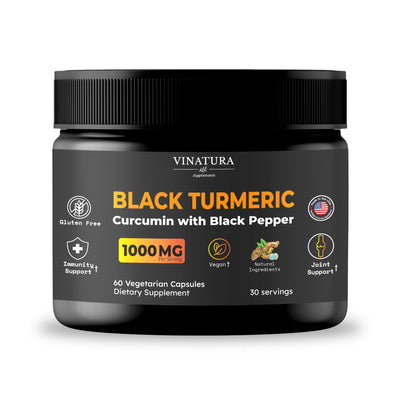
Black Turmeric Curcumin with Black Pepper lists, per 2-capsule serving, 500 mg black turmeric (Curcuma caesia), 495 mg turmeric curcumin (Curcuma longa) and 5 mg black pepper (Piper nigrum). The page does not specify a curcuminoid percentage or piperine content. The Sea Moss Olive Leaf Extract Blue Vervain Ashwagandha 1250mg page lists turmeric curcumin standardized to 95% curcuminoids within a 240 mg blend of several ingredients, without a separate amount. The studies above did not test these products, and none tested Curcuma caesia.
Frequently asked questions
Is turmeric the same as curcumin? No. Turmeric is the root; curcumin is one of its pigments, about 3% of turmeric powder by weight in one analysis.
Why is black pepper added? Piperine, from black pepper, raised blood curcumin in a 1998 study. It also affects how the body handles some medicines, and LiverTox links piperine-enhanced forms to liver injury cases.
How much did knee trials use? Daily amounts ranged from 180 mg of curcumin in a dispersible form to 1,500 mg of extract. These are study amounts, not recommendations; follow your product label and ask a healthcare professional.
Is curcumin safe for the liver? Turmeric is an established cause of rare, sometimes severe liver injury. Avoid it if you have liver disease, and stop and see a doctor if you notice yellow skin or eyes or dark urine.
References
- Tayyem RF, et al. Curcumin content of turmeric and curry powders. Nutr Cancer. 2006;55(2):126-131. doi:10.1207/s15327914nc5502_2
- Shoba G, et al. Influence of piperine on the pharmacokinetics of curcumin in animals and human volunteers. Planta Med. 1998;64(4):353-356. doi:10.1055/s-2006-957450
- Lao CD, et al. Dose escalation of a curcuminoid formulation. BMC Complement Altern Med. 2006;6:10. doi:10.1186/1472-6882-6-10
- Schiborr C, et al. The oral bioavailability of curcumin from micronized powder and liquid micelles is significantly increased in healthy humans and differs between sexes. Mol Nutr Food Res. 2014;58(3):516-527. doi:10.1002/mnfr.201300724
- Jäger R, et al. Comparative absorption of curcumin formulations. Nutr J. 2014;13:11. doi:10.1186/1475-2891-13-11
- Volak LP, et al. Effect of a herbal extract containing curcumin and piperine on midazolam, flurbiprofen and paracetamol (acetaminophen) pharmacokinetics in healthy volunteers. Br J Clin Pharmacol. 2013;75(2):450-462. doi:10.1111/j.1365-2125.2012.04364.x
- Kuptniratsaikul V, et al. Efficacy and safety of Curcuma domestica extracts compared with ibuprofen in patients with knee osteoarthritis: a multicenter study. Clin Interv Aging. 2014;9:451-458. doi:10.2147/CIA.S58535
- Shep D, et al. Safety and efficacy of curcumin versus diclofenac in knee osteoarthritis: a randomized open-label parallel-arm study. Trials. 2019;20(1):214. doi:10.1186/s13063-019-3327-2
- Panahi Y, et al. Curcuminoid treatment for knee osteoarthritis: a randomized double-blind placebo-controlled trial. Phytother Res. 2014;28(11):1625-1631. doi:10.1002/ptr.5174
- Nakagawa Y, et al. Short-term effects of highly-bioavailable curcumin for treating knee osteoarthritis: a randomized, double-blind, placebo-controlled prospective study. J Orthop Sci. 2014;19(6):933-939. doi:10.1007/s00776-014-0633-0
- Henrotin Y, et al. Bio-optimized Curcuma longa extract is efficient on knee osteoarthritis pain: a double-blind multicenter randomized placebo controlled three-arm study. Arthritis Res Ther. 2019;21(1):179. doi:10.1186/s13075-019-1960-5
- Wang Z, et al. Effectiveness of Curcuma longa extract for the treatment of symptoms and effusion-synovitis of knee osteoarthritis: a randomized trial. Ann Intern Med. 2020;173(11):861-869. doi:10.7326/M20-0990
- Lopresti AL, et al. An investigation into the effects of a curcumin extract (Curcugen) on osteoarthritis pain of the knee: a randomised, double-blind, placebo-controlled study. Nutrients. 2021;14(1):41. doi:10.3390/nu14010041
- Yuan S, et al. Effect of an oral complementary medicine combination for symptomatic knee osteoarthritis: a double-blind, randomized, placebo-controlled trial. Osteoarthritis Cartilage. 2026;34(10):1515-1524. doi:10.1016/j.joca.2026.06.008
- Onakpoya IJ, et al. Effectiveness of curcuminoids in the treatment of knee osteoarthritis: a systematic review and meta-analysis of randomized clinical trials. Int J Rheum Dis. 2017;20(4):420-433. doi:10.1111/1756-185X.13069
- Wang Z, et al. Efficacy and safety of turmeric extracts for the treatment of knee osteoarthritis: a systematic review and meta-analysis of randomised controlled trials. Curr Rheumatol Rep. 2021;23(2):11. doi:10.1007/s11926-020-00975-8
- Zhang Y, et al. Comparative effectiveness of nutritional supplements in the treatment of knee osteoarthritis: a network meta-analysis. Nutrients. 2025;17(15):2547. doi:10.3390/nu17152547
- Ringman JM, et al. Oral curcumin for Alzheimer's disease: tolerability and efficacy in a 24-week randomized, double blind, placebo-controlled study. Alzheimers Res Ther. 2012;4(5):43. doi:10.1186/alzrt146
- Lang A, et al. Curcumin in combination with mesalamine induces remission in patients with mild-to-moderate ulcerative colitis in a randomized controlled trial. Clin Gastroenterol Hepatol. 2015;13(8):1444-1449.e1. doi:10.1016/j.cgh.2015.02.019
- Nelson KM, et al. The essential medicinal chemistry of curcumin. J Med Chem. 2017;60(5):1620-1637. doi:10.1021/acs.jmedchem.6b00975
- Halegoua-DeMarzio D, et al. Liver injury associated with turmeric—a growing problem: ten cases from the Drug-Induced Liver Injury Network [DILIN]. Am J Med. 2023;136(2):200-206. doi:10.1016/j.amjmed.2022.09.026
- Lombardi N, et al. Acute liver injury following turmeric use in Tuscany: an analysis of the Italian Phytovigilance database and systematic review of case reports. Br J Clin Pharmacol. 2021;87(3):741-753. doi:10.1111/bcp.14460
- Bano G, et al. Effect of piperine on bioavailability and pharmacokinetics of propranolol and theophylline in healthy volunteers. Eur J Clin Pharmacol. 1991;41(6):615-617. doi:10.1007/BF00314996
- Velpandian T, et al. Piperine in food: interference in the pharmacokinetics of phenytoin. Eur J Drug Metab Pharmacokinet. 2001;26(4):241-247. doi:10.1007/BF03226378
- Bedada SK, et al. Effect of piperine on the metabolism and pharmacokinetics of carbamazepine in healthy volunteers. Drug Res (Stuttg). 2017;67(1):46-51. doi:10.1055/s-0042-118173
- Daveluy A, et al. Probable interaction between an oral vitamin K antagonist and turmeric (Curcuma longa). Therapie. 2014;69(6):519-520. doi:10.2515/therapie/2014062
- Fung FY, et al. A randomized, double-blind, placebo-controlled study on the anti-haemostatic effects of Curcuma longa, Angelica sinensis and Panax ginseng. Phytomedicine. 2017;32:88-96. doi:10.1016/j.phymed.2017.04.004
- Rasyid A, Lelo A. The effect of curcumin and placebo on human gall-bladder function: an ultrasound study. Aliment Pharmacol Ther. 1999;13(2):245-249. doi:10.1046/j.1365-2036.1999.00464.x
- Rasyid A, et al. Effect of different curcumin dosages on human gall bladder. Asia Pac J Clin Nutr. 2002;11(4):314-318. doi:10.1046/j.1440-6047.2002.00296.x
- Smith TJ, Ashar BH. Iron deficiency anemia due to high-dose turmeric. Cureus. 2019;11(1):e3858. doi:10.7759/cureus.3858
- National Institutes of Health, LiverTox. Turmeric. Last updated June 16, 2025. ncbi.nlm.nih.gov
- National Center for Complementary and Integrative Health. Turmeric. Last updated April 2025. nccih.nih.gov
- Therapeutic Goods Administration (Australia). Medicines containing turmeric or curcumin: risk of liver injury. Safety advisory, 2023. tga.gov.au
- EFSA Panel on Food Additives and Nutrient Sources Added to Food. Scientific opinion on the re-evaluation of curcumin (E 100) as a food additive. EFSA J. 2010;8(9):1679. doi:10.2903/j.efsa.2010.1679
Editorial note: This article reviews published research for educational purposes. It does not establish the effects or safety of any specific supplement, including Vinatura products, and is not medical advice. Written by Vinatura Editorial Team. Last reviewed November 2026.
Author
Product Disclaimer
Including an ingredient or study does not evaluate, endorse, or recommend any Vinatura product or any third-party product. Some ingredients discussed may not be used in any Vinatura product.
The content of the articles has not been evaluated by the Food and Drug Administration (FDA) and is not intended to promote or endorse any specific product. Any products sold on this website are not intended to diagnose, treat, cure, or prevent any disease.
Opinions and Endorsements
Any claims, statements, or opinions expressed in the articles are those of the author(s) and do not necessarily reflect the views or opinions of the manufacturers of the dietary supplement products. The products sold on this website are separate from the content of the articles and are not directly endorsed or associated with the information presented here.
Liability Disclaimer
The author(s) of the articles, website, and manufacturers of the dietary supplement products do not assume any liability for any potential consequences arising from the use of the information provided in the articles. Ingredient effects, dosages, and safety vary by individual, formulation, and context; some ingredients interact with medications or may be unsuitable during pregnancy or lactation. It is recommended that individuals consult with a qualified healthcare professional before making any dietary or lifestyle changes, including the use of dietary supplements.
Product Usage
Please refer to the product labels and packaging for specific usage instructions and guidelines for the dietary supplement products sold on this website.
Customer Support
For any concerns or questions regarding the dietary supplement products, please contact our customer support team, who will be more than happy to assist you.


Leave a Comment
Be the first to comment.
What do you think?