

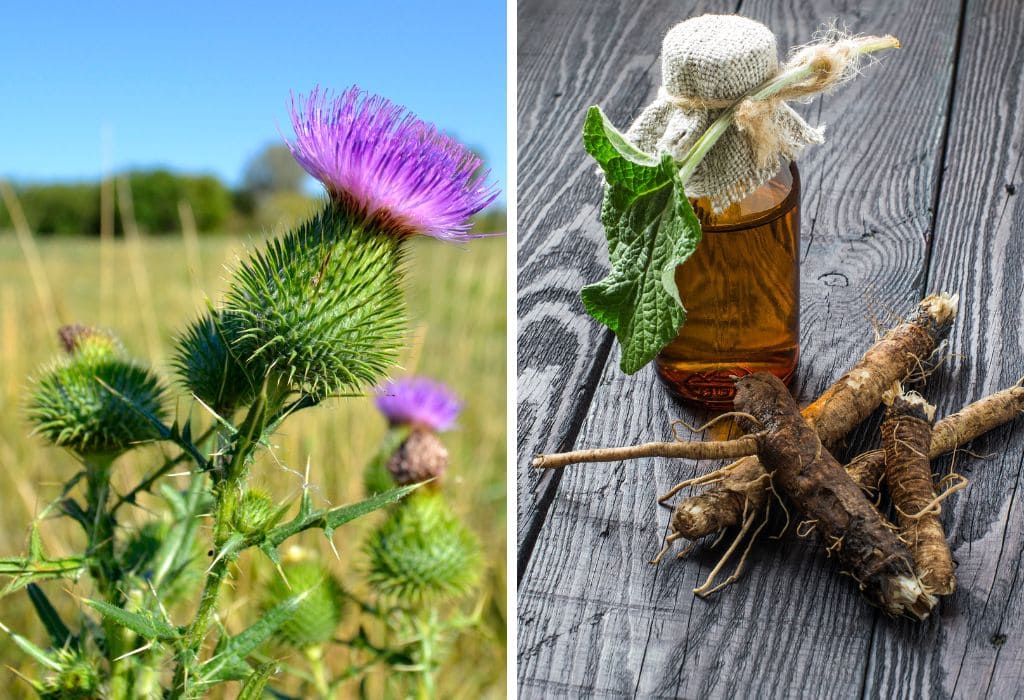
Milk Thistle vs Burdock: Differences, Human Studies and Safety
Quick answer. Milk thistle and burdock are different plants, and the research does not show that either one does the other's job. Milk thistle (Silybum marianum) is used for its seed extract, silymarin, for which two Cochrane reviews (18 and 17 randomized trials in liver disease) found no proven effect on deaths or complications, with at most small, very uncertain drops in liver enzymes; burdock (Arctium lappa) is used mainly for its root, which has only a few small human trials, none in liver disease. We found no study that tested the two together. Both belong to the daisy family (Asteraceae), so people allergic to those plants should avoid them; commercial burdock root tea has caused atropine-like poisoning, most likely from contamination, and the European Medicines Agency (EMA) does not recommend burdock in pregnancy or breastfeeding.
Milk thistle vs burdock at a glance
| Milk thistle | Burdock | |
|---|---|---|
| Latin name and family | Silybum marianum, daisy family (Asteraceae) | Arctium lappa, daisy family (Asteraceae) |
| Native range | Europe, Asia Minor and North Africa | Temperate Europe and Asia; introduced in North America |
| Part used | Seeds (botanically, small fruits) | Root; the root is also eaten as a vegetable in Japan and Korea; the fruit is a separate product |
| Main compounds | Silymarin, a group of flavonolignans, largely silybin (silibinin), silychristin and silydianin | Carbohydrates (up to 70% of dry mass), mainly inulin; polyphenols (1.9–3.65% of fresh root) such as chlorogenic and caffeic acids; lignans such as arctiin; polyacetylenes |
| Human studies | Many randomized trials in liver disease; two Cochrane reviews | A handful of small trials (knee osteoarthritis, diverticulitis, polycystic ovary syndrome, metabolic syndrome); none in liver disease |
| Typical study amounts | Silymarin 1,260 or 2,100 mg a day in the U.S. hepatitis C trial; various doses in the reviews | Root tea 4.5–6 g a day, root powder 460 mg a day, or 300 mL a day of a water extract |
| EU herbal status | EU monograph, traditional use for indigestion and fullness and "to support the liver function" once a doctor has ruled out serious disease | EU monograph, traditional use to increase urine flow, for temporary loss of appetite and for oily, flaky (seborrheic) skin |
| Main safety points | Mild stomach and gut symptoms; allergy; not recommended in pregnancy, breastfeeding or under 18 | Allergy, including anaphylaxis; contaminated teas; not recommended in pregnancy, breastfeeding or under 18 |
| Tested together? | No study found | No study found |
What human studies have tested
| Study | Who took part | Form and daily amount | Duration | What was measured | Result |
|---|---|---|---|---|---|
| Milk thistle: Rambaldi et al., 2007 (Cochrane review) | 18 randomized trials, 1,088 people with alcohol-related or hepatitis B or C liver disease | Milk thistle extracts, various doses | Varied | Deaths, complications, liver tissue | No significant effect on deaths (RR 0.78; 95% CI 0.53–1.15), complications or liver tissue. Fewer liver-related deaths in all trials (RR 0.50) but not in high-quality trials (RR 0.57; 0.28–1.19) |
| Milk thistle: Fried et al., 2012 (randomized, double-blind; U.S.) | 154 adults with chronic hepatitis C not cured by interferon | Silymarin 420 or 700 mg three times a day, or placebo | 24 weeks | ALT (a liver enzyme), virus levels, quality of life | 2 people per group met the ALT goal; no differences in ALT, virus levels or quality of life |
| Milk thistle: Wang et al., 2025 (Cochrane review) | 17 randomized trials, 2,069 adults with fatty liver disease (MASLD) | Silymarin alone (9 trials) or in complexes (8 trials) | 4 to 48 weeks | Serious side effects, deaths, quality of life, liver enzymes | Silymarin alone may lower ALT by 7.21 U/L vs placebo or no treatment (6 trials, 409 people; very low certainty). No trial reported deaths or quality of life |
| Burdock: Maghsoumi-Norouzabad et al., 2016 (randomized; Iran) | 36 adults aged 50–70 with knee osteoarthritis, all on acetaminophen and glucosamine | Root tea, 3 cups a day (2 g per cup), vs 3 cups of plain boiled water | 42 days | Inflammation markers (IL-6, hs-CRP) and oxidative stress markers | Within the tea group, IL-6, hs-CRP and malondialdehyde fell and antioxidant markers rose. Against plain water at the end, malondialdehyde, total antioxidant capacity and glutathione peroxidase differed, but IL-6 and hs-CRP did not. Pain was not an outcome of this paper |
| Burdock: Mizuki et al., 2019 (randomized, open-label; Japan) | 161 adults (aged 20–85) with a recent episode of uncomplicated diverticulitis (91) or diverticular bleeding (70); more of the tea group had had earlier diverticulitis. Group sizes and follow-up are from the results section; the abstract gives different figures | Roasted burdock tea, 1.5 g three times a day, vs no treatment | Median follow-up 16 months (bleeding) and 26 months (diverticulitis) | Recurrence | Diverticulitis returned in 10.6% vs 31.8%; no difference in bleeding recurrence (20.0% vs 22.9%) |
| Burdock: Taheri et al., 2026 (randomized, double-blind; Iran) | 60 women with polycystic ovary syndrome, all on metformin and an oral contraceptive | Root powder, 460 mg capsule, vs starch placebo | 12 weeks | Oxidative stress markers (main outcome), CRP, ovary volume, hair growth, menstrual frequency | Antioxidant markers higher, CRP and ovary volume lower vs placebo; no difference in hair growth score or menstrual frequency |
| Burdock: Ha et al., 2022 (randomized, double-blind; South Korea) | 42 women aged 70–80 with metabolic syndrome, in 4 groups (burdock, aqua exercise, both, or neither) | Root water extract drink, 100 mL three times a day, vs placebo drink | 16 weeks | Blood pressure, insulin resistance, artery stiffness | Systolic blood pressure fell within the burdock-only group, but changes did not differ between groups; the authors concluded that burdock alone "cannot be expected to have a significant effect". In the burdock-plus-exercise group, the augmentation index (an artery-stiffness measure) fell, which the authors called synergy, but pulse wave velocity, another stiffness measure, rose |
Milk thistle in brief. The trials enrolled people with liver disease, not healthy people, and the better-designed ones mostly found no benefit. The EMA judged the trial evidence insufficient and accepts milk thistle only as a traditional remedy. Our review of milk thistle trials covers these and other trials in detail.
Burdock in brief. Two of the four trials had no placebo (plain water or no treatment as the control), and most measured blood markers rather than symptoms. Two smaller Korean trials led by the same first author (40 and 24 women analyzed) found blood fats fell in the exercise groups in one, and SHBG rose in a burdock group of only 5 women in the other. The EMA found "no data available from controlled clinical studies" of burdock root in 2011, and in 2020 found no new clinical studies or safety concerns requiring a change. We found no trial of burdock root in people with liver disease; liver-protection claims rest on rat studies.
Practical points the evidence supports
- Check the plant and the part. Milk thistle studies tested standardized seed extracts measured as silymarin. Burdock studies tested root tea, root powder or a water extract; one tested an arctigenin-rich fruit extract as an experimental cancer drug, and root results do not apply to the fruit. A label that gives an extract ratio (such as 4:1) and a raw-root "equivalent" describes how the extract was made; no trial we found tested a ratio extract of burdock root.
- Study amounts are not recommendations. The U.S. hepatitis C trial gave 1,260 or 2,100 mg of silymarin a day. Burdock trials used 6 g of root as tea, 4.5 g of roasted tea, 460 mg of root powder or 300 mL of extract drink a day; most were taken after or with meals. The EU monograph for burdock root lists traditional amounts such as 2–6 g as an infusion three times a day for adults. Follow your product label and ask a healthcare professional.
- Taking them together. No study has tested milk thistle and burdock together, so there is no evidence that combining them adds a benefit.
- When to see a doctor. The EU burdock monograph advises seeing a doctor if symptoms last over 2 weeks (4 for skin use) or if fever, painful urination or blood in the urine occur, and advises against combining burdock with prescription water pills (diuretics).
Safety
Milk thistle. The EMA lists mild gut symptoms (dry mouth, nausea, upset stomach, diarrhea), headache and allergic reactions, frequency unknown. The 2007 Cochrane review found no increase in adverse events (RR 0.83; 95% CI 0.46–1.50), and in the U.S. hepatitis C trial side effects were similar to placebo. NIH's LiverTox says milk thistle "has not been implicated" in liver injury. The EMA rules it out for people allergic to daisy-family plants and does not recommend it in pregnancy, breastfeeding or under 18, where safety has not been established. LiverTox finds "little evidence" of clinically significant drug interactions: in 12 healthy volunteers, 28 days of milk thistle did not change four major drug-processing enzymes, but in 18 healthy men, silymarin raised blood levels of the heart drug talinolol by about 36%. The NIH's NCCIH notes that a small number of studies, mostly from Middle Eastern countries, suggest milk thistle extracts may help control blood sugar in type 2 diabetes, and advises anyone taking medicines to talk with a health care provider before using it.
Burdock. The EU monograph rules out burdock for people allergic to daisy-family plants and lists anaphylactic shock, frequency unknown. The EMA's assessment describes a 53-year-old Japanese man who went into anaphylactic shock after eating boiled burdock root, and contact dermatitis in three people from burdock plasters. Contamination is the other known risk. In 1978, a 26-year-old woman developed blurred vision, inability to urinate, dry mouth and bizarre behavior after drinking packaged burdock root tea from a health food shop; the FDA confirmed an atropine-like alkaloid in the product, and the authors called contamination during picking possible but unproven. A 1984 report found atropine in another commercial burdock root tea that poisoned a patient; its source could not be determined. Burdock root is not known to contain these alkaloids, and the EMA describes contamination, "possibly" with belladonna root. The EU monograph does not recommend burdock in pregnancy or breastfeeding, for lack of data, or under 18; the EMA assessment notes a handbook report of uterine stimulation but found no case reports or studies supporting it. The PCOS trial reported no side effects, and the diverticulitis trial one case of mild diarrhea. In the fruit-extract pancreatic cancer trial, side effects included higher GGT (a liver enzyme), blood sugar and bilirubin, all mild. We found no human interaction studies of burdock.
What research does not establish
- That milk thistle and burdock work better together; no study has tested the combination.
- That burdock root protects or "cleanses" the liver in people; the evidence is from rats.
- That milk thistle improves survival or prevents complications in liver disease.
- That burdock's results in small trials of sick people (with knee osteoarthritis, PCOS or diverticulitis) apply to healthy people or to other forms, such as concentrated extracts.
- That either herb is safe in pregnancy or breastfeeding.
How we reviewed the evidence
On November 5, 2026, we searched PubMed for (burdock OR "Arctium lappa") AND (randomized OR trial), screening all 69 records, and for burdock together with milk thistle or silymarin: 10 records, none a human study of both. A search for burdock with drug interactions or pharmacokinetics (76 records) found no human interaction study. ClinicalTrials.gov listed 10 records naming burdock, Arctium lappa or arctigenin as an intervention. We read the EMA monographs and assessment documents for both herbs, LiverTox, NCCIH and the burdock tea poisoning reports. Milk thistle trials come from our October 2026 review of that herb; we re-checked the main ones. We included randomized trials of burdock root, powder or extract taken by mouth, and the fruit-extract drug trial for safety only. We excluded multi-herb products (such as a four-herb cancer tea), a homeopathic acne study and topical products; animal and lab studies were used only to show where claims come from. Vinatura did not run any of these studies.
Vinatura Research Perspective
We asked of each source which plant part, in what form and amount, in whom and measured how, and whether anyone had tested the two herbs together. Milk thistle has been tested in many trials, summarized in two Cochrane reviews, and the better trials mostly found no effect on outcomes that matter to patients. Burdock has fewer, smaller trials that more often report positive results, but on blood markers, each from a single research group, and sometimes without a placebo. In the burdock trial with a matched placebo drink and four groups, the authors themselves concluded that burdock alone had no significant effect, and its claimed synergy rests on two stiffness measures that moved in opposite directions.
The old version of this page went beyond the evidence. It said the two herbs can be combined "to increase the effectiveness" of liver support; no study has tested that. It called milk thistle safe for children and pregnant or breastfeeding women; the EMA says safety in these groups has not been established and does not recommend use in pregnancy or breastfeeding. It said burdock had no reported dangerous side effects; anaphylaxis and contaminated teas have been documented. Its burdock liver and artery claims had no human trial behind them; the one burdock liver study it cited was in rats.
Our assessment: for milk thistle in liver disease, the evidence is substantial and mostly null, with low to very low certainty for small enzyme changes. For burdock root, evidence is preliminary for blood markers of oxidative stress (two trials) and weaker for inflammation markers: CRP fell against placebo in the PCOS trial, but IL-6 and hs-CRP did not differ from plain water in the knee osteoarthritis trial. For diverticulitis recurrence, there is one open-label trial. For the combination, there is no evidence. Larger placebo-controlled burdock root trials with symptom outcomes, the published results of registered burdock trials, or any trial of the two herbs together would change this view.
Where this ingredient appears in Vinatura products
TUDCA Milk Thistle 1250mg contains a 1,250 mg blend of TUDCA and milk thistle per 2-capsule serving, with the milk thistle extract standardized to 80% silymarin; the product page does not list the milk thistle amount separately. Sea Moss Olive Leaf Extract Blue Vervain Ashwagandha 1250mg is an 18-ingredient blend that lists 100 mg of burdock root extract (4:1, stated as equivalent to 400 mg of raw root) per 1,250 mg serving; its directions say 2 capsules daily. Neither product contains both herbs. The studies above did not test these products.
Frequently asked questions
Is burdock better than milk thistle? Neither has been shown to be better, and they have never been compared directly. Milk thistle has more trials, mostly null, in liver disease; burdock has a few small trials on other conditions.
Can you take milk thistle and burdock together? No study has tested the combination, so its benefits and safety are unknown. The EU monographs report no drug interactions, though one small study found silymarin raised levels of the heart drug talinolol; both carry the daisy-family allergy warning. Ask a healthcare professional, especially if you take medicines.
Is burdock root good for the liver like milk thistle? We found no human study of burdock root for liver health; the claims come from rat studies. Milk thistle has been tested in people with liver disease, without proven benefit on deaths or complications.
Are burdock and milk thistle related? Both are in the daisy family (Asteraceae), but they are different genera with different chemistry, so their research cannot be swapped.
References
- Rambaldi A, Jacobs BP, Gluud C. Milk thistle for alcoholic and/or hepatitis B or C virus liver diseases. Cochrane Database Syst Rev. 2007;(4):CD003620. doi:10.1002/14651858.CD003620.pub3
- Fried MW, et al. Effect of silymarin (milk thistle) on liver disease in patients with chronic hepatitis C unsuccessfully treated with interferon therapy: a randomized controlled trial. JAMA. 2012;308(3):274-282. doi:10.1001/jama.2012.8265
- Wang C, et al. Silymarin for adults with metabolic dysfunction-associated steatotic liver disease. Cochrane Database Syst Rev. 2025;6(6):CD015524. doi:10.1002/14651858.CD015524.pub2
- Gurley BJ, et al. In vivo assessment of botanical supplementation on human cytochrome P450 phenotypes: Citrus aurantium, Echinacea purpurea, milk thistle, and saw palmetto. Clin Pharmacol Ther. 2004;76(5):428-440. doi:10.1016/j.clpt.2004.07.007
- Han Y, et al. Effect of continuous silymarin administration on oral talinolol pharmacokinetics in healthy volunteers. Xenobiotica. 2009;39(9):694-699. doi:10.1080/00498250903060077
- Maghsoumi-Norouzabad L, et al. Effects of Arctium lappa L. (Burdock) root tea on inflammatory status and oxidative stress in patients with knee osteoarthritis. Int J Rheum Dis. 2016;19(3):255-261. doi:10.1111/1756-185X.12477
- Mizuki A, et al. Effects of Burdock tea on recurrence of colonic diverticulitis and diverticular bleeding: an open-labelled randomized clinical trial. Sci Rep. 2019;9(1):6793. doi:10.1038/s41598-019-43236-0
- Taheri H, et al. Effects of Arctium lappa L. root powder on some markers of oxidative stress and inflammation in women with polycystic ovary syndrome: a randomized, double-blind controlled clinical trial study. JBRA Assist Reprod. 2026;30(2):272-281. doi:10.5935/1518-0557.20250189
- Ha MS, et al. The combined intervention of aqua exercise and burdock extract synergistically improved arterial stiffness: a randomized, double-blind, controlled trial. Metabolites. 2022;12(10):970. doi:10.3390/metabo12100970
- Ha MS, et al. Effects of aquarobic exercise and burdock intake on serum blood lipids and vascular elasticity in Korean elderly women. Exp Gerontol. 2018;101:63-68. doi:10.1016/j.exger.2017.11.005
- Ha MS, et al. Exercise training and burdock root (Arctium lappa L.) extract independently improve abdominal obesity and sex hormones in elderly women with metabolic syndrome. Sci Rep. 2021;11(1):5175. doi:10.1038/s41598-021-84301-x
- Ikeda M, et al. Phase I trial of GBS-01 for advanced pancreatic cancer refractory to gemcitabine. Cancer Sci. 2016;107(12):1818-1824. doi:10.1111/cas.13086
- Bryson PD, et al. Burdock root tea poisoning: case report involving a commercial preparation. JAMA. 1978;239(20):2157. doi:10.1001/jama.1978.03280470069028
- Bryson PD. Burdock root tea poisoning [letter]. JAMA. 1978;240(15):1586. doi:10.1001/jama.1978.03290150032009
- Rhoads PM, et al. Anticholinergic poisonings associated with commercial burdock root tea. J Toxicol Clin Toxicol. 1984;22(6):581-584. doi:10.3109/15563658408992587
- Lin SC, et al. Hepatoprotective effects of Arctium lappa Linne on liver injuries induced by chronic ethanol consumption and potentiated by carbon tetrachloride. J Biomed Sci. 2002;9(5):401-409. doi:10.1007/BF02256533
- Romualdo GR, et al. Burdock (Arctium lappa L.) root attenuates preneoplastic lesion development in a diet and thioacetamide-induced model of steatohepatitis-associated hepatocarcinogenesis. Environ Toxicol. 2020;35(4):518-527. doi:10.1002/tox.22887
- Bok SH, et al. Safety of 8-weeks oral administration of Arctium lappa L. Lab Anim Res. 2017;33(3):251-255. doi:10.5625/lar.2017.33.3.251
- European Medicines Agency, HMPC. Community herbal monograph on Arctium lappa L., radix. EMA/HMPC/246763/2009. Adopted September 16, 2010. ema.europa.eu
- European Medicines Agency, HMPC. Assessment report on Arctium lappa L., radix. EMA/HMPC/246764/2009. Published April 14, 2011. ema.europa.eu
- European Medicines Agency, HMPC. Addendum to assessment report on Arctium lappa L., radix. EMA/HMPC/509409/2019. January 15, 2020. ema.europa.eu
- European Medicines Agency. Arctii radix: herbal medicinal product page. Accessed November 5, 2026. ema.europa.eu
- European Medicines Agency, HMPC. European Union herbal monograph on Silybum marianum (L.) Gaertn., fructus. Adopted June 5, 2018. ema.europa.eu
- European Medicines Agency. Silybi mariani fructus: herbal medicinal product summary. Last updated March 5, 2024. ema.europa.eu
- National Institutes of Health, LiverTox. Milk Thistle. Last updated January 21, 2020. ncbi.nlm.nih.gov
- National Center for Complementary and Integrative Health. Milk Thistle. Last updated February 2025. nccih.nih.gov
- Royal Botanic Gardens, Kew. Plants of the World Online: Arctium lappa L. Accessed November 5, 2026. powo.science.kew.org
Editorial note: This article reviews published research for educational purposes. It does not establish the effects or safety of any specific supplement, including Vinatura products, and is not medical advice. Written by Vinatura Editorial Team. Last reviewed November 2026.
Author
Product Disclaimer
Including an ingredient or study does not evaluate, endorse, or recommend any Vinatura product or any third-party product. Some ingredients discussed may not be used in any Vinatura product.
The content of the articles has not been evaluated by the Food and Drug Administration (FDA) and is not intended to promote or endorse any specific product. Any products sold on this website are not intended to diagnose, treat, cure, or prevent any disease.
Opinions and Endorsements
Any claims, statements, or opinions expressed in the articles are those of the author(s) and do not necessarily reflect the views or opinions of the manufacturers of the dietary supplement products. The products sold on this website are separate from the content of the articles and are not directly endorsed or associated with the information presented here.
Liability Disclaimer
The author(s) of the articles, website, and manufacturers of the dietary supplement products do not assume any liability for any potential consequences arising from the use of the information provided in the articles. Ingredient effects, dosages, and safety vary by individual, formulation, and context; some ingredients interact with medications or may be unsuitable during pregnancy or lactation. It is recommended that individuals consult with a qualified healthcare professional before making any dietary or lifestyle changes, including the use of dietary supplements.
Product Usage
Please refer to the product labels and packaging for specific usage instructions and guidelines for the dietary supplement products sold on this website.
Customer Support
For any concerns or questions regarding the dietary supplement products, please contact our customer support team, who will be more than happy to assist you.


Leave a Comment
Be the first to comment.
What do you think?