

NMNH (Reduced NMN): What Research Shows, and What Is Missing
Quick answer. NMNH (dihydronicotinamide mononucleotide) is the reduced form of NMN, a molecule cells use to make the coenzyme NAD+. In cell and mouse studies, NMNH raised NAD+ faster and far more than NMN, mostly when added to cells or injected. As of October 25, 2026, the only human data come from one 90-day trial in 80 healthy adults, run by the ingredient's maker and posted in August 2026 as a preprint that has not been peer-reviewed: blood NAD+ rose with dose, and all other reported benefits were exploratory. The trial reported six mild adverse events, none judged related, but it is too small and short to establish long-term safety, and lab studies found growth suppression and stress-response signals in some cells.
What NMNH is
NMNH is NMN carrying two extra hydrogen atoms on its nicotinamide ring: the same relationship NADH has to NAD+. Two research groups, in Amsterdam and Beijing, first reported it as an NAD+ precursor in 2020–2021. It is made in the laboratory by chemically reducing NMN or with enzymes that split NADH; the human trial used a calcium salt (NMNH-Ca). We found no data on NMNH in foods.
The abbreviation is ambiguous: one FDA file (NDI 1311) uses "NMNH" for nicotinamide mononucleotide hydrate, a form of ordinary NMN; the full name, dihydronicotinamide mononucleotide, identifies the reduced molecule.
How it differs from NMN and NR. NMN and nicotinamide riboside (NR) are oxidized precursors: in the usual account, NMN is converted to NR outside cells, and inside, NR kinase enzymes turn it back into NMN, which enzymes called NMNATs make into NAD+. NMNH takes a parallel, reduced route. Outside the cell it becomes NRH (reduced NR), which enters and is rephosphorylated by a different enzyme, adenosine kinase; NMNATs then make NADH, which cells oxidize to NAD+. The Amsterdam study reported that this route does not need NR kinases or NAMPT, the enzyme of the main NAD+ recycling pathway.
U.S. status. In September 2025, FDA reversed its 2022 view that NMN could not be sold as a dietary supplement; that letter does not mention NMNH, and we found no FDA statement excluding NMNH from supplements. FDA's list of new dietary ingredient notifications includes "Reduced Beta-Nicotinamide Mononucleotide, Calcium Salt" (NDI 1451) from the company that supplied the trial's product. During review, FDA questioned whether synthetic NMNH qualifies as a dietary ingredient, asked the company to confirm that it is stable in the digestive tract, and wrote that the safety data were "not sufficient" for long-term use but supported "500 mg/d for a limited duration of up to 90 days" (the company's answers are redacted). FDA's April 17, 2026 letter then acknowledged the notification for that use in healthy adults, not children or pregnant or breastfeeding women, raised no objection, and states that filing "does not constitute a finding by FDA" that the ingredient is safe. The letter concerns that company's notification; it does not address NMNH from other manufacturers. We found no EFSA opinion on NMNH.
What human studies have tested
Only the first row is a human study; the others are the main animal and cell studies, on which most claims about NMNH rest.
| Study | Who took part | Form and daily amount | Duration | What was measured | Result |
|---|---|---|---|---|---|
| Li et al., 2026 (human, randomized, double-blind, placebo-controlled; medRxiv preprint, not peer-reviewed; NCT06889740) | 80 healthy adults aged 40–65 at two sites in India (69 men; all Asian); 18 to 21 per group | NMNH calcium salt from its maker: 125, 250 or 500 mg once daily vs placebo (the paper does not say whether amounts are of the salt or of NMNH) | 90 days | Safety (main aim); whole-blood NAD+; exploratory: phenotypic age, treadmill 6-minute walk, SF-36 quality of life, BMI | No serious or treatment-related adverse events; no dropouts. Day-90 NAD+ change: +2.3 µM (placebo), +8.2, +15.9 and +39.9 µM. Versus placebo, the NAD+ rise was significant at 250 and 500 mg, not at 125 mg. Walking, phenotypic age and SF-36 improved mainly at 500 mg (exploratory). Maker supplied the product; 7 of 10 authors were its employees and 2 its paid advisors |
| Zapata-Pérez et al., 2021 (cells and mice) | Several cell lines; male mice, 8 per group | NMNH or NMN added to cells (up to 1 mM); 250 mg/kg injected into the abdomen in mice, twice, 20 hours apart | Up to 24 hours | NAD+ in cells, blood and organs; kidney-cell injury model | In mouse liver cells, 500 µM NMNH raised NAD+ almost 10-fold; NMN at most doubled it. In mice, NMNH doubled blood NAD+ for at least 20 hours (NMN's effect was gone by 4 hours) and raised liver NAD+ more than 5-fold. NMNH reduced a damage marker in kidney cells after oxygen deprivation. Two authors worked for a food company |
| Liu et al., 2021 (cells and mice; details from the 2020 preprint) | Human liver-cancer (HepG2) and other cell lines; male mice | 100 µM–1 mM in cells; in mice, 340 mg/kg injected once (liver NAD+) or 13.6 mg/kg injected daily for 4 weeks (weight); an oral test was reported without a dose | 6 hours to 4 weeks | NAD+, NADH, energy metabolism, cell growth, body weight | NMNH raised NAD+ about 5- to 7-fold in liver-cancer cells (NMN only slightly) and liver NAD+ 4-fold in mice. It raised NADH, suppressed glycolysis and the TCA cycle, halted the cell cycle at 1 mM and slowed cell growth above 250 µM. No change in mouse weight over 4 weeks |
| Vinten et al., 2026 (cells) | Mouse liver cells (AML12) | NMN, NR, NMNH or NRH, 500 µM | 24 hours | Gene activity, proteins, metabolites | NMNH changed 2,406 genes, vs 318 with NMN and 146 with NR. It switched on stress-response genes (glutathione S-transferases) without depleting glutathione and, unlike in the 2021 liver-cancer-cell study, in general did not change energy-related metabolites. No author conflicts declared |
| Banks et al., 2024 (mice; conference abstract only) | Mice on a high-fat diet | NMNH; dose and route not stated | 12 weeks | Weight, body fat, endurance, insulin action | Less fat gain and better endurance than vehicle-treated mice; not published as a full paper |
What the findings suggest
Blood NAD+ in people: rises with dose, in one unreviewed trial. In the 500 mg group, average whole-blood NAD+ went from 19.4 to 59.3 µM over 90 days. The 125 mg dose did not differ significantly from placebo. NAD+ was measured with a commercial microplate kit, and results from different blood tests are not directly comparable (see our NAD+ review), so these values cannot be set against NMN trials. Evidence strength: preliminary.
More potent than NMN? In cells and injected mice, yes; in people, untested. Both 2021 studies found NMNH raised NAD+ more and for longer than NMN, mostly by injection in mice. No human trial has compared NMNH with NMN or NR; in people, NMN and NR at 1,000 mg a day raised blood NAD+ similarly over 14 days (see our review of NMN trials).
Walking, "biological age" and quality of life: exploratory signals only. At 500 mg, compared with placebo, the 6-minute walk improved by 88.6 m, phenotypic age (an estimate from nine blood markers and age) fell 7.8 years, and all eight SF-36 domains improved. Effects at 250 mg were smaller (not significant for walking or phenotypic age), and at 125 mg walking was 13.7 m worse than placebo (not significant). The authors write that these endpoints "were not powered to establish definitive clinical efficacy." Evidence strength: very low.
Kidney protection, weight and aging: no human data. These effects come only from cell and mouse studies.
Where the evidence is limited or conflicting
- One trial, one sponsor, no peer review. The maker supplied the product, 9 of 10 authors were its employees or paid advisors, and two government programs in Guangzhou and Guangdong, China, funded the work. Its ClinicalTrials.gov record, with no posted results, was first submitted in March 2025, after the trial ended, and lists the efficacy measures, not safety, as primary outcomes; the preprint says registration preceded enrollment and cites an Indian registry entry we could not read.
- A narrow sample. Participants were healthy, aged 40 to 65, mostly men and all Asian; statin users, people with cancer in the past 5 years, and pregnant or breastfeeding women were excluded.
- An internal inconsistency. The preprint reports p < 0.001 for the 250 mg NAD+ result in one section and an adjusted p = 0.015 in another.
- Conflicting cell results. NMNH suppressed energy metabolism and growth in liver-cancer cells but generally left energy metabolites unchanged in mouse liver cells. Responses depend on cell type.
- Stability. In the 2020 preprint, NMNH was less stable than NMN in neutral solution (half-life about 2.4 days at room temperature). In solution, its sibling NRH oxidizes in air and breaks down quickly in acid. We found no published study of whether NMNH survives the digestive tract, a question FDA also put to the maker.
What buyers say, and what the research shows
Our team read 649 public Amazon reviews of seven NMNH products, including Vinatura's own listing, collected in September 2026 from the reviews Amazon shows most prominently; 449 were analyzed after setting aside a burst of recent five-star reviews on two listings. A theme counts as common on a listing when it makes up at least 10% of its praise, critical or overall review weight (weighted toward reviews shoppers marked helpful). Reviews show what buyers believe or report, not whether a product caused any change.
Belief: NMNH is a stronger NMN. Comparing NMNH with NMN was common on all 4 single-ingredient NMNH capsule listings (a median of 33.9% of review weight), and praise of NMNH as better than NMN or NR was common on 2 of the 6 other-brand listings. The belief rests on cell and injected-mouse studies; no human trial has compared them. In cells, "stronger" also meant broader changes (2,406 genes shifted with NMNH vs 318 with NMN), and a higher NAD+ number has not been shown to be better for health.
Belief: there is no way to know whether a product really contains NMNH. 23 critical reviews (222 helpful votes) on 6 of the 7 listings said a product was not NMNH or that nothing proved it was. A test of the specific lot, by a named laboratory using a method that separates NMNH from NMN and nicotinamide, can show identity and amount; since NMNH is less stable than NMN in solution, a result describes that lot when tested. We found no published survey of NMNH supplement content.
Belief: NMNH should bring noticeable energy. Energy was a common reason for buying on 3 of the 4 capsule listings, yet "felt nothing" complaints, and comments that any change was subtle or slow, were each common on 3 of the 4. The only human evidence is the trial's SF-36 survey, which includes an energy and fatigue scale: scores improved mainly at 500 mg, in an exploratory, unreviewed analysis with some baseline differences between groups.
Safety
- In the human trial. Six mild events: body pain (125 and 250 mg), fever (125 and 500 mg) and headache (placebo and 500 mg). All resolved, none was judged related, and no one stopped; 80 people over 90 days cannot reveal uncommon or delayed effects. In our review sample, headache, dizziness or tiredness complaints were common on 2 of 6 other-brand listings.
- Toxicology. No toxicology study of NMNH has been published. The maker's notification to FDA lists five unpublished studies (three genetic-toxicity tests, an acute test and a 90-day rat study) with results redacted; FDA's reviewers had "concerns about the selected NOAEL" (the highest dose without harmful effects). In the 2020 preprint, mice injected with up to 1,000 mg/kg every other day for a week showed no rise in the liver enzymes ALT and AST.
- Signals from lab studies. NMNH halted the cell cycle and slowed growth in some cell lines and switched on stress-response genes, which the authors called a "pseudo-stress response" because glutathione was not depleted. NRH, which NMNH becomes before entering cells, killed a liver-cancer cell line at 100–1,000 µM but not human embryonic kidney cells, pushed immune cells called macrophages toward an inflammatory state, and in mice showed "signs of toxicity" at higher doses.
- Who should be careful. We found no data in pregnancy, breastfeeding, children, or people with cancer or heart disease, and no interaction studies with medicines (PubMed, October 25, 2026); missing data do not mean there are no risks.
- Upper limits. None has been set for NMNH; the U.S. adult limit of 35 mg a day applies to supplemental nicotinic acid and nicotinamide.
Follow the label of the product you use, and ask a healthcare professional first if you are pregnant or breastfeeding, take prescription medicines, or have a medical condition.
What research does not establish
- That NMNH raises NAD+ more than NMN or NR in people.
- That NMNH improves energy, walking, biological age or any health outcome.
- That NMNH is safe beyond 90 days, above 500 mg a day, or in groups the trial excluded or barely included, such as women.
- That a higher blood NAD+ number from NMNH means better health.
- That NMNH combined with NR or TMG works differently from NMNH alone; no study has tested these combinations.
How we reviewed the evidence
On October 25, 2026, we searched PubMed for NMNH, reduced NMN and dihydronicotinamide mononucleotide (74 records for the main query, most of them enzyme chemistry), plus searches for trials, toxicity and interactions. We searched ClinicalTrials.gov (one NMNH trial) and the web for preprints, registry records and company statements. We included every study that gave NMNH to people, animals or cells, and excluded enzyme-engineering papers that use NMNH as a laboratory cofactor and multi-ingredient products. We read the human preprint, both 2021 studies (one through its preprint) and the 2026 liver-cell study in full, abstracts of related NRH studies, and FDA and NIH pages, including FDA's NDI 1451 letters. Buyer beliefs come from our team's September 2026 review analysis. Vinatura did not run any trials.
Vinatura Research Perspective
We asked four questions: does a human study exist, and as what (paper, preprint, registry entry or marketing claim); which ingredient and dose; who took part; and whether it measured a blood marker or something people would notice. Until August 2026, the 90-day trial at 125, 250 and 500 mg existed only as registry entries and company claims; it is now a preprint, not a peer-reviewed paper. In March 2025, paid promotional content from the maker said NAD+ "increased by 3 times" and biological age was "reduced by an average of 5 years." Those figures correspond to the 500 mg group's own before-and-after changes in the later preprint (blood NAD+ from 19.4 to 59.3 µM; phenotypic age down 5.2 years), not to the lower doses or the comparison with placebo.
Four more observations shape our reading. First, nearly all evidence that NMNH beats NMN comes from cells or injected mice; the human trial had no NMN arm. Second, its exploratory measures were noisy: the placebo group's phenotypic age rose 2.6 years in 90 days. Third, "more potent" is not "better": in cells, NMNH also activated stress-response genes and, in some cell lines, slowed growth. Fourth, FDA acknowledged the notification for 500 mg a day for up to 90 days, the trial's top dose and length, and found the data insufficient for longer use.
Our assessment: evidence that oral NMNH raises whole-blood NAD+ in people is limited to one unreviewed, sponsor-run trial; evidence that it outperforms NMN or NR in people is absent; evidence for energy, walking, aging or other health outcomes is insufficient; short-term safety data are limited and long-term data are missing. Peer-reviewed publication with full data, an independent trial that compares NMNH, NMN and NR by mouth with NAD+ measured by mass spectrometry, a trial of at least 6 to 12 months that includes women, and published toxicology studies would change this assessment.
Where this ingredient appears in Vinatura products
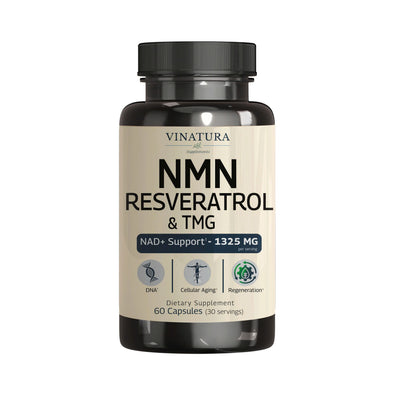
NMNH, Nicotinamide Riboside & TMG contains NMNH, nicotinamide riboside and TMG (betaine anhydrous) in a 2-capsule serving, 60 capsules per bottle. The studies above did not test this product, and none of them combined NMNH with NR or TMG.
Frequently asked questions
Is NMNH the same as NMN? No. It is the reduced form of NMN and reaches NAD+ by a different route.
Has NMNH been tested in people? Only in one 90-day trial of 80 adults, run by the ingredient's maker and posted in August 2026 as a preprint that has not been peer-reviewed.
How much NMNH did the human study use? 125, 250 or 500 mg once a day for 90 days. These are study amounts, not recommendations; follow your product label and ask a healthcare professional.
Can NMNH be sold in U.S. supplements? In April 2026, FDA raised no objection to one company's new dietary ingredient notification for NMNH calcium salt at 500 mg a day for up to 90 days in healthy adults, and stated that filing a notification is not a finding that the ingredient is safe. That letter does not address NMNH from other manufacturers.
References
- Li J, et al. Safety and exploratory efficacy of reduced β-nicotinamide mononucleotide calcium salt (NMNH-Ca) in healthy middle-aged and older adults: a randomized, double-blind, placebo-controlled trial. medRxiv [preprint, not peer-reviewed]. Posted August 12, 2026. doi:10.64898/2026.08.11.26360226
- ClinicalTrials.gov. NCT06889740: Evaluate the safety, tolerability, and efficacy of UthPeak NMNH (reduced nicotinamide mononucleotide) in healthy adult participants. Record read October 25, 2026. clinicaltrials.gov
- Zapata-Pérez R, et al. Reduced nicotinamide mononucleotide is a new and potent NAD+ precursor in mammalian cells and mice. FASEB J. 2021;35(4):e21456. doi:10.1096/fj.202001826R
- Liu Y, et al. Reduced nicotinamide mononucleotide (NMNH) potently enhances NAD+ and suppresses glycolysis, the TCA cycle, and cell growth. J Proteome Res. 2021;20(5):2596–2606. doi:10.1021/acs.jproteome.0c01037
- Liu Y, et al. Reduced nicotinamide mononucleotide (NMNH) potently enhances NAD+, causes reductive stress, and suppresses glycolysis and cell growth. bioRxiv [preprint of the paper above]. 2020. doi:10.1101/2020.11.03.366427
- Vinten KT, et al. Reduced versus oxidized NAD+ precursors drive distinct transcriptomic, proteomic, and metabolic profiles in hepatocytes. FASEB J. 2026;40(4):e71582. doi:10.1096/fj.202501925R
- Banks JL, et al. Metabolic dysfunction ameliorated by reduced nicotinamide mononucleotide in high fat diet fed mice. Australian and New Zealand Obesity Society Annual Scientific Conference 2024, abstract 21 [conference abstract]. asnevents.com.au
- Zapata-Pérez R, et al. Biotechnological production of reduced and oxidized NAD+ precursors. Food Res Int. 2023;165:112560. doi:10.1016/j.foodres.2023.112560
- Liu Y, et al. Protein engineering of NADH pyrophosphatase for efficient biocatalytic production of reduced nicotinamide mononucleotide. Front Bioeng Biotechnol. 2023;11:1159965. doi:10.3389/fbioe.2023.1159965
- Yang Y, et al. NRH salvage and conversion to NAD+ requires NRH kinase activity by adenosine kinase. Nat Metab. 2020;2(4):364–379. doi:10.1038/s42255-020-0194-9
- Zarei A, et al. Dihydronicotinamide riboside: synthesis from nicotinamide riboside chloride, purification and stability studies. RSC Adv. 2021;11(34):21036–21047. doi:10.1039/d1ra02062e
- Sonavane M, et al. Dihydronicotinamide riboside promotes cell-specific cytotoxicity by tipping the balance between metabolic regulation and oxidative stress. PLoS One. 2020;15(11):e0242174. doi:10.1371/journal.pone.0242174
- Chini CCS, et al. Dihydronicotinamide riboside is a potent NAD+ precursor promoting a pro-inflammatory phenotype in macrophages. Front Immunol. 2022;13:840246. doi:10.3389/fimmu.2022.840246
- Rumpler M, et al. Therapeutic potential of dihydronicotinamide riboside (NRH) on obesity and glucose intolerance in mice. Nat Commun. 2026;17(1). doi:10.1038/s41467-026-70965-4
- Christen S, et al. The differential impact of three different NAD+ boosters on circulatory NAD and microbial metabolism in humans. Nat Metab. 2026;8(1):62–73. doi:10.1038/s42255-025-01421-8
- U.S. Food and Drug Administration, Human Foods Program. Response to citizen petition, Docket No. FDA-2023-P-0872 (letter to the Natural Products Association and Alliance for Natural Health USA). September 29, 2025. regulations.gov
- U.S. Food and Drug Administration. Submitted 75-day premarket notifications for new dietary ingredients. Content current as of July 10, 2026; read October 25, 2026. fda.gov
- U.S. Food and Drug Administration, Human Foods Program, Office of Dietary Supplement Programs. Letter to Effepharm (Shanghai) Co., Ltd. regarding NDI 1451, Reduced Beta-Nicotinamide Mononucleotide, Calcium Salt. April 17, 2026. Docket FDA-2025-S-0023-0159. regulations.gov
- NDI 1451 – Reduced Beta-Nicotinamide Mononucleotide Calcium Salt – original NDI notification [notifier file, partly redacted; includes FDA letters of January 20 and February 6, 2026]. Docket FDA-2025-S-0023-0160. Posted July 9, 2026. regulations.gov
- NDI 1311 – Nicotinamide Mononucleotide Hydrate – original NDI notification [notifier document]. Docket FDA-2023-S-0023-0084. Posted March 12, 2024. regulations.gov
- Effepharm Ltd [paid promotional content]. UthPeak™: world's first clinical trial on NMNH. NutraIngredients, March 21, 2025. nutraingredients.com
- National Institutes of Health, Office of Dietary Supplements. Niacin: fact sheet for health professionals. Updated November 18, 2022. ods.od.nih.gov
Editorial note: This article reviews published research for educational purposes. It does not establish the effects or safety of any specific supplement, including Vinatura products, and is not medical advice. Written by Vinatura Editorial Team. Last reviewed October 2026.
Author
Product Disclaimer
Including an ingredient or study does not evaluate, endorse, or recommend any Vinatura product or any third-party product. Some ingredients discussed may not be used in any Vinatura product.
The content of the articles has not been evaluated by the Food and Drug Administration (FDA) and is not intended to promote or endorse any specific product. Any products sold on this website are not intended to diagnose, treat, cure, or prevent any disease.
Opinions and Endorsements
Any claims, statements, or opinions expressed in the articles are those of the author(s) and do not necessarily reflect the views or opinions of the manufacturers of the dietary supplement products. The products sold on this website are separate from the content of the articles and are not directly endorsed or associated with the information presented here.
Liability Disclaimer
The author(s) of the articles, website, and manufacturers of the dietary supplement products do not assume any liability for any potential consequences arising from the use of the information provided in the articles. Ingredient effects, dosages, and safety vary by individual, formulation, and context; some ingredients interact with medications or may be unsuitable during pregnancy or lactation. It is recommended that individuals consult with a qualified healthcare professional before making any dietary or lifestyle changes, including the use of dietary supplements.
Product Usage
Please refer to the product labels and packaging for specific usage instructions and guidelines for the dietary supplement products sold on this website.
Customer Support
For any concerns or questions regarding the dietary supplement products, please contact our customer support team, who will be more than happy to assist you.


Leave a Comment
Be the first to comment.
What do you think?