

TMG (Betaine): Homocysteine, Cholesterol, Exercise and NMN
Quick answer. TMG, short for trimethylglycine and also called betaine, is a small molecule found in foods such as beets, spinach and whole grains; supplements use betaine anhydrous. In placebo-controlled trials, 1.5 to 6 g a day for 6 weeks or more lowered fasting homocysteine in healthy adults, with larger drops at higher doses. The main limit is that a lower homocysteine number has not been shown to prevent heart disease, and at 4 to 6 g a day betaine raised total or LDL cholesterol in several trials. No published trial has tested TMG with NMN or NR in people; the pairing rests on biochemistry and indirect markers. Prescription betaine is an FDA-approved treatment for the inherited disorder homocystinuria, which is a separate, medically supervised use.
What TMG is
TMG is glycine with three methyl groups attached. The body uses one of those methyl groups to turn homocysteine back into the amino acid methionine. Betaine also acts as an osmolyte, a compound cells use to hold water and protect proteins under stress.
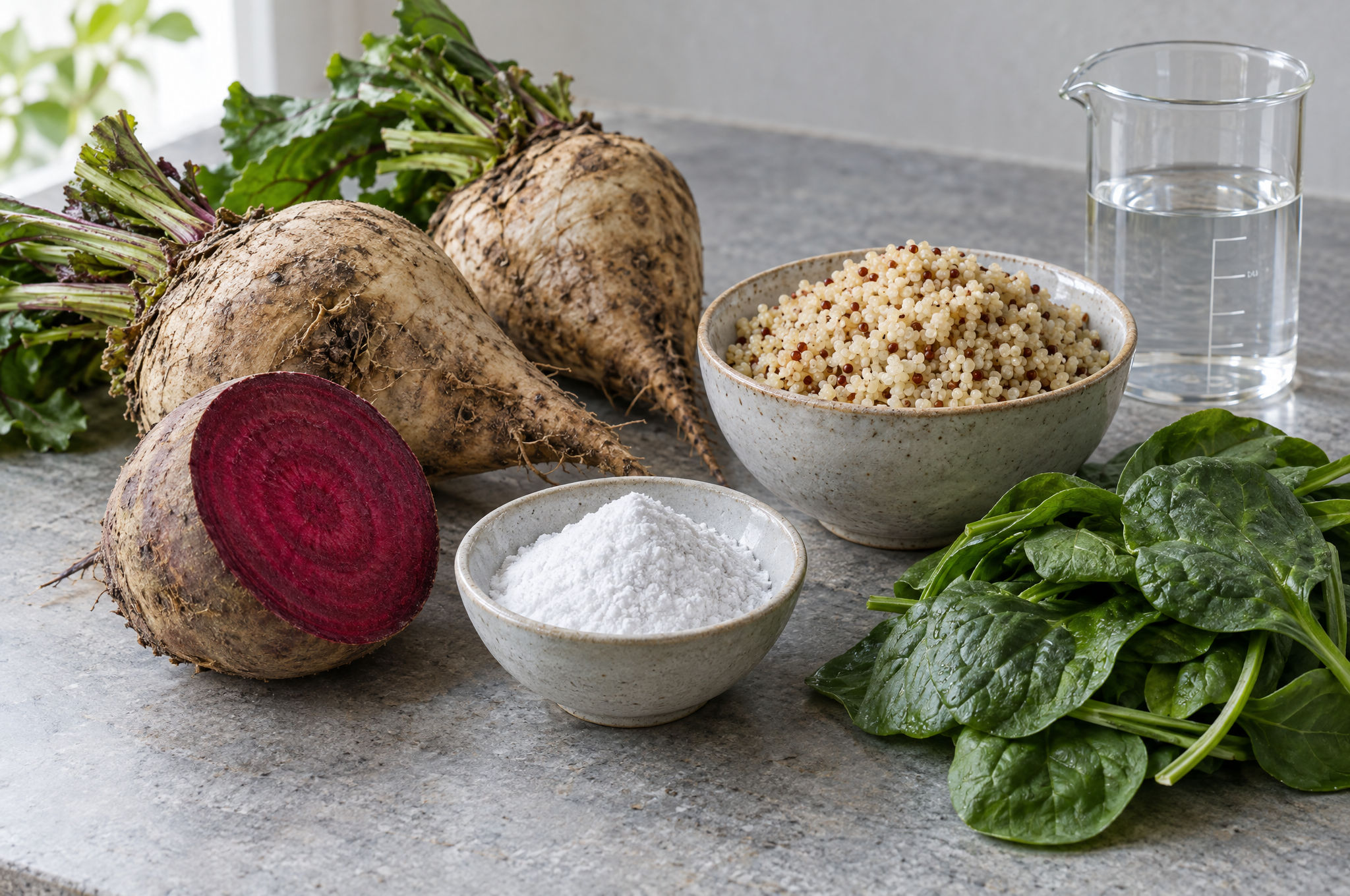
Diet supplies some betaine, from foods such as beets, spinach and whole-grain breads. Estimates of average intake range from 100 to 300 mg a day (NIH Office of Dietary Supplements, ODS) to about 830 mg a day (European Food Safety Authority, EFSA).
Three forms are easy to confuse:
- Betaine anhydrous (TMG), the form in supplements and in the trials below.
- Prescription betaine anhydrous powder (an FDA-approved drug for homocystinuria), first approved in 1996 to lower high homocysteine in homocystinuria, a group of rare inherited disorders that includes cystathionine beta-synthase (CBS) deficiency, MTHFR deficiency and cobalamin cofactor defects. The label dose for adults and children 3 and older is 6 g a day, given as 3 g twice daily. This approval does not mean betaine supplements treat any disease.
- Betaine hydrochloride, an acid salt tested in registered trials of stomach acidity, used for a different purpose.
What human studies have tested
| Study | Who took part | Form and daily amount | Duration | What was measured | Result |
|---|---|---|---|---|---|
| Olthof et al., 2003 (placebo-controlled) | 76 healthy adults, 4 groups of 19 | Betaine 1.5, 3 or 6 g vs placebo | 6 weeks | Fasting homocysteine; homocysteine after a methionine load | Fasting homocysteine 12%, 15% and 20% lower than placebo at 1.5, 3 and 6 g |
| Steenge et al., 2003 (placebo-controlled) | Men and women with mildly elevated homocysteine, 3 groups of 12 | Betaine 6 g vs folic acid 0.8 mg vs placebo | 6 weeks | Fasting and post-load homocysteine | Fasting homocysteine fell 1.8 µmol/L with betaine and 2.7 µmol/L with folic acid, relative to placebo; only betaine reduced the post-load rise |
| Alfthan et al., 2004 (dose-escalation, no placebo) | 34 healthy adults | Betaine 1, 3, then 6 g, then 6 g plus folic acid 1 mg | 1 week per step | Plasma homocysteine, plasma betaine | Homocysteine −1.1% (not significant), −10% and −14% at 1, 3 and 6 g |
| McRae, 2013 (meta-analysis) | 5 randomized trials in healthy adults | Betaine at least 4 g | 6 to 24 weeks | Plasma homocysteine | Pooled drop of 1.23 µmol/L (95% CI −1.61 to −0.85) |
| Schwab et al., 2002 (randomized, placebo-controlled; Finland) | 42 adults with obesity on a calorie-reduced diet | Betaine 6 g vs placebo | 12 weeks | Body weight and composition, energy expenditure, homocysteine, lipids | No extra weight or fat loss vs placebo; homocysteine fell; total and LDL cholesterol higher than in the placebo group |
| Olthof et al., 2005 (pooled data from 3 randomized trials) | 151 healthy adults | Betaine 6 g (lower doses in some arms) vs placebo | 6 weeks | Blood lipids | LDL +0.36 mmol/L (95% CI 0.25 to 0.46) and triglycerides +0.14 mmol/L vs placebo at 6 g; rises at lower doses were not significant |
| Zawieja et al., 2021 (meta-analysis) | 6 randomized trials in adults | Betaine at least 4 g | 6 to 24 weeks | Total, LDL and HDL cholesterol, triglycerides | Total cholesterol +0.34 mmol/L (95% CI 0.02 to 0.65); LDL, HDL and triglycerides not significantly changed |
| Zawieja et al., 2022 (randomized, double-blind crossover; Poland) | 43 physically active men aged 18 to 45 (CrossFit trainees) completed, of 55 enrolled | Betaine 2.5 g (24 men) or 5.0 g (19 men) vs placebo | 21 days per period | Homocysteine, lipids, inflammation markers, liver enzymes | Homocysteine 17.1 to 15.6 µmol/L; no change in lipids; no side effects reported. Publicly funded |
| Lee et al., 2010 (randomized, double-blind crossover; U.S.) | 12 recreationally active men with at least 3 months of resistance training | Betaine 2.5 g (1.25 g twice daily) vs placebo | 14 days per period | Power and force in bench, squat and jump tests | Higher bench throw power and isometric bench force; no difference in repetitions to fatigue. Funded by a betaine maker that employed one author |
| Cholewa et al., 2013 (randomized; U.S.) | 23 strength-trained men | Betaine 2.5 g vs placebo, with a 6-week training program | 6 weeks | Body composition (skinfolds), arm and thigh size, strength, training volume | Body fat, fat mass and lean mass improved in the betaine group only; arm size and bench training volume rose; no difference in 1-repetition-maximum strength. Funded by a betaine maker that employed one author |
| del Favero et al., 2012 (randomized, double-blind; Brazil) | Untrained adults in 4 groups | Betaine 2 g, creatine 20 g, both, or placebo | 10 days | Muscle phosphocreatine, strength, power, body composition | Betaine alone changed none of these; creatine raised strength and power |
| Cholewa et al., 2018 (randomized, double-blind; U.S.) | 23 young women new to weight training completed (36 randomized) | Betaine 2.5 g vs placebo, with supervised training | 9 weeks after a 1-week acclimation (abstract says 8) | Body composition, strength, jump | Fat mass −2.0 vs −0.8 kg; no difference in strength, jump or lean mass. Betaine and placebo supplied by a betaine maker that employed one author |
| Zawieja et al., 2024 (meta-analysis) | 17 trials, 317 healthy people aged 15 to 60 (21% female) | Betaine, various amounts | At least 7 days | Strength, power, endurance | Maximal strength improved (standardized effect 0.47, 95% CI 0.04 to 0.89), mainly lower body; jump improved only after one low-quality study was excluded; no effect on upper-body strength, sprint cycling power or muscular endurance |
| Ashtary-Larky et al., 2022 (meta-analysis) | Trials published through August 2021 | Betaine, various amounts | Various | Body weight, fat mass, fat-free mass | No significant effect on any measure |
| Berven et al., 2023 (NR-SAFE; randomized, double-blind; Norway) | 20 adults with Parkinson's disease | Nicotinamide riboside (NR) 3,000 mg vs placebo; no betaine given | 4 weeks | Safety, NAD+ metabolites, homocysteine and methyl-donor markers | Serum homocysteine +1.66 µmol/L with NR, mostly in the first 3 days; whole-blood SAM, SAH and methionine unchanged; blood betaine slightly lower. NR supplied by its maker; two authors hold NR patent applications |
| Sun et al., 2017 (randomized; China) | 30 adults | One 300 mg dose of nicotinamide or nicotinic acid vs water; no betaine given | 3 hours | Plasma betaine, choline, homocysteine | After nicotinamide, plasma betaine 24.4% lower and homocysteine higher than control |
We found no published human trial of NMN or NR combined with TMG.
What the findings suggest
Homocysteine. Doses of 1.5 g a day and above lowered fasting homocysteine in healthy adults over 6 weeks, and 6 g lowered it by about a fifth in one trial. A 1 g dose for one week did not. The drops are small in absolute terms, about 1 to 2 µmol/L. Folic acid lowered fasting homocysteine at least as much in a direct comparison, and the authors of one trial wrote that it is not known whether this effect lowers cardiovascular risk. Evidence strength: moderate for lowering the marker, none for preventing disease.
Cholesterol. At 6 g a day, pooled data from 151 healthy adults showed LDL about 14 mg/dL higher than placebo (0.36 mmol/L), and the obesity trial also found higher LDL. The 2021 meta-analysis found a rise in total cholesterol of about 13 mg/dL (0.34 mmol/L) but no significant change in LDL. In active men taking 2.5 or 5 g for 3 weeks, lipids did not change. EFSA noted that 4 g a day raised total and LDL cholesterol in overweight adults with metabolic syndrome, but not in healthy people or at 3 g a day. Evidence strength: moderate that higher doses can raise cholesterol, especially at 6 g and in people with excess weight.
Exercise. Trials are small (the 2024 meta-analysis pooled 317 people from 17 trials, under 20 per trial on average), and results differ by test. That meta-analysis found a small-to-moderate gain in maximal strength, mostly in the legs, and a jump gain only after one low-quality study was removed, but no effect on most other measures. All three U.S. training trials in the table were funded by, or received their betaine from, a betaine maker that employed one of the authors, and one author of the 2024 meta-analysis led two of them. Evidence strength: low.
Body composition and weight. Two trials that combined betaine with weight training, one in men and one in women, both with industry ties, reported more fat loss, but betaine did not add to diet-driven weight loss in adults with obesity, and a 2022 meta-analysis found no effect on body weight, fat mass or fat-free mass. Evidence strength: low, and mostly null.
TMG with NMN or NR. The idea: NAD+ breakdown releases nicotinamide, which the body clears partly by attaching a methyl group from SAM, the main methyl donor, producing SAH and then homocysteine. In people, a single 300 mg nicotinamide dose lowered plasma betaine within 3 hours. In the NR-SAFE trial, 3,000 mg of NR a day raised serum homocysteine slightly, but SAM, SAH and methionine in whole blood stayed stable, and the authors concluded the methyl-donor pool was not depleted. No study has tested whether adding TMG changes any of this, and we found no published NMN data on these markers. On the precursors themselves, see our reviews of NMN human trials and NMNH research. Evidence strength: theory supported by indirect markers; no outcome data.
Where the evidence is limited or conflicting
- Marker, not outcome. No trial of betaine supplements has measured heart attacks, strokes or other clinical events. Lowering homocysteine and raising LDL push in opposite directions, and the 2005 pooled analysis warned that the lipid effect "may undo" any benefit.
- Dose and population. Most homocysteine and lipid data come from 4 to 6 g a day, and the LDL rise was clearer in one pooled analysis than in a later meta-analysis. Amounts below 1 g a day are barely studied.
- Exercise research is small and concentrated. In the 2024 meta-analysis, 21% of participants were women, and only people aged 15 to 60 were eligible.
- The NMN pairing has no direct test. The only studies we found combining NR with betaine were animal studies of four-ingredient mixtures in rodents fed high-fat diets. On ClinicalTrials.gov, one trial compares NMN plus TMG with NMN alone: a crossover study of 40 adults aged 60 to 80 that began recruiting in 2026, uses exercise tolerance as its main outcome and lists fasting homocysteine among its other outcomes. Its registry entry says the data will inform an over-the-counter product; no results were posted as of November 5, 2026.
What buyers say, and what the research shows
Our team read about 1,260 public Amazon reviews of 11 NAD+-precursor products, most combining NMN with resveratrol, including Vinatura's own listing (collected September 21, 2026); several of these formulas contain TMG. They show what buyers believe, not evidence of effect.
Belief: "TMG makes an NMN formula more complete." Praise for the resveratrol-plus-TMG combination reached at least 10% of positive-review weight on 5 of the 10 competing listings. The research answer: no published trial has compared NMN with and without TMG, and the one registered trial of that comparison is still recruiting.
Belief: "NMN and TMG stacks cause joint pain or gout." Three reviews across the 11 listings described joint pain or gout, all on formulas that combine NMN, TMG and resveratrol. The betaine trials we read did not report joint pain or gout, and the prescription label lists nausea and stomach upset as the most common reactions. Three reports cannot show a cause, and these formulas have several active ingredients. Anyone with new joint pain should stop the product and see a doctor.
Safety
In trials. Two trials we read in full reported no side effects at 2.5 to 5 g a day for 3 to 9 weeks; the abstracts of the other trials did not report adverse events. The prescription label lists nausea and gastrointestinal distress as the most common reactions in people treated for homocystinuria. ODS notes that small studies of athletes found no safety concerns but that "research has not adequately evaluated the safety of betaine."
Cholesterol. The best-documented risk is higher total or LDL cholesterol at 4 to 6 g a day. People with high LDL, heart disease or excess weight, or who take cholesterol-lowering medicine, should ask their doctor first.
Official limits. No U.S. upper limit exists. EFSA took 4 g a day as its reference point, applied a tenfold safety factor, and judged 400 mg a day (6 mg per kilogram of body weight) on top of the usual diet as safe for adults.
Homocystinuria and methionine. The prescription label warns that in CBS deficiency, betaine can raise already high blood methionine, that cerebral edema (brain swelling) has been reported in patients with very high methionine, including patients treated with betaine, and that methionine should be kept below 1,000 µmol/L. People with any form of homocystinuria should use betaine only as directed by their specialist.
Medicines, pregnancy and children. We found no human studies of betaine interacting with medicines. The prescription label says limited case reports have not identified a drug-associated risk in pregnancy and that no breastfeeding data exist. We found no safety data for TMG supplements in pregnancy, breastfeeding or childhood; ask a healthcare professional first.
What research does not establish
- That betaine supplements prevent heart disease, stroke or any other illness.
- That a few hundred milligrams of TMG a day lowers homocysteine; trials that lowered it used 1.5 g or more.
- That TMG is needed alongside NMN or NR, or that it changes their effects.
- That betaine reduces body fat or body weight in most people.
- That betaine supplements are safe in pregnancy, breastfeeding or childhood.
How we reviewed the evidence
On November 5, 2026, we gathered PubMed trials and meta-analyses of oral betaine on homocysteine, lipids, exercise and body composition, using related-article lists for two seed trials and targeted lookups, and read 36 abstracts and four full texts; a second reviewer then re-checked every cited record and the full texts of five trials. PubMed searches (run on the PubMed website because the search tool failed) for NR or NMN with betaine found 6 records, none a human study of the combination; for NR or NMN with homocysteine, 8 records, of which one was a human trial (NR-SAFE). We read the prescription label on DailyMed, the ODS exercise fact sheet and summaries of EFSA's 2017 and 2019 betaine opinions, and searched ClinicalTrials.gov (82 betaine or TMG records; 1 combining TMG with an NAD+ precursor). We used animal studies only to show what is untested in people and excluded betaine hydrochloride, topical products and multi-ingredient formulas. None of the cited trials is listed as retracted. Buyer data come from our team's September 2026 review deep-dive. Vinatura did not run any trials.
Vinatura Research Perspective
We asked four questions of each study: how much betaine, for how long, in whom, and whether the outcome was a lab marker or a health event. The homocysteine trials answer the first three (healthy adults, 1.5 to 6 g a day, 6 weeks or more) but not the fourth. The same doses that lowered homocysteine by 1 to 2 µmol/L raised LDL or total cholesterol in several trials, so a net benefit for the heart is unproven.
Comparing the trials with how TMG is sold showed a gap. Our NMN-resveratrol-TMG formula lists 200 mg of TMG per serving. That is within the range of estimated dietary intake, half of EFSA's 400 mg figure, and one-seventh or less of the smallest dose that lowered homocysteine in a trial (1.5 g). At these amounts, neither the homocysteine drop nor the cholesterol rise has been studied. The "methylation" rationale for pairing TMG with NMN is plausible biochemistry, but the most direct human data come from 3,000 mg of NR a day, three times the amount used in most earlier NR trials, according to that trial's authors, and showed a small, early homocysteine rise without methyl-donor depletion. Claims that NMN depletes methyl groups go beyond that evidence.
Our assessment: moderate evidence that gram doses lower homocysteine; moderate evidence that 4 to 6 g can raise cholesterol; low evidence for strength; little or no evidence for fat loss; and no outcome evidence for TMG alongside NMN or NR. A randomized trial giving NMN with and without a few hundred milligrams of TMG for at least 12 weeks, with homocysteine, SAM/SAH and lipids measured, would change this assessment, as would published results from the registered NMN-plus-TMG trial.
Where this ingredient appears in Vinatura products
NMN Resveratrol TMG lists 200 mg trimethylglycine (as betaine anhydrous) per 2-capsule serving, with 1,000 mg NMN and 125 mg trans-resveratrol. NMNH, Nicotinamide Riboside & TMG contains NMNH, nicotinamide riboside and TMG (betaine anhydrous). The studies above did not test these products, and none tested TMG combined with NMN, NMNH or NR.
Frequently asked questions
Is TMG the same as betaine? Yes. TMG and betaine anhydrous are the same compound. Betaine hydrochloride is a different, acidic form.
How much TMG did studies use? Homocysteine trials used 1.5 to 6 g a day for 6 to 24 weeks; the exercise trials we cite used 2 to 2.5 g a day for 10 days to about 9 weeks. These are study amounts, not recommendations. Follow your product label and ask a healthcare professional.
Do I need TMG if I take NMN or NR? No trial has answered this. One NR study at 3,000 mg a day found a small rise in homocysteine but no sign of methyl-donor depletion. If you are concerned about homocysteine, ask your doctor about testing.
References
- Olthof MR, van Vliet T, Boelsma E, Verhoef P. Low dose betaine supplementation leads to immediate and long term lowering of plasma homocysteine in healthy men and women. J Nutr. 2003;133(12):4135–4138. doi:10.1093/jn/133.12.4135
- Steenge GR, Verhoef P, Katan MB. Betaine supplementation lowers plasma homocysteine in healthy men and women. J Nutr. 2003;133(5):1291–1295. doi:10.1093/jn/133.5.1291
- Alfthan G, et al. The effect of low doses of betaine on plasma homocysteine in healthy volunteers. Br J Nutr. 2004;92(4):665–669. doi:10.1079/bjn20041253
- McRae MP. Betaine supplementation decreases plasma homocysteine in healthy adult participants: a meta-analysis. J Chiropr Med. 2013;12(1):20–25. doi:10.1016/j.jcm.2012.11.001
- Schwab U, et al. Betaine supplementation decreases plasma homocysteine concentrations but does not affect body weight, body composition, or resting energy expenditure in human subjects. Am J Clin Nutr. 2002;76(5):961–967. doi:10.1093/ajcn/76.5.961
- Olthof MR, et al. Effect of homocysteine-lowering nutrients on blood lipids: results from four randomised, placebo-controlled studies in healthy humans. PLoS Med. 2005;2(5):e135. doi:10.1371/journal.pmed.0020135
- Zawieja EE, Zawieja B, Chmurzynska A. Betaine supplementation moderately increases total cholesterol levels: a systematic review and meta-analysis. J Diet Suppl. 2021;18(1):105–117. doi:10.1080/19390211.2019.1699223
- Zawieja E, Durkalec-Michalski K, Muzsik-Kazimierska A, Chmurzynska A. The effect of 3-week betaine supplementation on blood biomarkers of cardiometabolic health in young physically active males. Metabolites. 2022;12(8):731. doi:10.3390/metabo12080731
- Lee EC, et al. Ergogenic effects of betaine supplementation on strength and power performance. J Int Soc Sports Nutr. 2010;7:27. doi:10.1186/1550-2783-7-27
- Cholewa JM, et al. Effects of betaine on body composition, performance, and homocysteine thiolactone. J Int Soc Sports Nutr. 2013;10(1):39. doi:10.1186/1550-2783-10-39
- del Favero S, et al. Creatine but not betaine supplementation increases muscle phosphorylcreatine content and strength performance. Amino Acids. 2012;42(6):2299–2305. doi:10.1007/s00726-011-0972-5
- Cholewa JM, et al. The effects of chronic betaine supplementation on body composition and performance in collegiate females: a double-blind, randomized, placebo controlled trial. J Int Soc Sports Nutr. 2018;15(1):37. doi:10.1186/s12970-018-0243-x
- Zawieja E, Machek S, Zanchi NE, Cholewa J, Woźniewicz M. Effects of chronic betaine supplementation on exercise performance: systematic review and meta-analysis. J Sports Sci. 2024;42(22):2131–2144. doi:10.1080/02640414.2024.2423578
- Ashtary-Larky D, et al. Betaine supplementation fails to improve body composition: a systematic review and meta-analysis. Br J Nutr. 2022;128(5):975–988. doi:10.1017/S0007114521004062
- Berven H, et al. NR-SAFE: a randomized, double-blind safety trial of high dose nicotinamide riboside in Parkinson's disease. Nat Commun. 2023;14(1):7793. doi:10.1038/s41467-023-43514-6
- Sun WP, et al. Comparison of the effects of nicotinic acid and nicotinamide degradation on plasma betaine and choline levels. Clin Nutr. 2017;36(4):1136–1142. doi:10.1016/j.clnu.2016.07.016
- Yang H, et al. Combined metabolic activators decrease liver steatosis by activating mitochondrial metabolism in hamsters fed with a high-fat diet. Biomedicines. 2021;9(10):1440. doi:10.3390/biomedicines9101440
- Quesada-Vázquez S, et al. Supplementation with a specific combination of metabolic cofactors ameliorates non-alcoholic fatty liver disease, hepatic fibrosis, and insulin resistance in mice. Nutrients. 2021;13(10):3532. doi:10.3390/nu13103532
- EFSA Panel on Dietetic Products, Nutrition and Allergies. Safety of betaine as a novel food pursuant to Regulation (EC) No 258/97. EFSA J. 2017;15(11):e05057. doi:10.2903/j.efsa.2017.5057
- EFSA Panel on Nutrition, Novel Foods and Food Allergens. Safety of betaine as a novel food pursuant to Regulation (EU) 2015/2283. EFSA J. 2019;17(4):e05658. doi:10.2903/j.efsa.2019.5658
- National Institutes of Health, Office of Dietary Supplements. Dietary Supplements for Exercise and Athletic Performance: Fact Sheet for Health Professionals. Accessed November 5, 2026. ods.od.nih.gov
- U.S. National Library of Medicine, DailyMed. Betaine anhydrous powder for oral solution (prescription drug for homocystinuria): prescribing information. Revised November 2024. dailymed.nlm.nih.gov
- ClinicalTrials.gov. NCT07144527: Nicotinamide Mononucleotide Supplementation for Exercise Tolerance Improvement in Healthy Older Adults. Accessed November 5, 2026. clinicaltrials.gov
- ClinicalTrials.gov. Searches of the intervention field for betaine or trimethylglycine, and for NMN, NMNH or nicotinamide riboside with TMG, trimethylglycine or betaine. Accessed November 5, 2026. clinicaltrials.gov
Editorial note: This article reviews published research for educational purposes. It does not establish the effects or safety of any specific supplement, including Vinatura products, and is not medical advice. Written by Vinatura Editorial Team. Last reviewed November 2026.
Author
Product Disclaimer
Including an ingredient or study does not evaluate, endorse, or recommend any Vinatura product or any third-party product. Some ingredients discussed may not be used in any Vinatura product.
The content of the articles has not been evaluated by the Food and Drug Administration (FDA) and is not intended to promote or endorse any specific product. Any products sold on this website are not intended to diagnose, treat, cure, or prevent any disease.
Opinions and Endorsements
Any claims, statements, or opinions expressed in the articles are those of the author(s) and do not necessarily reflect the views or opinions of the manufacturers of the dietary supplement products. The products sold on this website are separate from the content of the articles and are not directly endorsed or associated with the information presented here.
Liability Disclaimer
The author(s) of the articles, website, and manufacturers of the dietary supplement products do not assume any liability for any potential consequences arising from the use of the information provided in the articles. Ingredient effects, dosages, and safety vary by individual, formulation, and context; some ingredients interact with medications or may be unsuitable during pregnancy or lactation. It is recommended that individuals consult with a qualified healthcare professional before making any dietary or lifestyle changes, including the use of dietary supplements.
Product Usage
Please refer to the product labels and packaging for specific usage instructions and guidelines for the dietary supplement products sold on this website.
Customer Support
For any concerns or questions regarding the dietary supplement products, please contact our customer support team, who will be more than happy to assist you.


Leave a Comment
Be the first to comment.
What do you think?